Intermittent malaria screening and treatment showed no significant benefit for infants in Papua, Indonesia
Intermittent screening and treatment for malaria complementary to routine immunisation in the first year of life in Papua, Indonesia: a cluster randomised superiority trial
Cluster randomised, open label, superiority trialNo clear difference
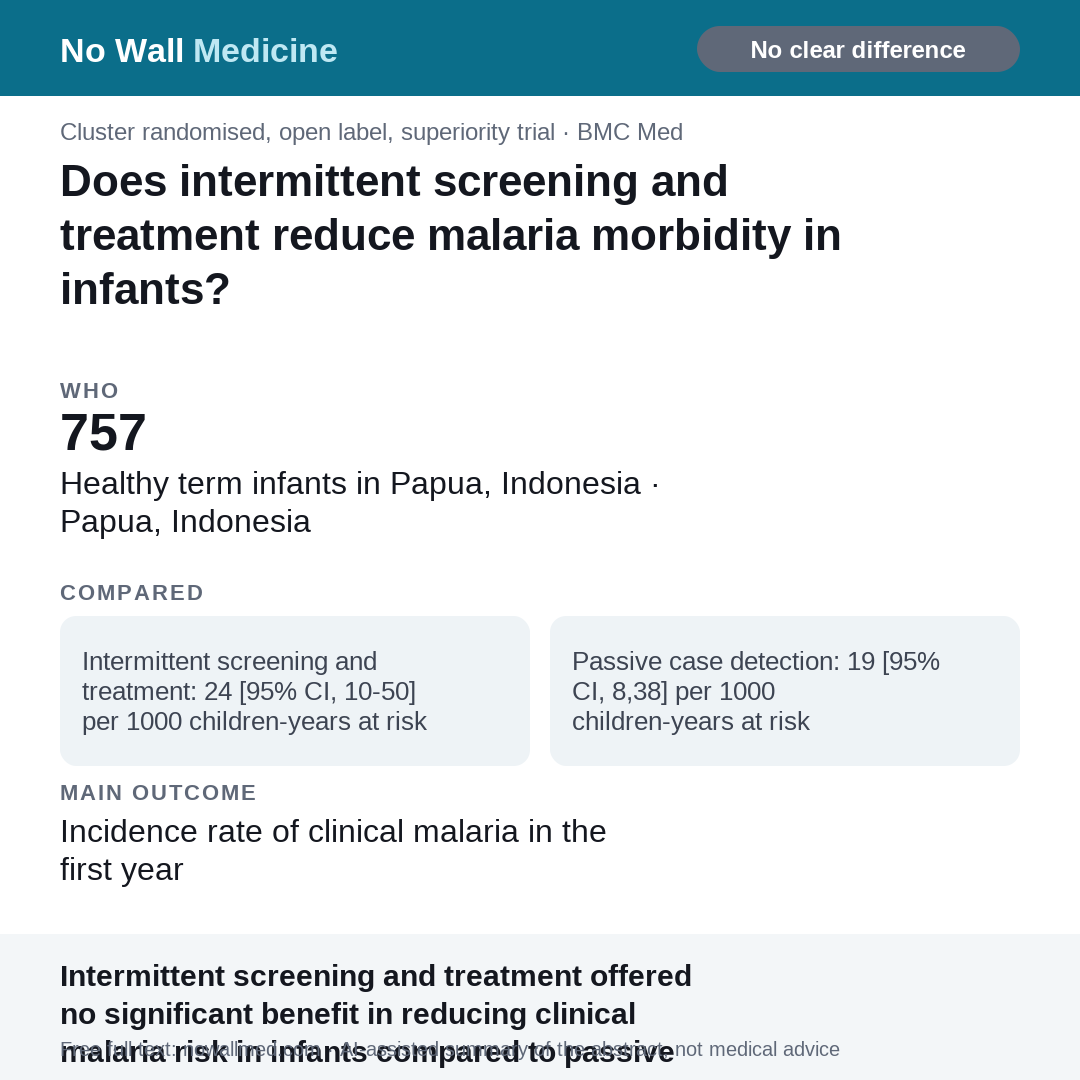
Does intermittent screening and treatment reduce malaria morbidity in infants?
Who
757
Healthy term infants in Papua, Indonesia · Papua, Indonesia
Compared
Intermittent screening and treatment: 24 [95% CI, 10-50] per 1000 children-years at risk
Passive case detection: 19 [95% CI, 8,38] per 1000 children-years at risk
Main outcome
Incidence rate of clinical malaria in the first year
Result: adjusted incidence rate ratio 1.77 (95% CI 0.62-5.01)
Bottom line: Intermittent screening and treatment offered no significant benefit in reducing clinical malaria risk in infants compared to passive case detection.
BMC Med · 2022-06-08Download image
Clinical question: Does intermittent screening and treatment reduce malaria morbidity in infants?
Why it matters: It was unknown if intermittent screening and treatment for malaria could reduce illness in infants living in high transmission areas outside of Africa.
Key points
- Researchers studied 757 infants across 21 village health post clusters, comparing intermittent screening and treatment at immunization visits to passive case detection when symptoms appear.
- The incidence rate of clinical malaria was 24 per 1000 children-years in the screening group and 19 per 1000 children-years in the passive detection group.
- There was no significant difference in the prevalence of malaria parasites in the blood at 12 months or the risk of anaemia between the two groups.
Headline and key points written with AI from the paper’s abstract, with every number checked against it. Read the paper before relying on them.
Was this summary helpful?
Subject terms
Cite this article
Poespoprodjo JR, Hafiidhaturrahmah, Sariyanti N, Indrawanti R, McLean ARD, Simpson JA. Intermittent screening and treatment for malaria complementary to routine immunisation in the first year of life in Papua, Indonesia: a cluster randomised superiority trial. BMC Med. 2022. doi:10.1186/s12916-022-02394-1
Spotted a mistake? Suggest a correction
Top studies every Monday
The week’s key trials and guidelines in your specialties, plus any topics you follow. By email, free.
Get the weekly digest