Supervised primaquine treatment reduces the risk of malaria recurrence compared to unsupervised treatment
Supervised versus unsupervised primaquine radical cure for the treatment of falciparum and vivax malaria in Papua, Indonesia: a cluster-randomised, controlled, open-label superiority trial
Cluster-randomised, controlled, open-label superiority trialBenefit found
Is supervised or unsupervised primaquine radical cure more effective for uncomplicated malaria?
Who
419
Patients with uncomplicated Plasmodium falciparum or Plasmodium vivax malaria · Papua, Indonesia
Compared
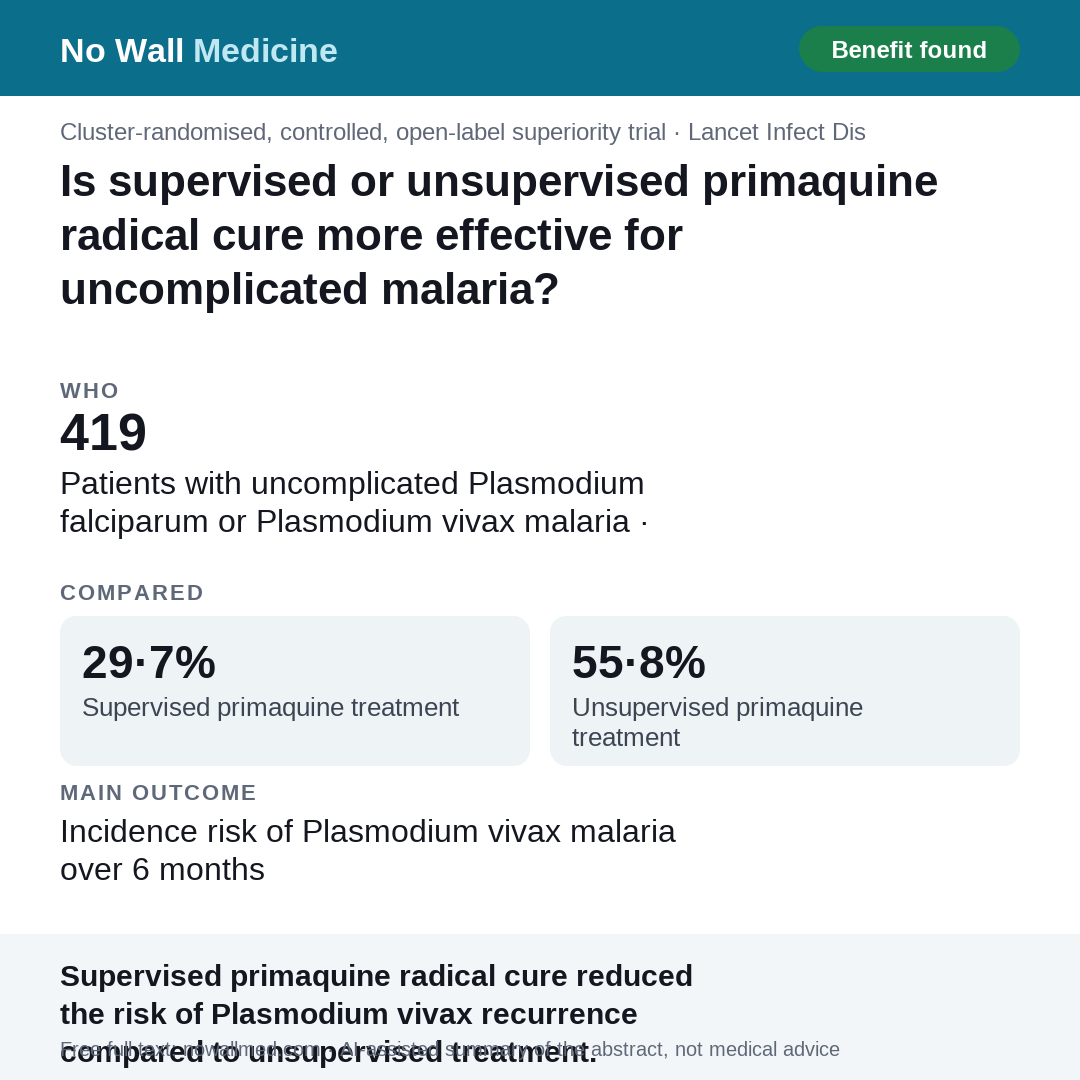
29·7%Supervised primaquine treatment (95% CI 16·4-49·9)
55·8%Unsupervised primaquine treatment (32·3-81·8)
Main outcome
Incidence risk of Plasmodium vivax malaria over 6 months
Result: hazard ratio 0·23 (95% CI 0·07-0·76)
Bottom line: Supervised primaquine radical cure reduced the risk of Plasmodium vivax recurrence compared to unsupervised treatment.
Funded by: Bill & Melinda Gates Foundation, Wellcome Trust, Australian Government
Lancet Infect Dis · 2021-10-25Download image
Clinical question: Is supervised or unsupervised primaquine radical cure more effective for uncomplicated malaria?
Why it matters: Poor adherence to the recommended 14-day primaquine regimen undermines its ability to prevent Plasmodium vivax recurrence in areas where both falciparum and vivax malaria exist.
Key points
- Researchers studied 419 patients in Papua, Indonesia, comparing supervised versus unsupervised 14-day primaquine courses for uncomplicated malaria.
- The incidence risk of Plasmodium vivax recurrence over 6 months was 29.7% in the supervised group versus 55.8% in the unsupervised group.
- Seven serious adverse events occurred, three in the supervised group and four in the unsupervised group, but none were deemed treatment-related.
Headline and key points written with AI from the paper’s abstract, with every number checked against it. Read the paper before relying on them.
Was this summary helpful?
Abstract
Background
There is a high risk of Plasmodium vivax recurrence in patients treated for Plasmodium falciparum malaria in co-endemic areas. Primaquine radical cure has the potential to reduce P vivax recurrences in patients presenting with P falciparum as well as P vivax malaria but is undermined by poor adherence to the currently recommended 14-day regimen. We aimed to assess the efficacy and safety of supervised versus unsupervised primaquine radical cure in patients presenting with uncomplicated malaria. Methods
We did a cluster-randomised, controlled, open-label superiority trial in Papua, Indonesia. 21 clusters of village health posts, matched by annual parasite index, were randomly assigned (1:1) to treat patients (age >12 months and body weight >5 kg) presenting with confirmed uncomplicated P falciparum or P vivax malaria with oral dihydroartemisinin-piperaquine plus either a supervised or unsupervised 14-day course of oral primaquine (0·5 mg/kg per day). Patients in the supervised group were supervised taking their primaquine dose on alternate days. Patients were followed-up for 6 months and those who presented again with malaria were retreated with the same drug regimen. Masking was not possible due to the nature of the study. The primary outcome was the incidence risk of P vivax malaria over 6 months, assessed in the modified intention-to-treat population (all patients who were assigned to a treatment group, excluding patients who were lost to follow-up after their first visit). This trial is now complete, and is registered with ClinicalTrials.gov, NCT02787070. Findings
Between Sept 14, 2016, and July 31, 2018, 436 patients were screened for eligibility and 419 were enrolled; 223 (53%) patients in 11 clusters were assigned to supervised primaquine treatment and 196 (47%) in ten clusters to unsupervised primaquine treatment. 161 (72%) of 223 patients in the supervised group and 151 (77%) of 196 in the unsupervised group completed 6 months of follow-up. At 6 months, the incidence risk of P vivax recurrence in the supervised group was 29·7% (95% CI 16·4-49·9) versus 55·8% (32·3-81·8) in the unsupervised group (hazard ratio 0·23 [95% CI 0·07-0·76]; p=0·016). The incidence rate for P vivax recurrence was 539 (95% CI 390-747) infections per 1000 person-years in the supervised group versus 859 (673-1096) in the unsupervised group (incidence rate ratio 0·63 [95% CI 0·42-0·94]; p=0·025). The corresponding rates in the 224 patients who presented with P falciparum malaria were 346 (95% CI 213-563) and 660 (446-977; incidence rate ratio 0·52 [95% CI 0·28-0·98]; p=0·043). Seven serious adverse events were reported (three in the supervised group, four in the unsupervised group), none of which were deemed treatment-related, and there were no deaths. Interpretation
In this area of moderate malaria transmission, supervision of primaquine radical cure treatment reduced the risk of P vivax recurrence. This finding was apparent for patients presenting with either P falciparum or P vivax malaria. Further studies are warranted to investigate the safety and efficacy of radical cure for patients presenting with uncomplicated falciparum malaria in other co-endemic areas. Funding
The Bill & Melinda Gates Foundation, Wellcome Trust, and Department of Foreign Affairs and Trade of the Australian Government. Translation
For the Indonesian translation of the abstract see Supplementary Materials section.
Abstract reproduced under the article’s CC BY licence.
Subject terms
Cite this article
Poespoprodjo JR, Burdam FH, Candrawati F, Ley B, Meagher N, Kenangalem E. Supervised versus unsupervised primaquine radical cure for the treatment of falciparum and vivax malaria in Papua, Indonesia: a cluster-randomised, controlled, open-label superiority trial. Lancet Infect Dis. 2021. doi:10.1016/S1473-3099(21)00358-3
Spotted a mistake? Suggest a correction
Top studies every Monday
The week’s key trials and guidelines in your specialties, plus any topics you follow. By email, free.
Get the weekly digest