International policies for managing secondary genomic findings show gaps in analysis and clinical follow-up
International policies guiding the selection, analysis, and clinical management of secondary findings from genomic sequencing: A systematic review
Systematic reviewMixed results
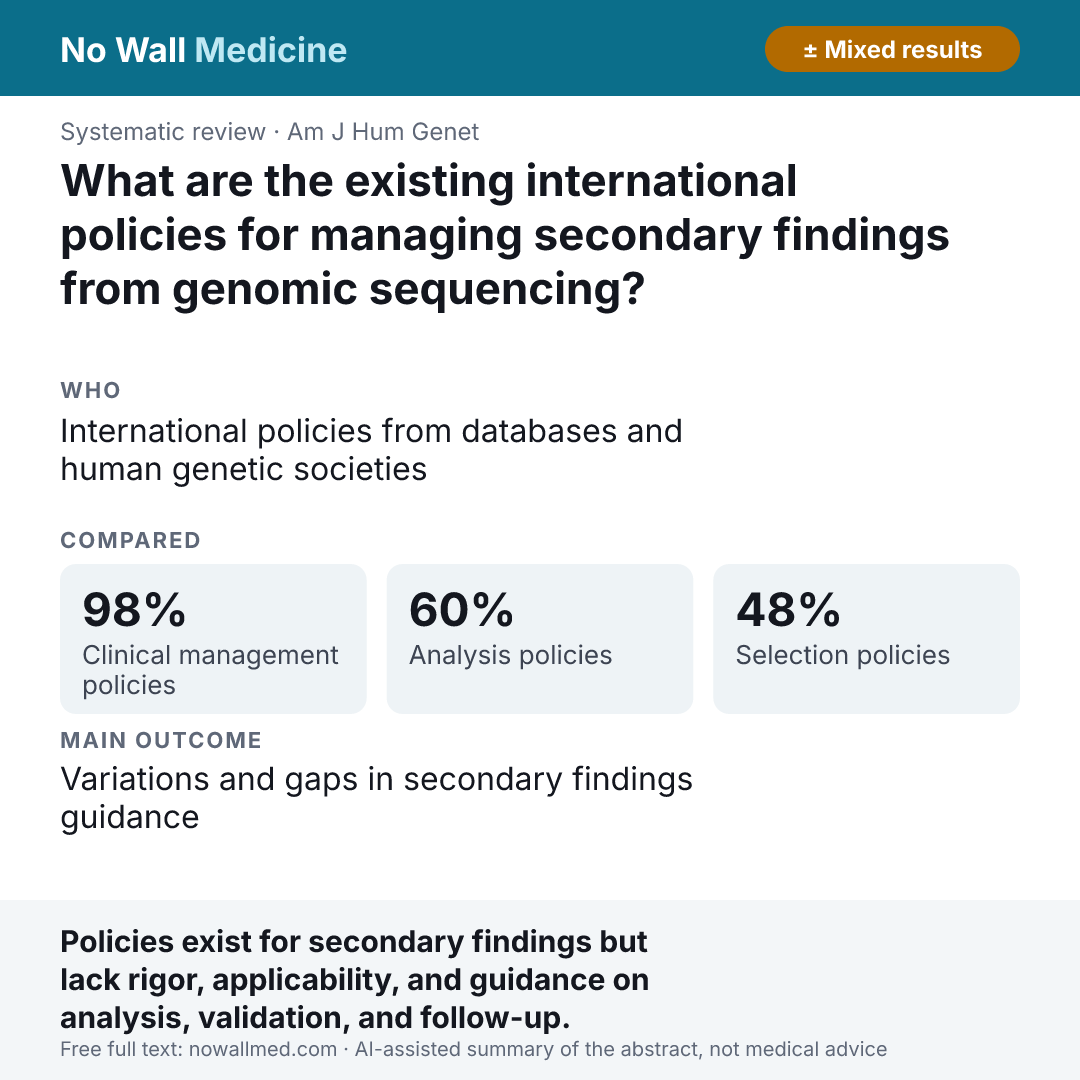
What are the existing international policies for managing secondary findings from genomic sequencing?
Who
International policies from databases and human genetic societies
Compared
98%Clinical management policies (n = 62)
60%Analysis policies (n = 38)
48%Selection policies (n = 30)
Main outcome
Variations and gaps in secondary findings guidance
Bottom line: Policies exist for secondary findings but lack rigor, applicability, and guidance on analysis, validation, and follow-up.
Limitation: Policies were limited by their rigor and applicability.
Am J Hum Genet · 2024-09-18 · Save PNG
Clinical question: What are the existing international policies for managing secondary findings from genomic sequencing?
Why it matters: Existing practices guiding the clinical investigation of secondary findings from genomic sequencing are inconsistent.
Key points
- Researchers reviewed 63 policies from academic databases and 64 international human genetic societies regarding the selection, analysis, and management of secondary findings from genomic sequencing.
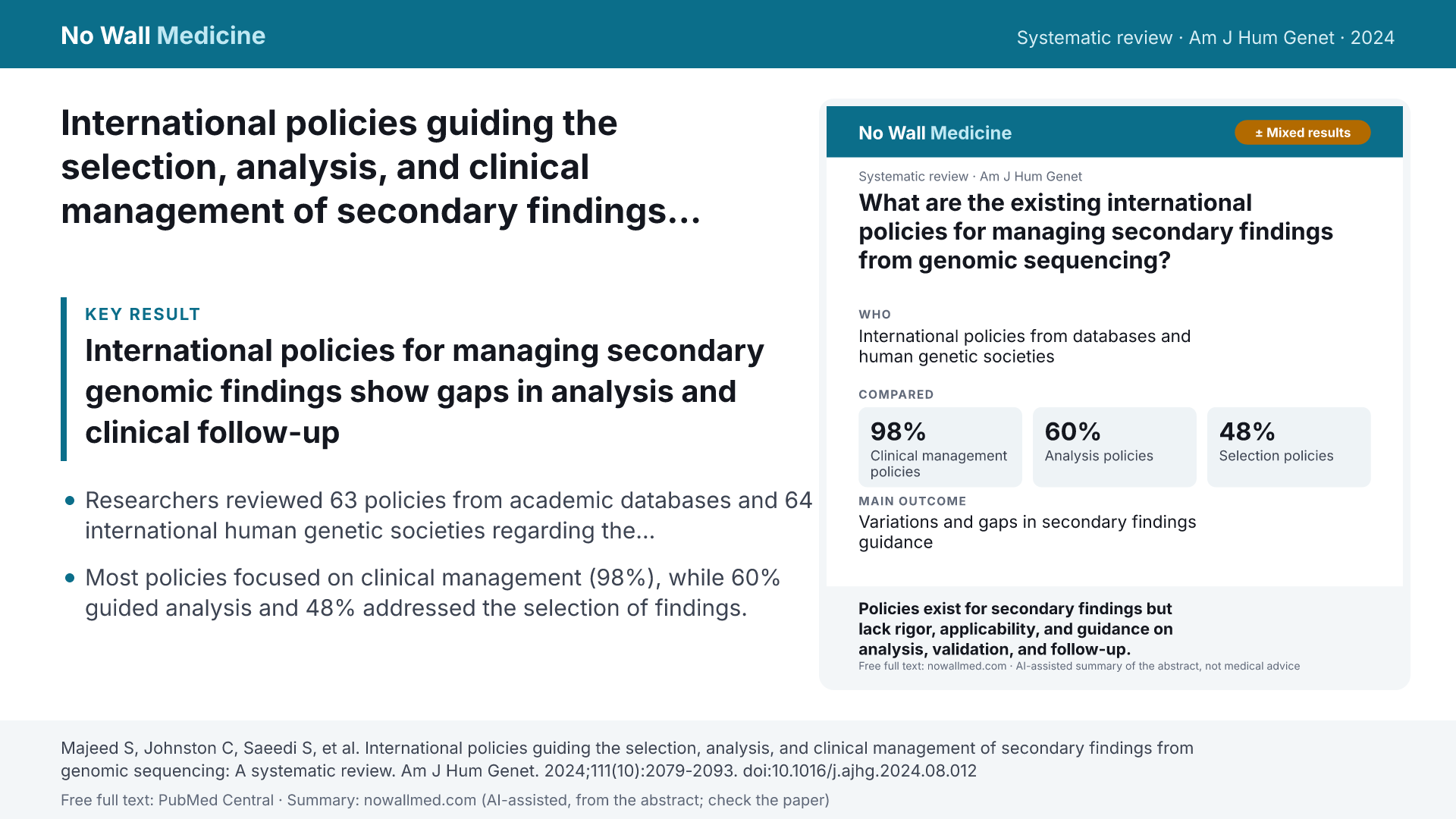
- Most policies focused on clinical management (98%), while 60% guided analysis and 48% addressed the selection of findings.
- While policies were rated highly for scope and clarity with a median score of 69, they had low median scores for rigor (27) and applicability (25).
Limitation the authors note: The policies were limited by their rigor and applicability.
Headline and key points written with AI from the paper’s abstract, with every number checked against it. Read the paper before relying on them.
Was this summary helpful?
Subject terms
Headline, design, result, key points, caveat and citation as plain text.
Cite this article
Majeed S, Johnston C, Saeedi S, et al. International policies guiding the selection, analysis, and clinical management of secondary findings from genomic sequencing: A systematic review. Am J Hum Genet. 2024;111(10):2079-2093. doi:10.1016/j.ajhg.2024.08.012
Spotted a mistake? Suggest a correction