Opportunistic screening for secondary findings increases laboratory workload and yields many uncertain genetic variants
Opportunistic screening for broad range of medically relevant secondary findings: Laboratory benefits and burdens
Randomized clinical trialMixed results
Does opportunistic screening for secondary findings increase laboratory benefits and burdens?
Who
279
Participants undergoing exome sequencing
Compared
Control: only primary cancer findings
Intervention: cancer findings and a choice of secondary findings
Main outcome
Laboratory effort for variant filtration, classification, and report preparation
Result: variant filtration 7.7 times longer (95% CI 5.3 to 11.3)
Bottom line: Opportunistic screening yields reportable findings but increases laboratory burden through many nonreportable variants and increased analysis time.
Genet Med · 2025-10-14Download image
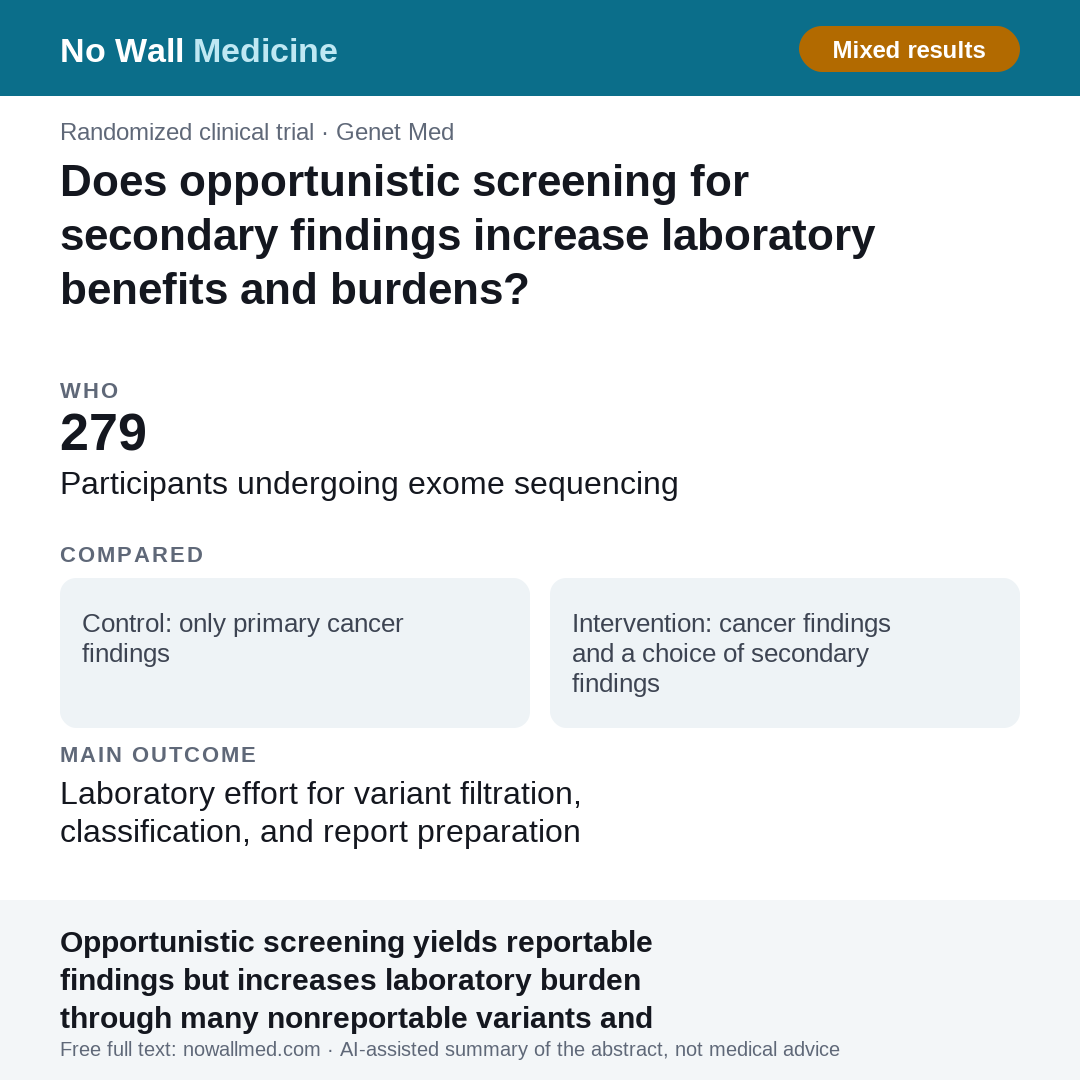
Clinical question: Does opportunistic screening for secondary findings increase laboratory benefits and burdens?
Why it matters: Clinicians need to understand the laboratory benefits and burdens of using exome sequencing to screen for a broad range of medically relevant secondary findings.
Key points
- Researchers studied 279 participants in a randomized clinical trial to compare receiving only primary cancer findings versus receiving cancer findings plus a choice of secondary findings.
- Of 4441 unique variants found, 5.0% (221) were reportable pathogenic or likely pathogenic variants, while 81.4% (3615) were nonreportable variants of uncertain significance.
- The intervention arm required variant filtration that was 7.7 times longer, variant classification that was 13.3 times longer, and report preparation that was 3.3 times longer.
Headline and key points written with AI from the paper’s abstract, with every number checked against it. Read the paper before relying on them.
Topics
Cite this article
Mighton C, Reble E, Sam J, Kodida R, Shickh S, Clausen M. Opportunistic screening for broad range of medically relevant secondary findings: Laboratory benefits and burdens. Genet Med. 2025. doi:10.1016/j.gim.2025.101599
Spotted a mistake? Suggest a correction