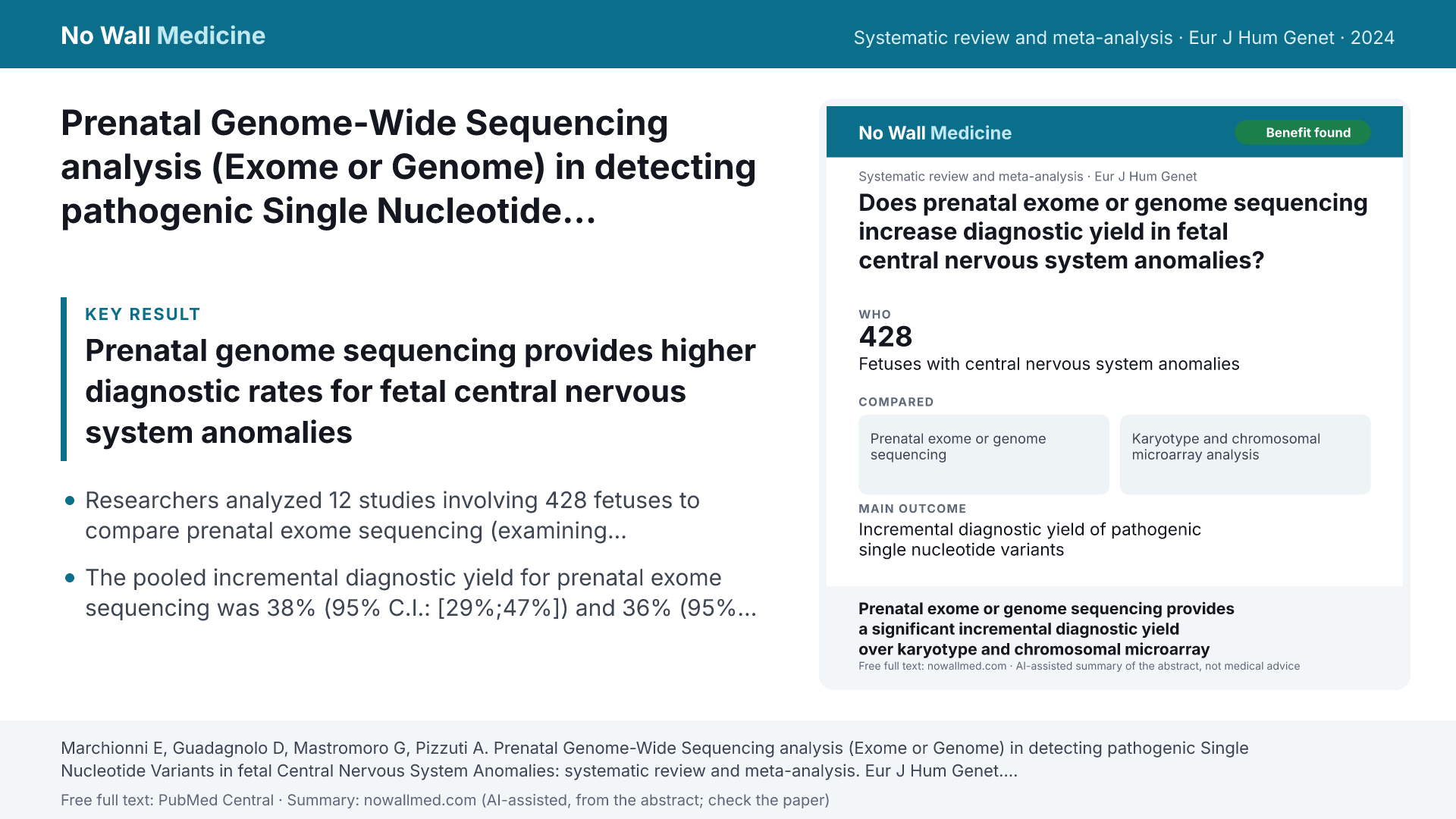
Prenatal genome sequencing provides higher diagnostic rates for fetal central nervous system anomalies
Prenatal Genome-Wide Sequencing analysis (Exome or Genome) in detecting pathogenic Single Nucleotide Variants in fetal Central Nervous System Anomalies: systematic review and meta-analysis
Systematic review and meta-analysisBenefit found
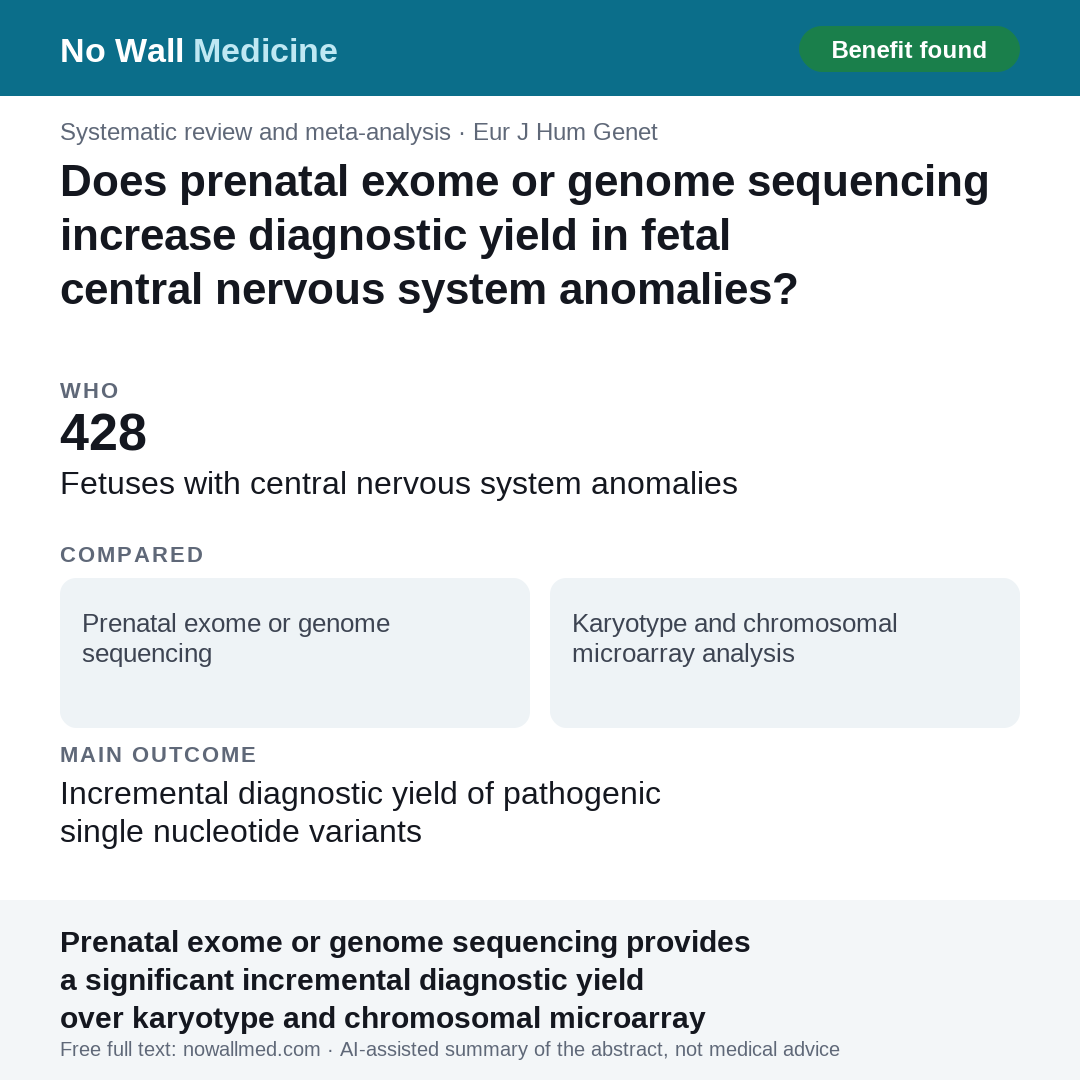
Does prenatal exome or genome sequencing increase diagnostic yield in fetal central nervous system anomalies?
Who
428
Fetuses with central nervous system anomalies
Compared
Prenatal exome or genome sequencing
Karyotype and chromosomal microarray analysis
Main outcome
Incremental diagnostic yield of pathogenic single nucleotide variants
Result: 38% (95% C.I.: [29%;47%])
Bottom line: Prenatal exome or genome sequencing provides a significant incremental diagnostic yield over karyotype and chromosomal microarray analysis in fetal central nervous system anomalies.
Eur J Hum Genet · 2024-03-15Download image
Clinical question: Does prenatal exome or genome sequencing increase diagnostic yield in fetal central nervous system anomalies?
Why it matters: The specific detection rates for prenatal exome or genome sequencing in cases of fetal central nervous system anomalies are still under investigation.
Key points
- Researchers analyzed 12 studies involving 428 fetuses to compare prenatal exome sequencing (examining protein-coding genes) or genome sequencing against standard karyotype and chromosomal microarray analysis.
- The pooled incremental diagnostic yield for prenatal exome sequencing was 38% (95% C.I.: [29%;47%]) and 36% (95% C.I.: [28%;45%]) when including genome sequencing data.
- The diagnostic yield was 22% (95% C.I.: [15%;31%]) for isolated anomalies, 33% (95% C.I.: [22%;46%]) for central nervous system-only anomalies, and 46% (95% C.I.: [38%;55%]) for non-isolated anomalies.
Headline and key points written with AI from the paper’s abstract, with every number checked against it. Read the paper before relying on them.
Was this summary helpful?
Subject terms
Cite this article
Marchionni E, Guadagnolo D, Mastromoro G, Pizzuti A. Prenatal Genome-Wide Sequencing analysis (Exome or Genome) in detecting pathogenic Single Nucleotide Variants in fetal Central Nervous System Anomalies: systematic review and meta-analysis. Eur J Hum Genet. 2024. doi:10.1038/s41431-024-01590-2
Spotted a mistake? Suggest a correction
Top studies every Monday
The week’s key trials and guidelines in your specialties, plus any topics you follow. By email, free.
Get the weekly digest