International Stereotactic Radiosurgery Society (ISRS) practice guidelines for radiosurgery in recurrent high-grade glioma
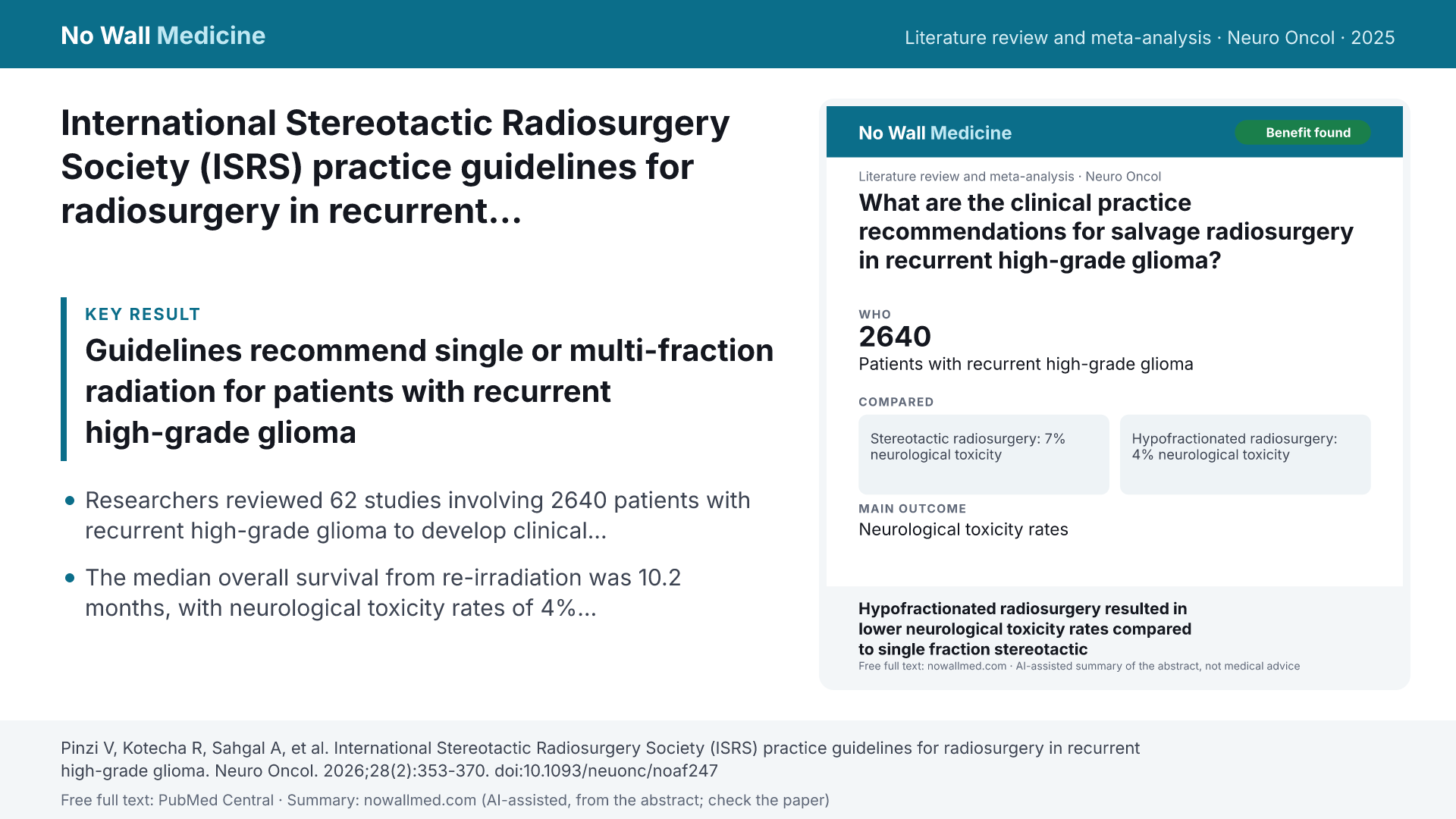
Key result: Guidelines recommend single or multi-fraction radiation for patients with recurrent high-grade glioma
Key points
- Researchers reviewed 62 studies involving 2640 patients with recurrent high-grade glioma to develop clinical practice recommendations.
- The median overall survival from re-irradiation was 10.2 months, with neurological toxicity rates of 4% for hypofractionated radiosurgery versus 7% for single-fraction stereotactic radiosurgery.
- A cumulative equivalent dose in two fractions (EQD2) greater than 120-130 Gy was associated with a higher risk of radiation necrosis.
Why it matters: There is currently no standard-of-care salvage treatment approach for patients whose high-grade glioma has returned after initial therapy.
Limitation the authors note: The authors state that no definitive conclusions can be drawn due to limited prospective data.
Discussion prompts
- Would these patients look like yours? Who was left out?
- Is the main outcome one that matters to patients?
- Is the difference large enough to change what you do?
Cite: Pinzi V, Kotecha R, Sahgal A, et al. International Stereotactic Radiosurgery Society (ISRS) practice guidelines for radiosurgery in recurrent high-grade glioma. Neuro Oncol. 2026;28(2):353-370. doi:10.1093/neuonc/noaf247
Free full text: PubMed Central · Summary and visual abstract: nowallmed.com/a/international-stereotactic-radiosurgery-society-isrs-practice-ngtbni/ (AI-assisted from the abstract; check the paper before relying on it).