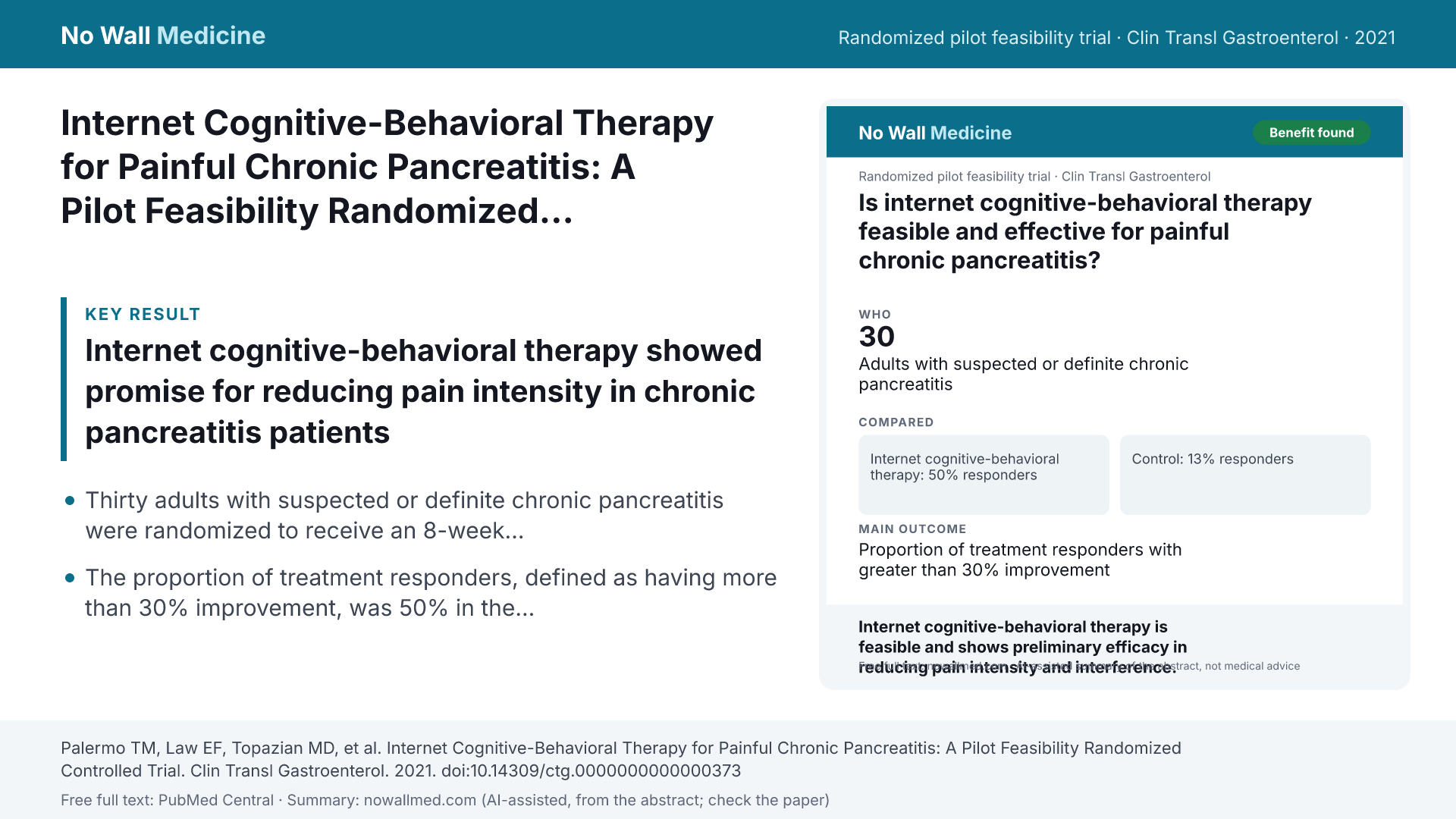
Internet cognitive-behavioral therapy showed promise for reducing pain intensity in chronic pancreatitis patients
Internet Cognitive-Behavioral Therapy for Painful Chronic Pancreatitis: A Pilot Feasibility Randomized Controlled Trial
Randomized pilot feasibility trialBenefit found
Is internet cognitive-behavioral therapy feasible and effective for painful chronic pancreatitis?
Who
30
Adults with suspected or definite chronic pancreatitis
Compared
Internet cognitive-behavioral therapy: 50% responders
Control: 13% responders
Main outcome
Proportion of treatment responders with greater than 30% improvement
Bottom line: Internet cognitive-behavioral therapy is feasible and shows preliminary efficacy in reducing pain intensity and interference.
Limitation: This was a pilot feasibility trial requiring future definitive trials.
Clin Transl Gastroenterol · 2021-06-18Download image
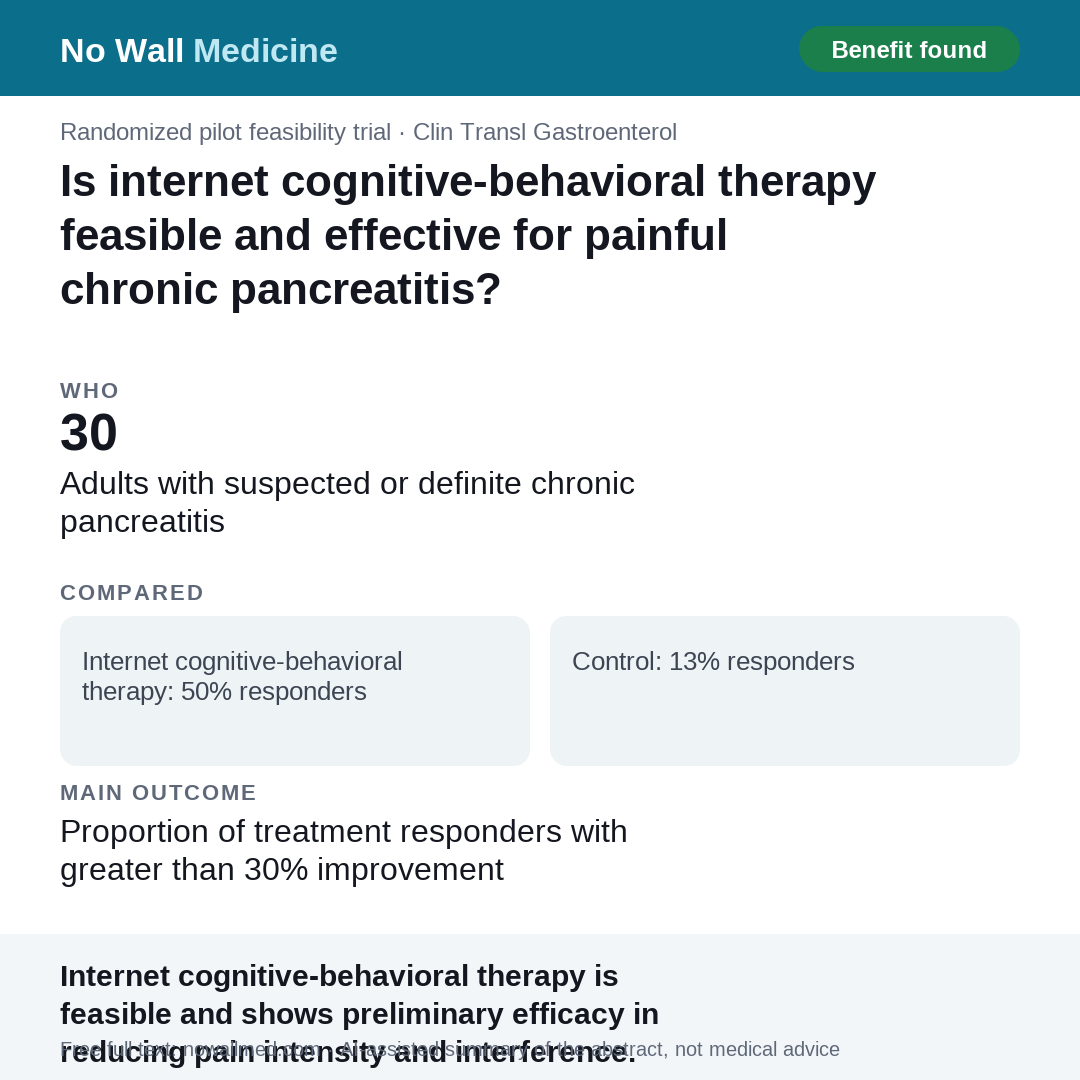
Clinical question: Is internet cognitive-behavioral therapy feasible and effective for painful chronic pancreatitis?
Key points
- Thirty adults with suspected or definite chronic pancreatitis were randomized to receive an 8-week internet-based cognitive-behavioral therapy program or a control.
- The proportion of treatment responders, defined as having more than 30% improvement, was 50% in the internet cognitive-behavioral therapy group compared to 13% in the control group.
- Eighty percent of participants rated the internet program as highly acceptable and 64.3% completed all 5 lessons.
Headline and key points written with AI from the paper’s abstract, with every number checked against it. Read the paper before relying on them.
Was this summary helpful?
Subject terms
Cite this article
Palermo TM, Law EF, Topazian MD, et al. Internet Cognitive-Behavioral Therapy for Painful Chronic Pancreatitis: A Pilot Feasibility Randomized Controlled Trial. Clin Transl Gastroenterol. 2021. doi:10.14309/ctg.0000000000000373
Spotted a mistake? Suggest a correction