Internet Cognitive-Behavioral Therapy for Painful Chronic Pancreatitis: A Pilot Feasibility Randomized Controlled Trial
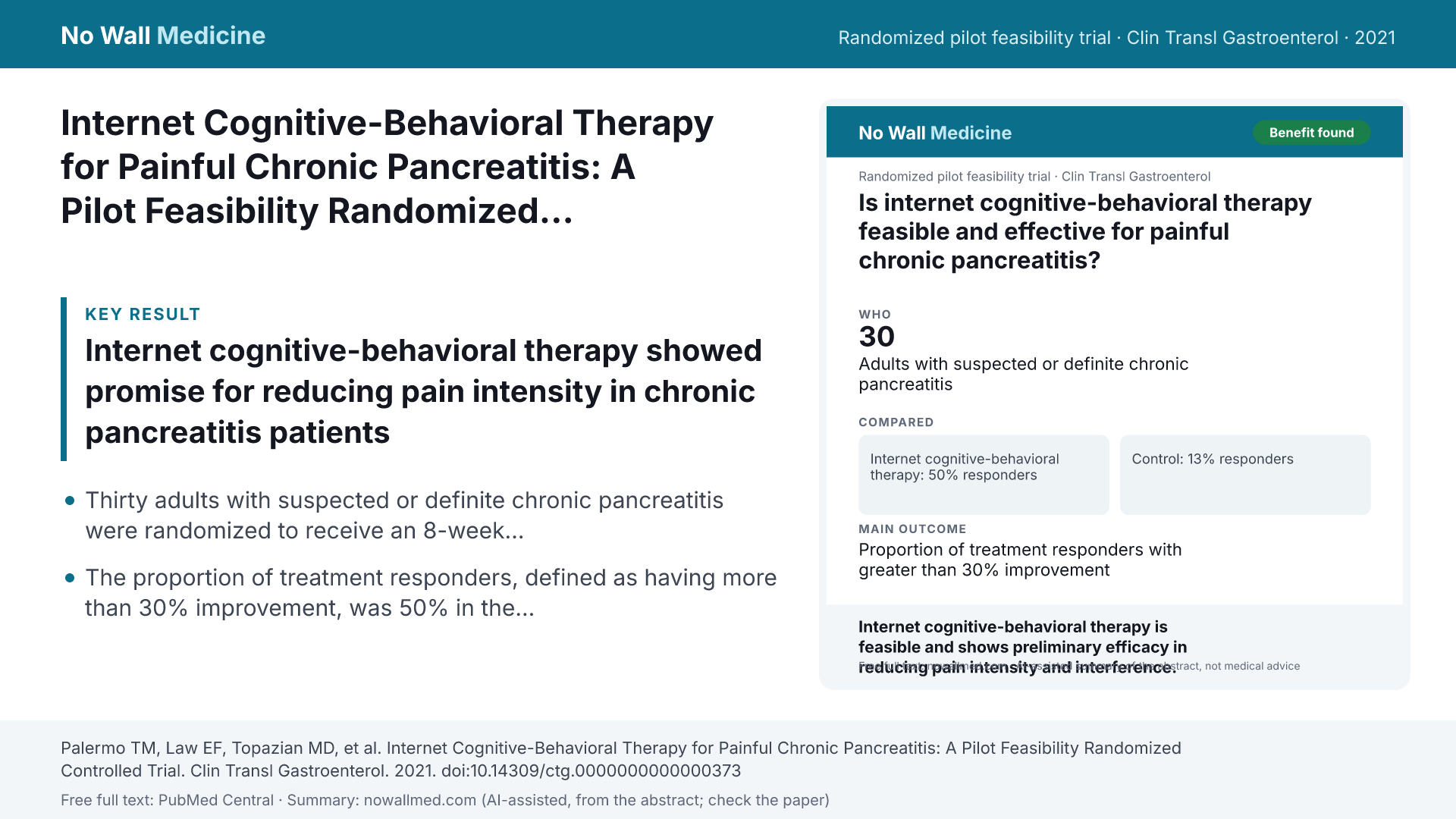
Key result: Internet cognitive-behavioral therapy showed promise for reducing pain intensity in chronic pancreatitis patients
Randomized pilot feasibility trialBenefit found
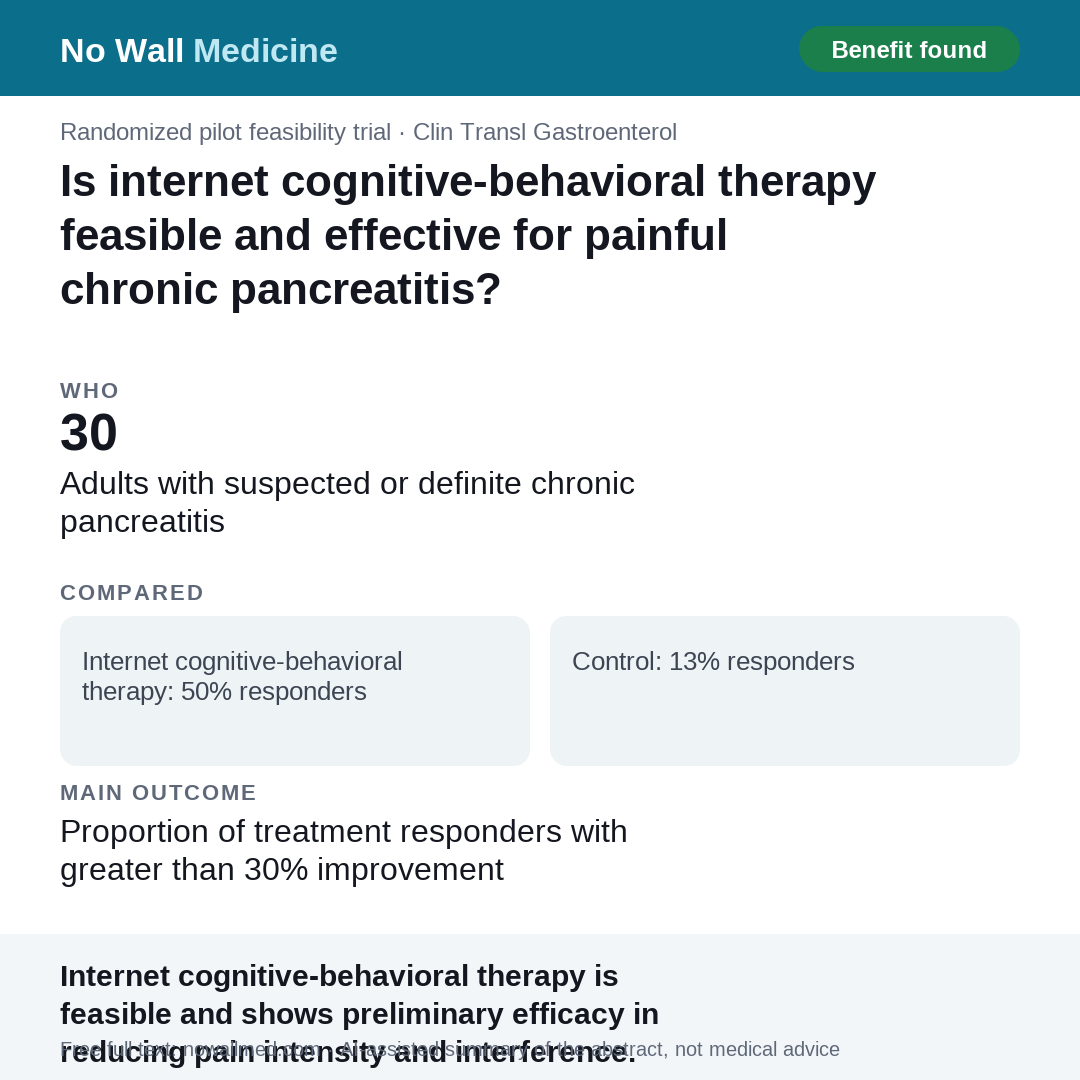
Is internet cognitive-behavioral therapy feasible and effective for painful chronic pancreatitis?
Who
30
Adults with suspected or definite chronic pancreatitis
Compared
Internet cognitive-behavioral therapy: 50% responders
Control: 13% responders
Main outcome
Proportion of treatment responders with greater than 30% improvement
Bottom line: Internet cognitive-behavioral therapy is feasible and shows preliminary efficacy in reducing pain intensity and interference.
Limitation: This was a pilot feasibility trial requiring future definitive trials.
Clin Transl Gastroenterol · 2021-06-18Download image
Key points
- Thirty adults with suspected or definite chronic pancreatitis were randomized to receive an 8-week internet-based cognitive-behavioral therapy program or a control.
- The proportion of treatment responders, defined as having more than 30% improvement, was 50% in the internet cognitive-behavioral therapy group compared to 13% in the control group.
- Eighty percent of participants rated the internet program as highly acceptable and 64.3% completed all 5 lessons.
Discussion prompts
- Would these patients look like yours? Who was left out?
- Is the main outcome one that matters to patients?
- Is the difference large enough to change what you do?
Cite: Palermo TM, Law EF, Topazian MD, et al. Internet Cognitive-Behavioral Therapy for Painful Chronic Pancreatitis: A Pilot Feasibility Randomized Controlled Trial. Clin Transl Gastroenterol. 2021. doi:10.14309/ctg.0000000000000373
Free full text: PubMed Central · Summary and visual abstract: nowallmed.com/a/internet-cognitive-behavioral-therapy-for-painful-chronic-50ksv1/ (AI-assisted from the abstract; check the paper before relying on it).