Internet-delivered exposure and response prevention showed no significant change in tic severity at 12 months
Internet-Delivered Exposure and Response Prevention for Pediatric Tourette Syndrome: 12-Month Follow-Up of a Randomized Clinical Trial
Randomized clinical trialNo clear difference
Is internet-delivered exposure and response prevention more effective than psychoeducation for youths with Tourette syndrome?
Who
221
Youths aged 9 to 17 years with Tourette syndrome or chronic tic disorder · Research clinic in Stockholm, Sweden
Compared
55%Internet-delivered exposure and response prevention
50%Internet-delivered psychoeducation
Main outcome
Treatment response rate and change in tic severity
Result: odds ratio 1.25 (95% CI 0.73-2.16)
Bottom line: Internet-delivered exposure and response prevention was not superior to psychoeducation in reducing tic severity at 12-month follow-up.
JAMA Netw Open · 2024-05-01Download image
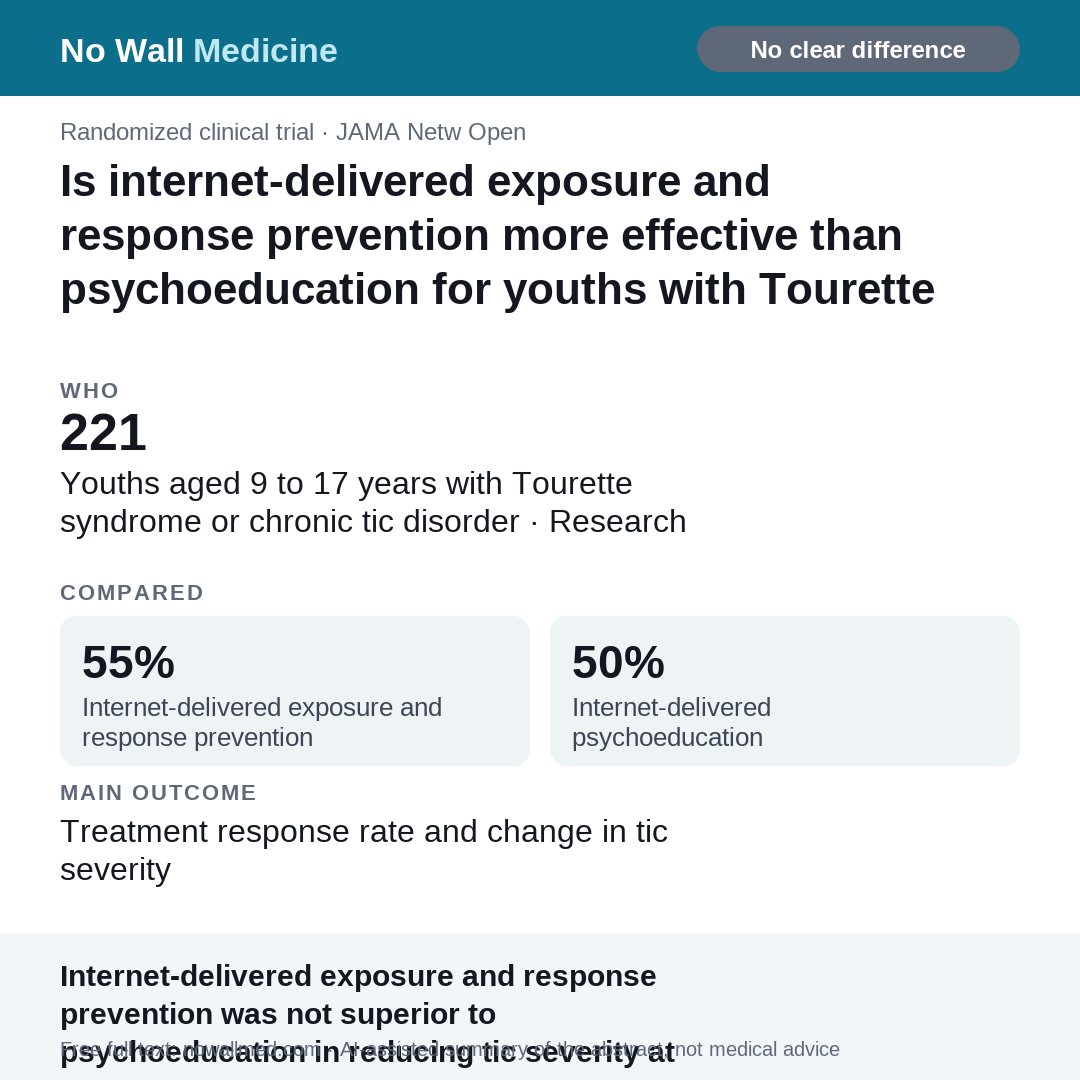
Clinical question: Is internet-delivered exposure and response prevention more effective than psychoeducation for youths with Tourette syndrome?
Why it matters: The long-term effects and cost-effectiveness of therapist-supported, internet-delivered exposure and response prevention for youths with Tourette syndrome or chronic tic disorder are uncertain.
Key points
- The study followed 208 participants aged 9 to 17 years with Tourette syndrome or chronic tic disorder to compare internet-delivered exposure and response prevention against psychoeducation.
- Between the 3-month and 12-month follow-up, there were no statistically significant changes in tic severity in the exposure and response prevention group or the psychoeducation group.
- Treatment response rates at 12 months were 55% for exposure and response prevention and 50% for psychoeducation, which was not a statistically significant difference.
Headline and key points written with AI from the paper’s abstract, with every number checked against it. Read the paper before relying on them.
Was this summary helpful?
Subject terms
Cite this article
Andrén P, Sampaio F, Ringberg H, Wachtmeister V, Warnström M, Isomura K. Internet-Delivered Exposure and Response Prevention for Pediatric Tourette Syndrome: 12-Month Follow-Up of a Randomized Clinical Trial. JAMA Netw Open. 2024. doi:10.1001/jamanetworkopen.2024.8468
Spotted a mistake? Suggest a correction
Top studies every Monday
The week’s key trials and guidelines in your specialties, plus any topics you follow. By email, free.
Get the weekly digest