Internet-delivered exposure and response prevention shows higher response rates for children with Tourette syndrome
Therapist-Supported Internet-Delivered Exposure and Response Prevention for Children and Adolescents With Tourette Syndrome: A Randomized Clinical Trial
Single-masked, parallel group, superiority randomized clinical trialBenefit found
Is internet-delivered exposure and response prevention effective for children with Tourette syndrome?
Who
221
Children and adolescents aged 9 to 17 years with Tourette syndrome or chronic tic disorder · Research clinic in Stockholm, Sweden
Compared
Internet-delivered exposure and response prevention: mean reduction of 6.08 points
5.29Internet-delivered education
Main outcome
Change in tic severity measured by Yale Global Tic Severity Scale
Result: odds ratio 2.22 (95% CI 1.27 to 3.90)
Bottom line: Internet-delivered exposure and response prevention led to higher treatment response rates than education at little additional cost.
JAMA Netw Open · 2022-08-01Download image
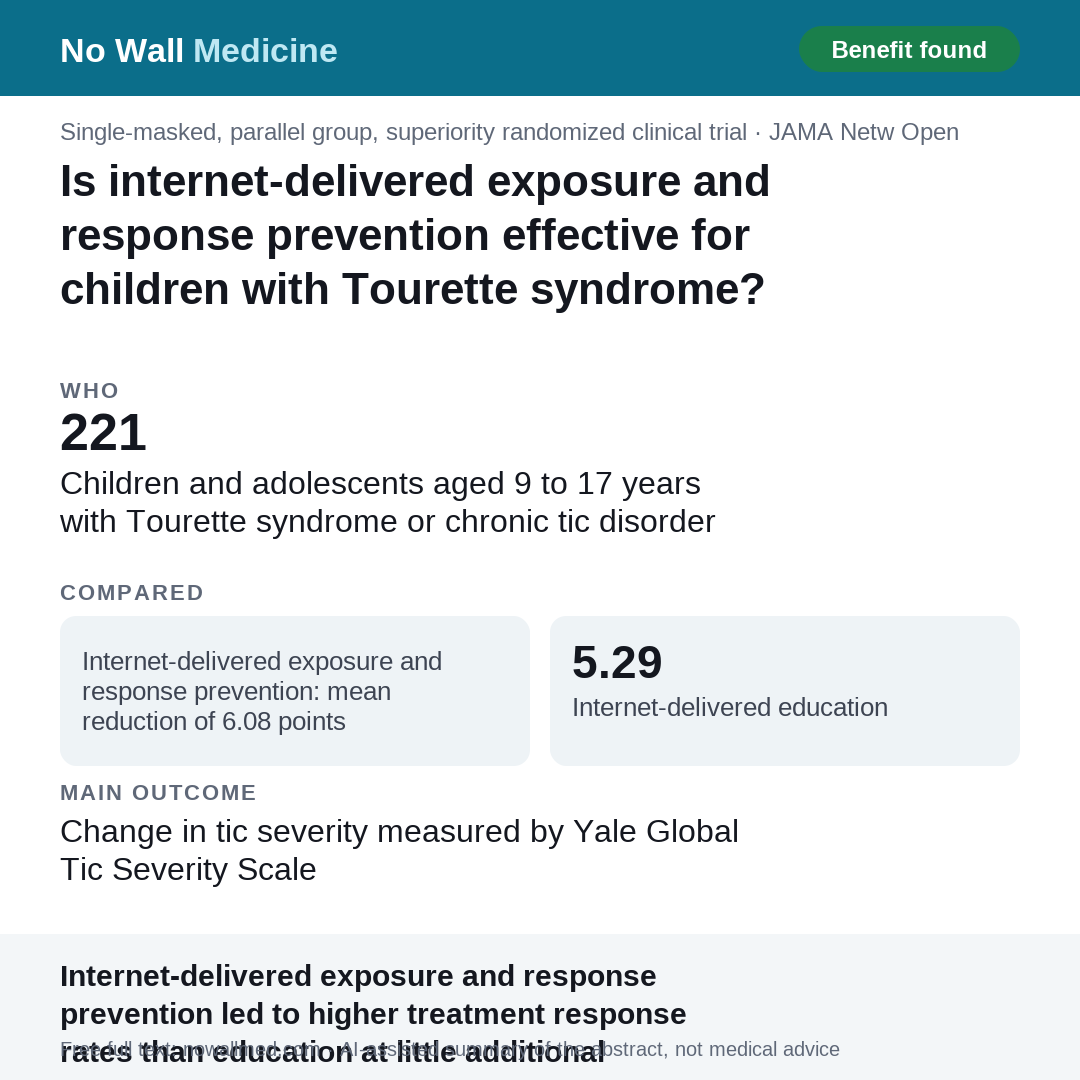
Clinical question: Is internet-delivered exposure and response prevention effective for children with Tourette syndrome?
Why it matters: The availability of behavior therapy for individuals with Tourette syndrome and chronic tic disorder is limited.
Key points
- Researchers studied 221 children and adolescents aged 9 to 17 years with Tourette syndrome or chronic tic disorder, comparing internet-delivered exposure and response prevention to internet-delivered education.
- While both groups showed similar improvements in tic severity scores, 47.2% of the exposure and response prevention group were classified as treatment responders compared to 28.7% in the education group.
- The exposure and response prevention group had a mean reduction of 6.08 points on the Yale Global Tic Severity Scale Total Tic Severity Score at the 3-month follow-up.
Headline and key points written with AI from the paper’s abstract, with every number checked against it. Read the paper before relying on them.
Was this summary helpful?
Subject terms
Cite this article
Andrén P, Holmsved M, Ringberg H, Wachtmeister V, Isomura K, Aspvall K. Therapist-Supported Internet-Delivered Exposure and Response Prevention for Children and Adolescents With Tourette Syndrome: A Randomized Clinical Trial. JAMA Netw Open. 2022. doi:10.1001/jamanetworkopen.2022.25614
Spotted a mistake? Suggest a correction
Top studies every Monday
The week’s key trials and guidelines in your specialties, plus any topics you follow. By email, free.
Get the weekly digest