Online behavioral therapy for tics was more effective than psychoeducation in children and adolescents
Therapist-supported online remote behavioural intervention for tics in children and adolescents in England (ORBIT): a multicentre, parallel group, single-blind, randomised controlled trial
Multicentre, parallel group, single-blind, randomised controlled trialBenefit found
Is internet-delivered, therapist-supported exposure and response prevention effective for tics?
Who
224
Children and adolescents aged 9-17 with Tourette syndrome or chronic tic disorder · Two study sites in England
Compared
Exposure and Response Prevention: mean total decrease in YGTSS-TTSS of 4·5 (16%, SD 1·1)
Psychoeducation: mean total decrease in YGTSS-TTSS of 1·6 (6%, 1·0)
Main outcome
Yale Global Tic Severity Scale Total Tic Severity Score
Result: -2·29 points (95% CI -3·86 to -0·71)
Bottom line: Online, therapist-supported exposure and response prevention effectively reduces tic severity in children and adolescents.
Limitation: Patients were not directly informed of their allocation, so they were not masked to treatment.
Funded by: National Institute for Health Research and Health and Technology Assessment
Lancet Psychiatry · 2021-09-01Download image
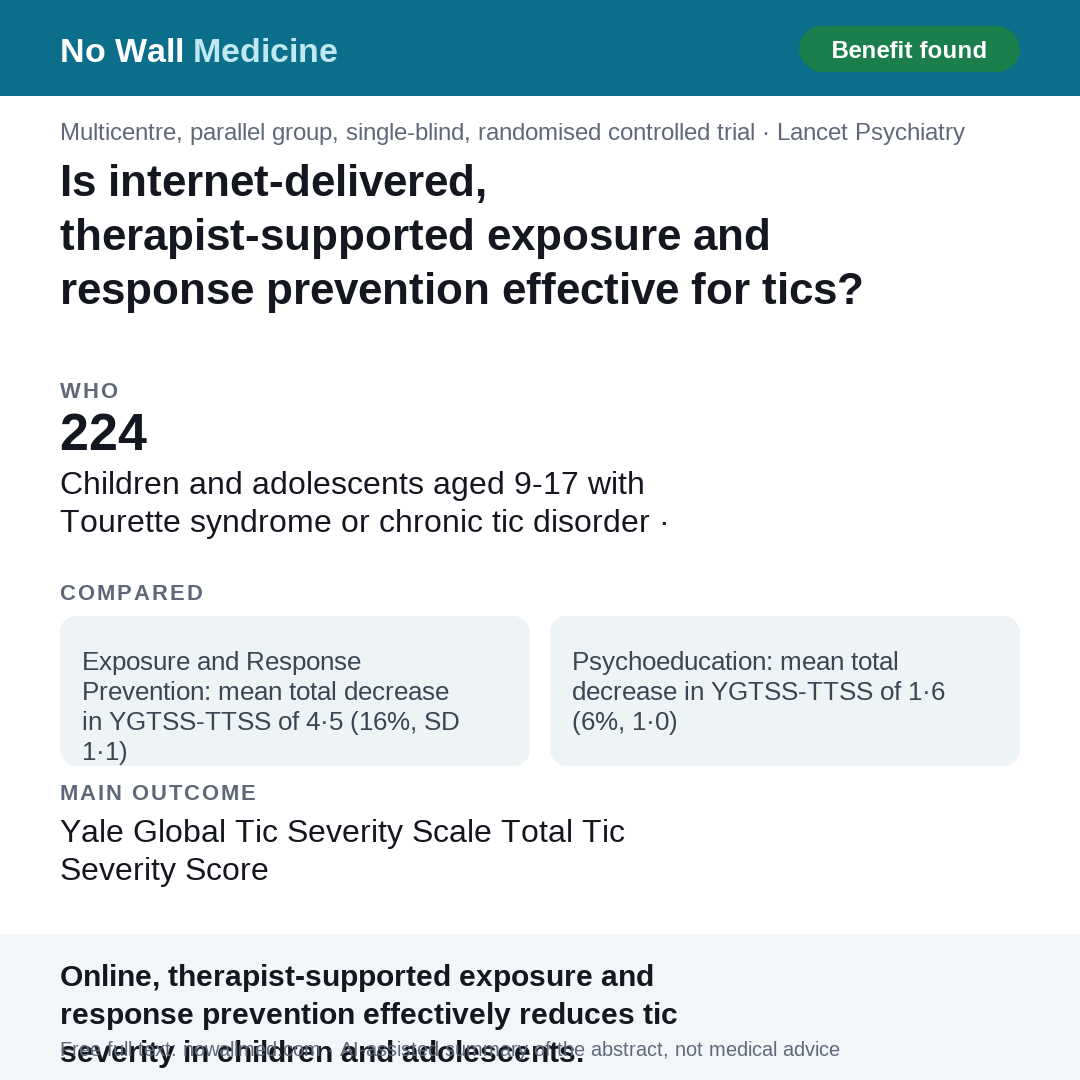
Clinical question: Is internet-delivered, therapist-supported exposure and response prevention effective for tics?
Why it matters: The effectiveness of internet-delivered, therapist-supported, and parent-assisted exposure and response prevention for treating tics in young people remained uncertain.
Key points
- Researchers randomized 224 children and adolescents with Tourette syndrome or chronic tic disorder to receive either 10 weeks of online exposure and response prevention or psychoeducation.
- The online behavioral therapy group had a mean total tic severity score decrease of 4.5 (16%) compared to a 1.6 (6%) decrease in the psychoeducation group at 3 months.
- The estimated mean difference in tic severity score change between the two groups was -2.29 points (95% CI -3.86 to -0.71) in favor of the behavioral therapy.
Headline and key points written with AI from the paper’s abstract, with every number checked against it. Read the paper before relying on them.
Was this summary helpful?
Abstract
Background
Exposure and Response Prevention (ERP) is a form of behavioural therapy for tics; however, its effectiveness remains uncertain. We aimed to evaluate the effectiveness of internet-delivered, therapist-supported, and parent-assisted ERP for treatment of tics in children and young people with Tourette syndrome or chronic tic disorder. Methods
This multicentre, parallel group, single-blind, randomised controlled trial was conducted across two study sites in England. Participants were recruited via 16 patient identification centres, two study sites in England (Nottingham and London), or online self-referral. Eligible participants were aged 9-17 years, had Tourette syndrome or chronic tic disorder, had not received behavioural therapy for tics in the past 12 months or were about to start, and had a Yale Global Tic Severity Scale (YGTSS) Total Tic Severity Score (TTSS) of more than 15 or more than 10 if they had only motor or vocal tics. Patients were excluded if they had started or stopped medication for tics within the past 2 months; had current alcohol or substance dependence, psychosis, suicidality, anorexia nervosa, or suspected moderate to severe intellectual disability; or presented an immediate risk to self or others; or the parent or carer was unable to speak, read, or write in English. Eligible patients were randomly assigned (1:1) by masked outcome assessors to receive 10 weeks of online, remotely delivered, therapist-supported ERP or psychoeducation (active control). Outcome assessors, statisticians, health economists, the trial manager, and the chief investigator were masked to group allocation. Patients were not directly informed of their allocation, but this could be established from the content once treatment commenced and the patients were not, therefore, considered masked to treatment. The primary outcome was YGTSS-TTSS 3 months after randomisation, and analysis was done in all randomised patients for whom data were available for each timepoint and outcome. Safety analysis was by intention to treat. Longer term follow-up is ongoing. This trial is registered with ISRCTN (ISRCTN70758207) and ClinicalTrials.gov (NCT03483493). Findings
Between May 8, 2018, and Sept 30, 2019, we assessed 445 candidates for inclusion in the study. 221 potential participants were excluded (90 did not meet inclusion criteria, 84 declined to participate, and 47 unable to contact family). 224 participants were enrolled and randomly assigned to ERP (n=112) or psychoeducation (n=112). The enrolled patients were mostly male (n=177; 79%) and of White ethnicity (n=195; 87%). 11 patients were lost to follow-up 3 months after randomisation in the ERP group, compared with 12 patients in the psychoeducation group. Mean YGTSS-TTSS at 3 months after randomisation was 23·9 (SD 8·2) in the ERP group and 26·8 (7·3) in the psychoeducation group. The mean total decrease in YGTSS-TTSS at 3 months was 4·5 (16%, SD 1·1) in the ERP group versus 1·6 (6%, 1·0) in the psychoeducation group. The estimated mean difference in YGTSS-TTSS change between the groups adjusted for baseline and site was -2·29 points (95% CI -3·86 to -0·71) in favour of ERP, with an effect size of -0·31 (95% CI -0·52 to -0·10). Two serious adverse events occurred (one collapse and one tic attack), both in the psychoeducation group, neither of which were related to study treatment. Interpretation
ERP is an effective behavioural therapy for tics. Remotely delivered, online ERP with minimal therapist contact time represents an efficient public mental health approach to improve access to behavioural therapy for tics in children and adolescents. Funding
National Institute for Health Research and Health and Technology Assessment.
Abstract reproduced under the article’s CC BY licence.
Subject terms
Cite this article
Hollis C, Hall CL, Jones R, Marston L, Novere ML, Hunter R. Therapist-supported online remote behavioural intervention for tics in children and adolescents in England (ORBIT): a multicentre, parallel group, single-blind, randomised controlled trial. Lancet Psychiatry. 2021. doi:10.1016/S2215-0366(21)00235-2
Spotted a mistake? Suggest a correction
Top studies every Monday
The week’s key trials and guidelines in your specialties, plus any topics you follow. By email, free.
Get the weekly digest