Ultrasound measurements of blood flow in pregnancy show varying levels of reliability and reproducibility
Interobserver and intraobserver variability of fetal and maternal Doppler measurements: systematic review and meta-analysis
Systematic review and meta-analysisMixed results
What is the variability and reproducibility of fetal and maternal Doppler ultrasound measurements?
Who
2457
Patients with singleton or multiple pregnancies
Compared
0.88Umbilical artery intraobserver (95% CI, 0.77-0.94)
0.68Umbilical artery interobserver (95% CI, 0.55-0.79)
0.85Middle cerebral artery intraobserver (95% CI, 0.69-0.93)
0.80Middle cerebral artery interobserver (95% CI, 0.62-0.90)
Main outcome
Intraobserver and interobserver reproducibility of Doppler ultrasound measurements
Bottom line: Doppler ultrasound measurements showed generally poor-to-moderate reproducibility according to strict criteria, suggesting a need for standardized protocols.
Ultrasound Obstet Gynecol · 2026-08-08Download image
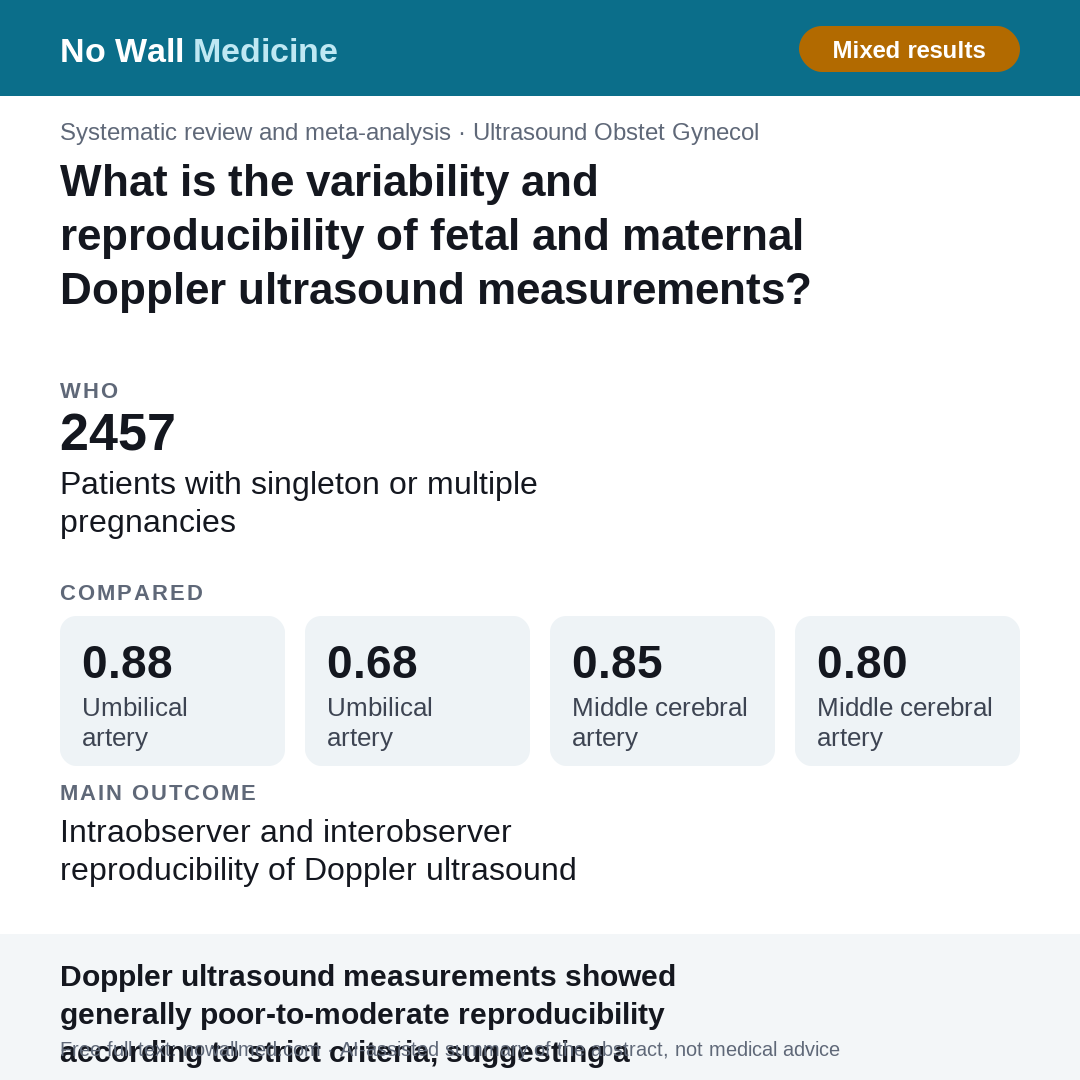
Clinical question: What is the variability and reproducibility of fetal and maternal Doppler ultrasound measurements?
Why it matters: It is unclear how reproducible Doppler ultrasound measurements of blood flow in the umbilical, fetal brain, and uterine arteries are in clinical practice.
Key points
- Researchers analyzed 26 studies involving 2457 patients to evaluate how consistently ultrasound can measure blood flow in the umbilical, fetal brain, and uterine arteries.
- The pooled intraobserver intraclass correlation coefficient, a measure of consistency within one person, was 0.88 for umbilical artery, 0.85 for fetal brain, and 0.90 for uterine artery.
- The pooled interobserver intraclass correlation coefficient, measuring consistency between different people, was 0.68 for umbilical artery, 0.80 for fetal brain, and 0.84 for uterine artery.
Headline and key points written with AI from the paper’s abstract, with every number checked against it. Read the paper before relying on them.
Topics
Spotted a mistake? Suggest a correction