Animal therapy and videoconferencing were associated with reduced loneliness in older adults in long-term care
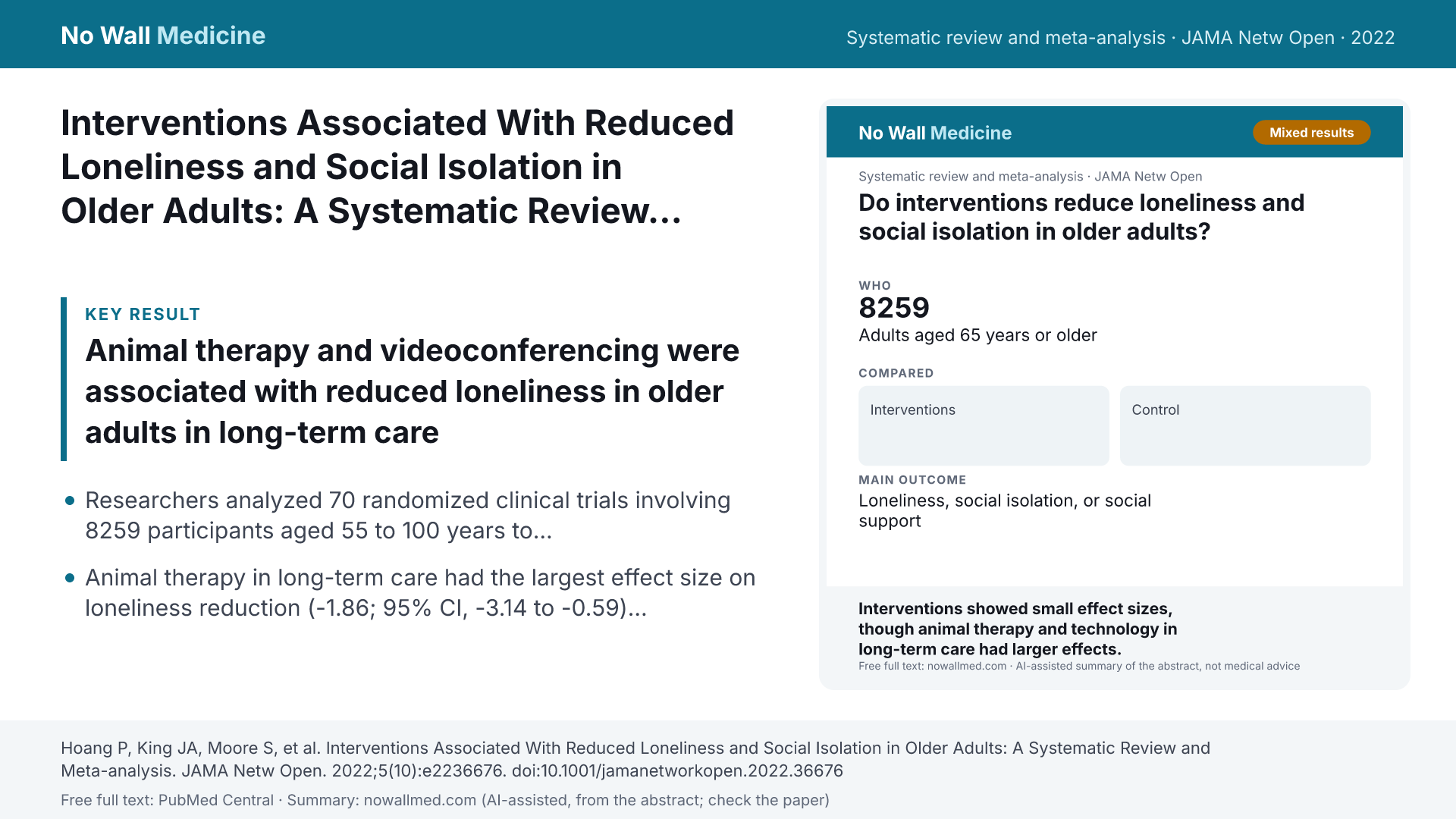
Interventions Associated With Reduced Loneliness and Social Isolation in Older Adults: A Systematic Review and Meta-analysis
Systematic review and meta-analysisMixed results
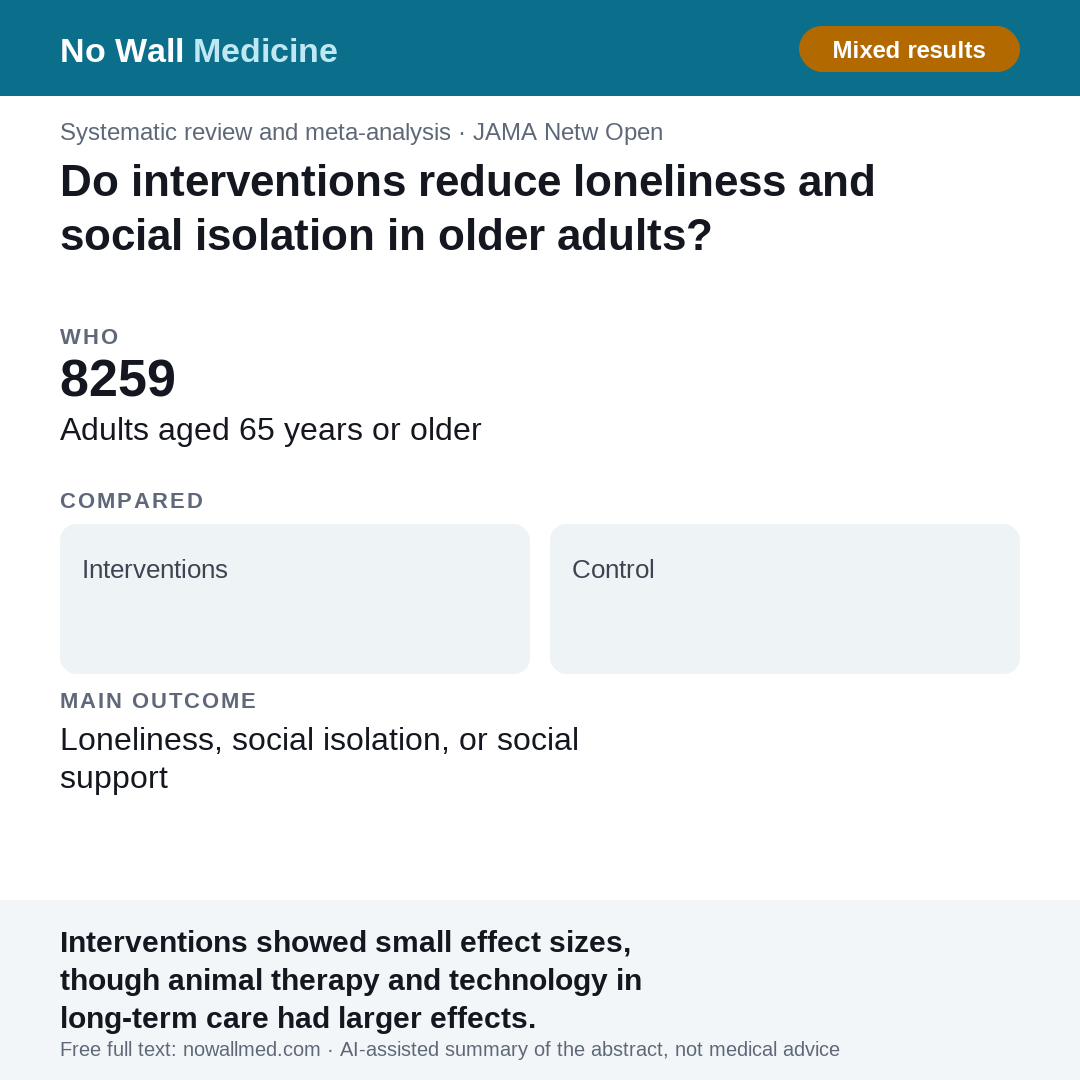
Do interventions reduce loneliness and social isolation in older adults?
Who
8259
Adults aged 65 years or older
Compared
Interventions
Control
Main outcome
Loneliness, social isolation, or social support
Bottom line: Interventions showed small effect sizes, though animal therapy and technology in long-term care had larger effects.
Limitation: The overall quality of evidence was very low and heterogeneity was high.
JAMA Netw Open · 2022-10-03Download image
Clinical question: Do interventions reduce loneliness and social isolation in older adults?
Why it matters: It is unknown which specific interventions are most effective at reducing loneliness and social isolation in older adults.
Key points
- Researchers analyzed 70 randomized clinical trials involving 8259 participants aged 55 to 100 years to evaluate interventions for loneliness and social isolation.
- Animal therapy in long-term care had the largest effect size on loneliness reduction (-1.86; 95% CI, -3.14 to -0.59) followed by videoconferencing (-1.40; 95% CI, -2.37 to -0.44).
- Most other interventions, including exercise, music therapy, and psychotherapy, were associated with small effect sizes.
Limitation the authors note: The authors stated that the overall quality of evidence was very low and the small number of studies per intervention limits conclusions.
Headline and key points written with AI from the paper’s abstract, with every number checked against it. Read the paper before relying on them.
Was this summary helpful?
Subject terms
Cite this article
Hoang P, King JA, Moore S, et al. Interventions Associated With Reduced Loneliness and Social Isolation in Older Adults: A Systematic Review and Meta-analysis. JAMA Netw Open. 2022. doi:10.1001/jamanetworkopen.2022.36676
Spotted a mistake? Suggest a correction