Objective
To compare the benefits and harms of therapeutic interventions for adhesive capsulitis. Design
Systematic review and network meta-analysis of randomised controlled trials. Data sources
Medline, Cochrane Library, Embase, Web of Science, and Scopus were searched from inception to 1 May 2025, with an update in November 2025. Eligibility criteria for selecting studies
Randomised controlled trials enrolling adults with adhesive capsulitis, comparing active treatment with another intervention, placebo, or usual care. Main outcome measures
Pain, function, range of motion, and adverse events. Results
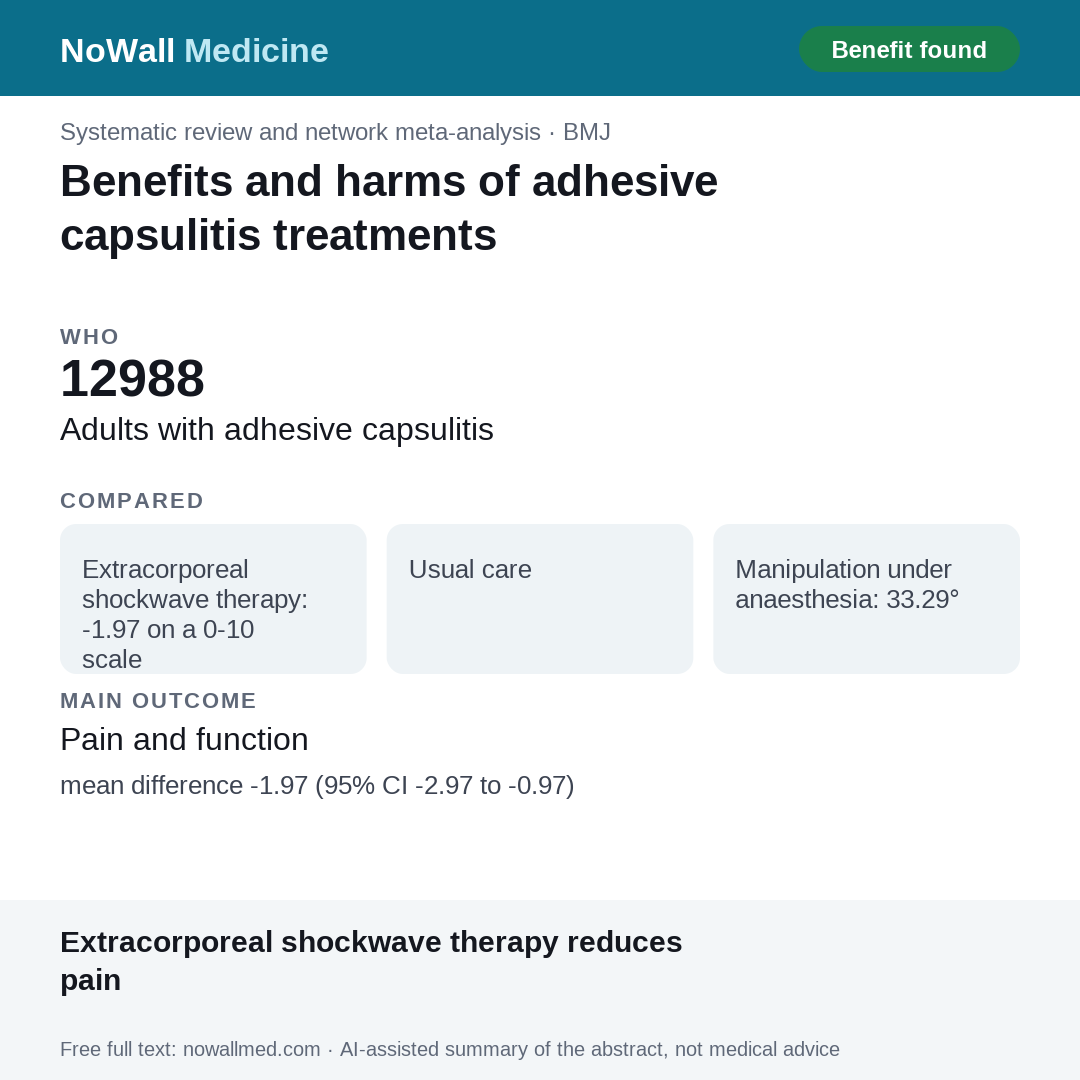
A total of 189 randomised controlled trials involving 12 988 participants and 59 interventions were included. Most trials contributing to principal outcomes were at high risk of bias (71% for pain, 72% for function, and 71% for range of motion). At short term follow-up, moderate certainty evidence suggested that extracorporeal shockwave therapy probably reduced pain compared with usual care (mean difference -1.97 on a 0-10 scale, 95% confidence interval (CI) -2.97 to -0.97). Low certainty evidence suggested that extracorporeal shockwave therapy may improve function (mean difference -11.42 on a 0-100 scale, 95% CI -16.68 to -6.15), although direct and indirect estimates were limited by important incoherence. For short term range of motion, moderate certainty evidence suggested that manipulation under anaesthesia combined with intra-articular steroid injections probably improved flexion (mean difference 33.29°, 95% CI 11.19° to 55.39°), as did manipulation under anaesthesia alone (26.16°, 8.19° to 44.13°). Low certainty evidence suggested that extracorporeal shockwave therapy may improve flexion (22.42°, 12.99° to 31.84°) and abduction (18.62°, 8.09° to 29.14°), but both comparisons were limited by important incoherence. At mid-term follow-up, evidence for possible improvements in function with extracorporeal shockwave therapy and flexion with passive mobilisation was of low certainty, while evidence for pain reduction with extracorporeal shockwave therapy was of very low certainty. Most other comparative estimates were supported by low or very low certainty evidence. Comparative safety remained highly uncertain because adverse events were incompletely and inconsistently reported; the absence of reported adverse events should not be interpreted as evidence of absence of harm. Conclusion
Moderate certainty evidence suggests short term pain reduction with extracorporeal shockwave therapy and improved short term flexion with manipulation under anaesthesia, with or without intra-articular steroid injections. Most other treatment effects remain uncertain because of low certainty and incoherence, and comparative safety and mid-term effects are poorly established. The available evidence is mainly short term and outcome specific. Longer term comparative effectiveness, overall benefits and harms, and applicability beyond predominantly primary adhesive capsulitis remain uncertain. Systematic review registration
PROSPERO CRD420251070468.
Abstract reproduced under the article’s CC BY licence.
Topics
Humans; Bursitis; Randomized Controlled Trials as Topic; Range of Motion, Articular; Extracorporeal Shockwave Therapy; Treatment Outcome
Physical activity coaching and text messaging for adults with mobility limitations (ComeBACK): hybrid type 1 effectiveness implementation randomised controlled trial