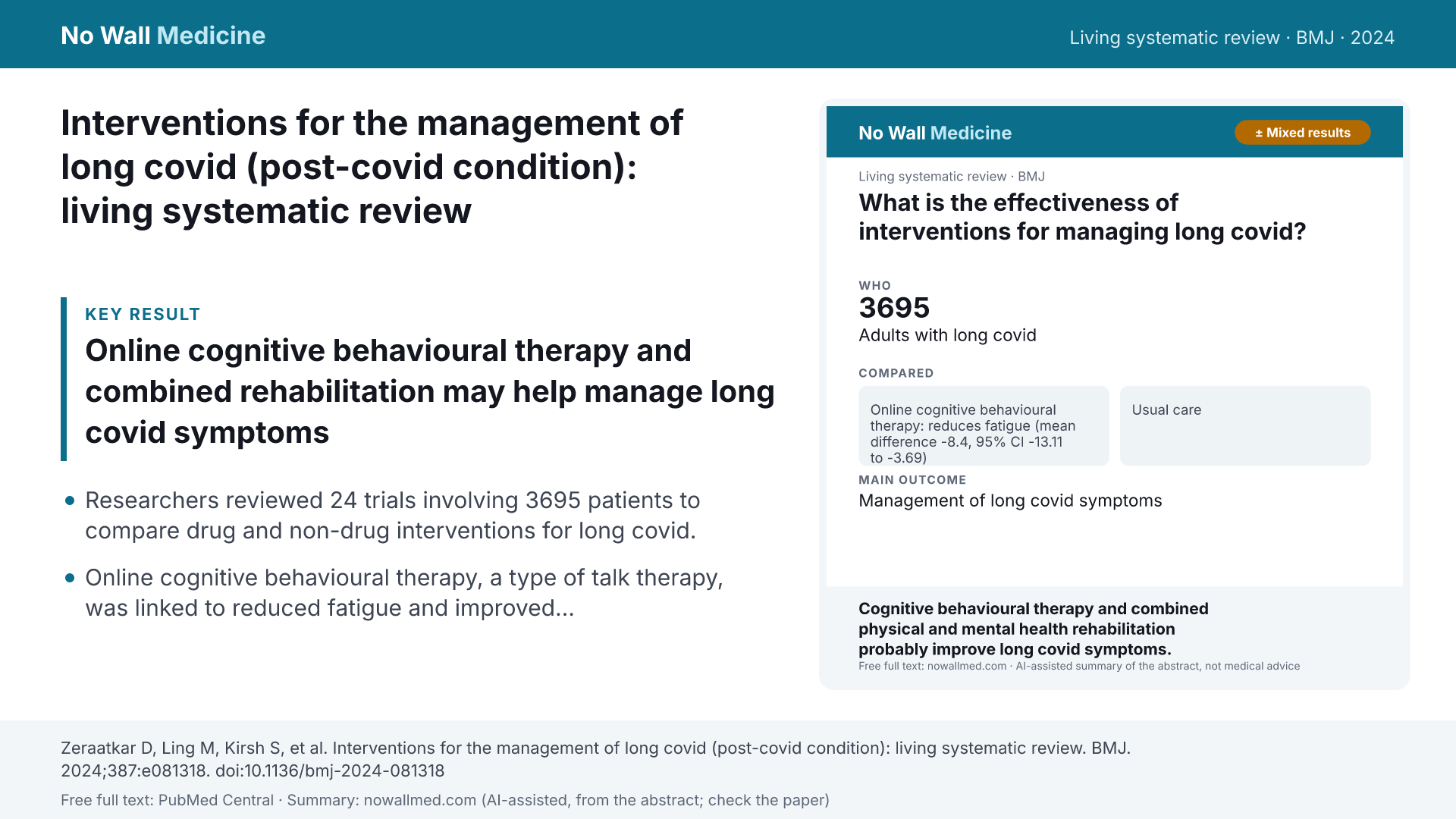
Online cognitive behavioural therapy and combined rehabilitation may help manage long covid symptoms
Interventions for the management of long covid (post-covid condition): living systematic review
Living systematic reviewMixed results
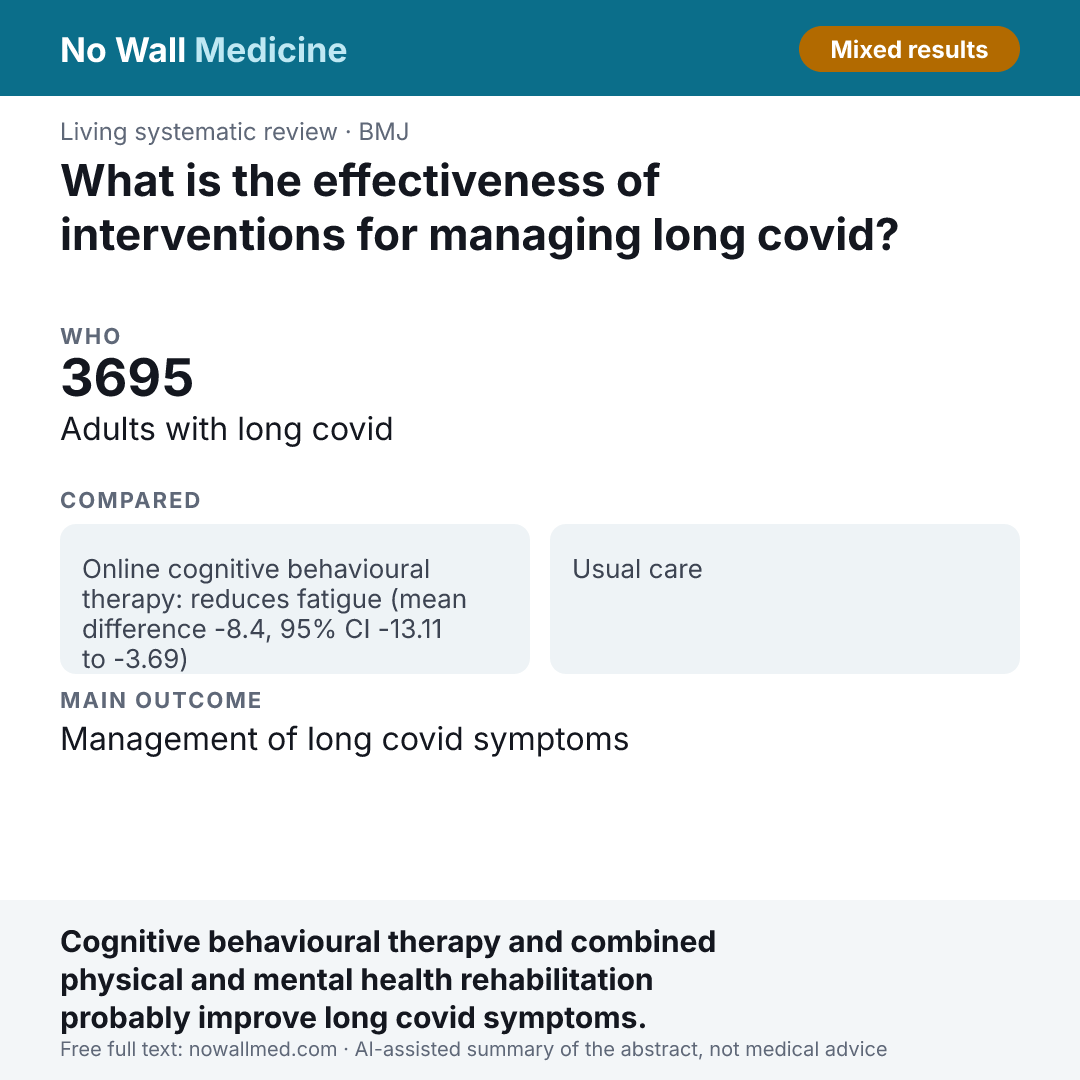
What is the effectiveness of interventions for managing long covid?
Who
3695
Adults with long covid
Compared
Online cognitive behavioural therapy: reduces fatigue (mean difference -8.4, 95% CI -13.11 to -3.69)
Usual care
Main outcome
Management of long covid symptoms
Bottom line: Cognitive behavioural therapy and combined physical and mental health rehabilitation probably improve long covid symptoms.
BMJ · 2024-11-27 · Save PNG
Clinical question: What is the effectiveness of interventions for managing long covid?
Key points
- Researchers reviewed 24 trials involving 3695 patients to compare drug and non-drug interventions for long covid.
- Online cognitive behavioural therapy, a type of talk therapy, was linked to reduced fatigue and improved concentration compared to usual care.
- Combined physical and mental health rehabilitation was associated with improved overall health, reduced depression, and better quality of life.
Headline and key points written with AI from the paper’s abstract, with every number checked against it. Read the paper before relying on them.
Was this summary helpful?
Abstract
Objective
To compare the effectiveness of interventions for the management of long covid (post-covid condition). Design
Living systematic review. Data sources
Medline, Embase, CINAHL, PsycInfo, Allied and Complementary Medicine Database, and Cochrane Central Register of Controlled Trials from inception to December 2023. Eligibility criteria
Trials that randomised adults (≥18 years) with long covid to drug or non-drug interventions, placebo or sham, or usual care. Results
24 trials with 3695 patients were eligible. Four trials (n=708 patients) investigated drug interventions, eight (n=985) physical activity or rehabilitation, three (n=314) behavioural, four (n=794) dietary, four (n=309) medical devices and technologies, and one (n=585) a combination of physical exercise and mental health rehabilitation. Moderate certainty evidence suggested that, compared with usual care, an online programme of cognitive behavioural therapy (CBT) probably reduces fatigue (mean difference -8.4, 95% confidence interval (CI) -13.11 to -3.69; Checklist for Individual Strength fatigue subscale; range 8-56, higher scores indicate greater impairment) and probably improves concentration (mean difference -5.2, -7.97 to -2.43; Checklist for Individual Strength concentration problems subscale; range 4-28; higher scores indicate greater impairment). Moderate certainty evidence suggested that, compared with usual care, an online, supervised, combined physical and mental health rehabilitation programme probably leads to improvement in overall health, with an estimated 161 more patients per 1000 (95% CI 61 more to 292 more) experiencing meaningful improvement or recovery, probably reduces symptoms of depression (mean difference -1.50, -2.41 to -0.59; Hospital Anxiety and Depression Scale depression subscale; range 0-21; higher scores indicate greater impairment), and probably improves quality of life (0.04, 95% CI 0.00 to 0.08; Patient-Reported Outcomes Measurement Information System 29+2 Profile; range -0.022-1; higher scores indicate less impairment). Moderate certainty evidence suggested that intermittent aerobic exercise 3-5 times weekly for 4-6 weeks probably improves physical function compared with continuous exercise (mean difference 3.8, 1.12 to 6.48; SF-36 physical component summary score; range 0-100; higher scores indicate less impairment). No compelling evidence was found to support the effectiveness of other interventions, including, among others, vortioxetine, leronlimab, combined probiotics-prebiotics, coenzyme Q10, amygdala and insula retraining, combined L-arginine and vitamin C, inspiratory muscle training, transcranial direct current stimulation, hyperbaric oxygen, a mobile application providing education on long covid. Conclusion
Moderate certainty evidence suggests that CBT and physical and mental health rehabilitation probably improve symptoms of long covid. Systematic review registration
Open Science Framework https://osf.io/9h7zm/. Readers' note
This article is a living systematic review that will be updated to reflect emerging evidence. Updates may occur for up to two years from the date of original publication.
Abstract reproduced under the article’s CC BY licence.
Subject terms
Headline, design, result, key points, caveat and citation as plain text.
Cite this article
Zeraatkar D, Ling M, Kirsh S, et al. Interventions for the management of long covid (post-covid condition): living systematic review. BMJ. 2024;387:e081318. doi:10.1136/bmj-2024-081318
Spotted a mistake? Suggest a correction