Cervical cerclage and pessary show no significant benefit for preventing preterm birth after laser surgery
Interventions to prevent preterm birth following fetoscopic laser surgery for twin-to-twin transfusion syndrome: systematic review and meta-analysis
Systematic review and meta-analysisNo clear difference
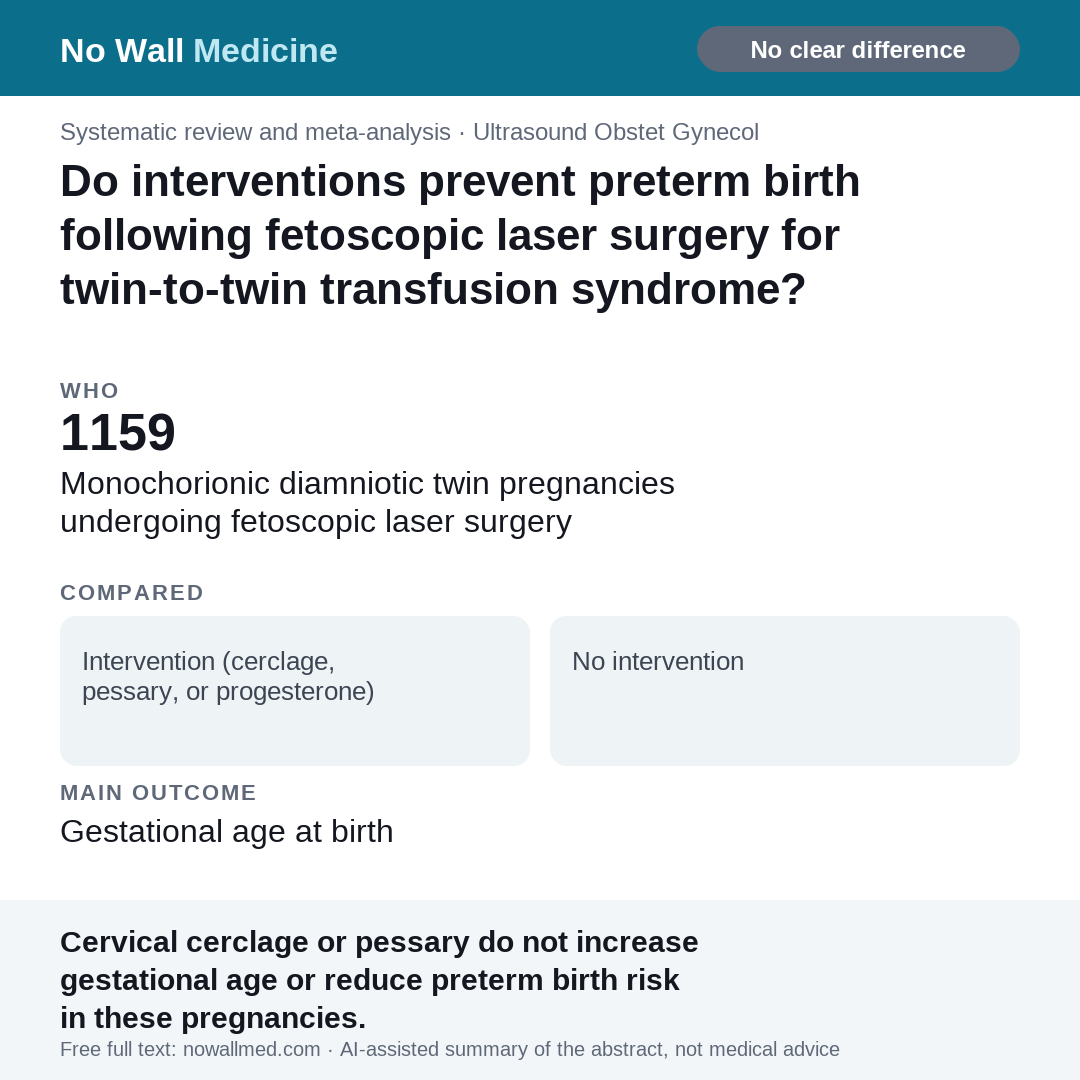
Do interventions prevent preterm birth following fetoscopic laser surgery for twin-to-twin transfusion syndrome?
Who
1159
Monochorionic diamniotic twin pregnancies undergoing fetoscopic laser surgery
Compared
Intervention (cerclage, pessary, or progesterone)
No intervention
Main outcome
Gestational age at birth
Bottom line: Cervical cerclage or pessary do not increase gestational age or reduce preterm birth risk in these pregnancies.
Limitation: Small sample sizes, lack of comparison, and lack of stratification in original publications.
Ultrasound Obstet Gynecol · 2025-06-05Download image
Clinical question: Do interventions prevent preterm birth following fetoscopic laser surgery for twin-to-twin transfusion syndrome?
Why it matters: It is unclear if interventions like cervical cerclage or pessaries can increase gestational age at birth for twin pregnancies undergoing laser surgery for twin-to-twin transfusion syndrome.
Key points
- Researchers analyzed 1159 pregnancies in ten studies to evaluate if cervical cerclage, cervical pessary, or vaginal progesterone affects preterm birth after laser surgery for twin-to-twin transfusion syndrome.
- Cervical cerclage was not associated with a difference in mean gestational age at birth, the interval between surgery and delivery, or the risk of fetal or perinatal loss.
- In women with a cervical length under 30 mm, cervical pessary was not associated with a reduced risk of preterm birth before 32, 28, or 24 weeks' gestation.
Limitation the authors note: The authors noted small sample sizes, a lack of comparison in original publications, and a lack of stratification according to Quintero stage, gestational age at surgery, and cervical length cut-offs.
Headline and key points written with AI from the paper’s abstract, with every number checked against it. Read the paper before relying on them.
Topics
Cite this article
Eltaweel N, D'Antonio F, Prasad S, Mustafa H, Khalil A. Interventions to prevent preterm birth following fetoscopic laser surgery for twin-to-twin transfusion syndrome: systematic review and meta-analysis. Ultrasound Obstet Gynecol. 2025. doi:10.1002/uog.29230
Spotted a mistake? Suggest a correction
Top studies every Monday
The week’s key trials and guidelines in your specialties, plus any topics you follow. By email, free.
Get the weekly digest