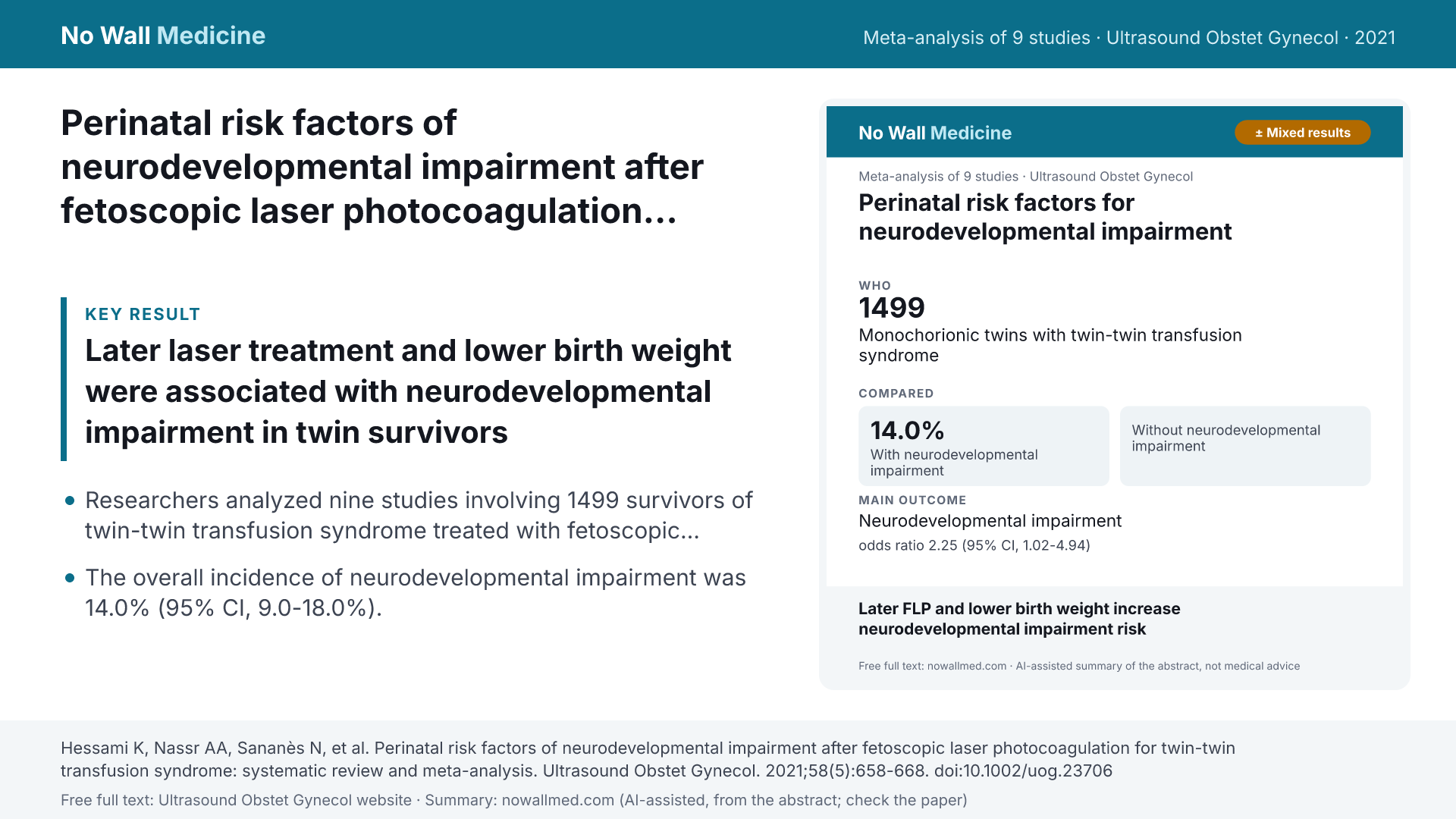
Later laser treatment and lower birth weight were associated with neurodevelopmental impairment in twin survivors
Perinatal risk factors of neurodevelopmental impairment after fetoscopic laser photocoagulation for twin-twin transfusion syndrome: systematic review and meta-analysis
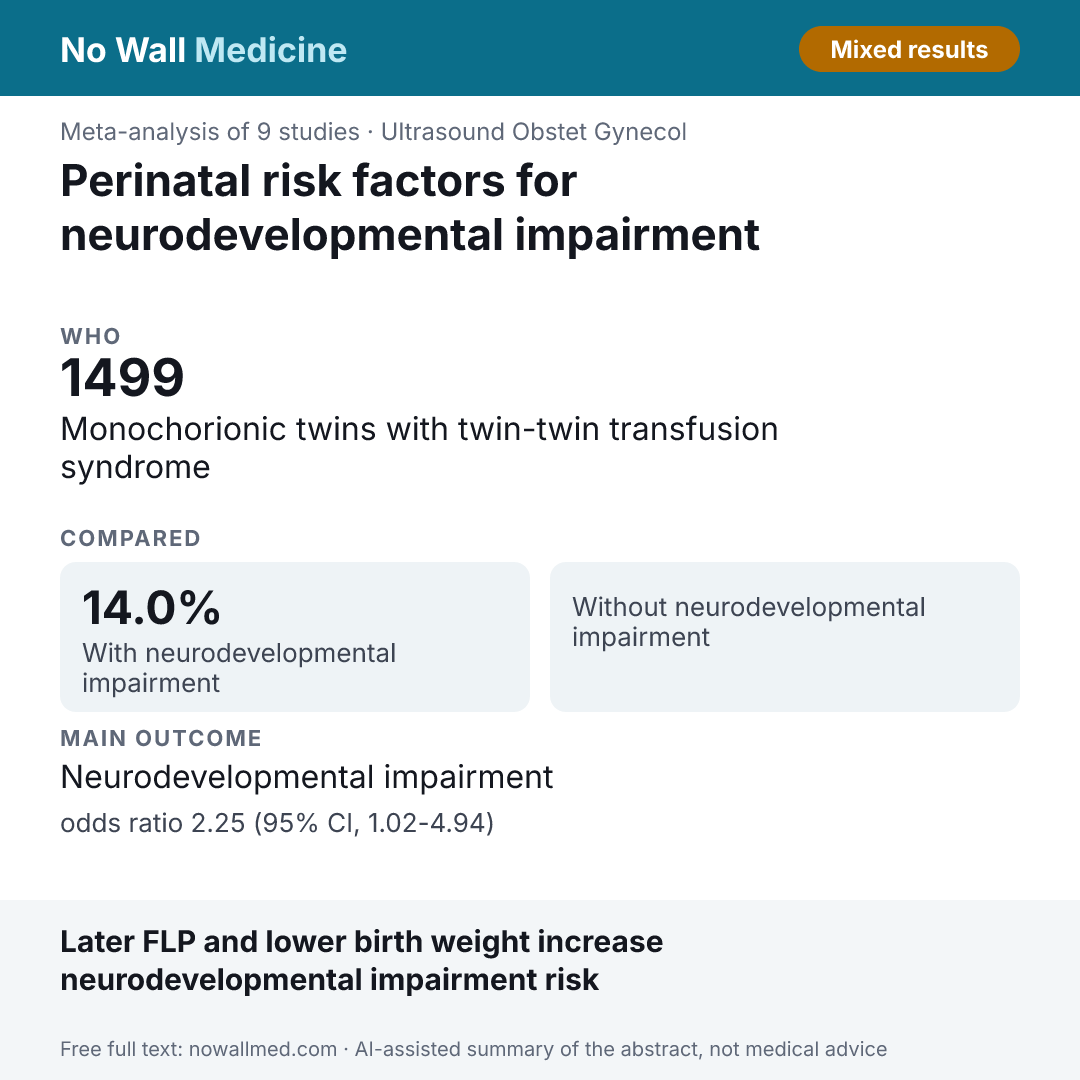
Meta-analysis of 9 studiesMixed results
Perinatal risk factors for neurodevelopmental impairment
Who
1499
Monochorionic twins with twin-twin transfusion syndrome
Compared
14.0%With neurodevelopmental impairment (95% CI, 9.0-18.0%)
Without neurodevelopmental impairment
Main outcome
Neurodevelopmental impairment
Result: odds ratio 2.25 (95% CI, 1.02-4.94)
Bottom line: Later FLP and lower birth weight increase neurodevelopmental impairment risk
Ultrasound Obstet Gynecol · 2021-06-08 · Save PNG
Key points
- Researchers analyzed nine studies involving 1499 survivors of twin-twin transfusion syndrome treated with fetoscopic laser photocoagulation, a procedure to treat shared blood vessel issues in twins.
- The overall incidence of neurodevelopmental impairment was 14.0% (95% CI, 9.0-18.0%).
- Neurodevelopmental impairment was associated with later gestational age at laser treatment, earlier gestational age at delivery, and lower birth weight.
Headline and key points written with AI from the paper’s abstract, with every number checked against it. Read the paper before relying on them.
Was this summary helpful?
Subject terms
Headline, design, result, key points, caveat and citation as plain text.
Cite this article
Hessami K, Nassr AA, Sananès N, et al. Perinatal risk factors of neurodevelopmental impairment after fetoscopic laser photocoagulation for twin-twin transfusion syndrome: systematic review and meta-analysis. Ultrasound Obstet Gynecol. 2021;58(5):658-668. doi:10.1002/uog.23706
Spotted a mistake? Suggest a correction