Vaccination and immunoglobulin reduce infection risk in patients with certain blood cancers
Interventions to reduce infections in patients with hematological malignancies: a systematic review and meta-analysis
Systematic review and meta-analysis of randomized controlled trialsMixed results
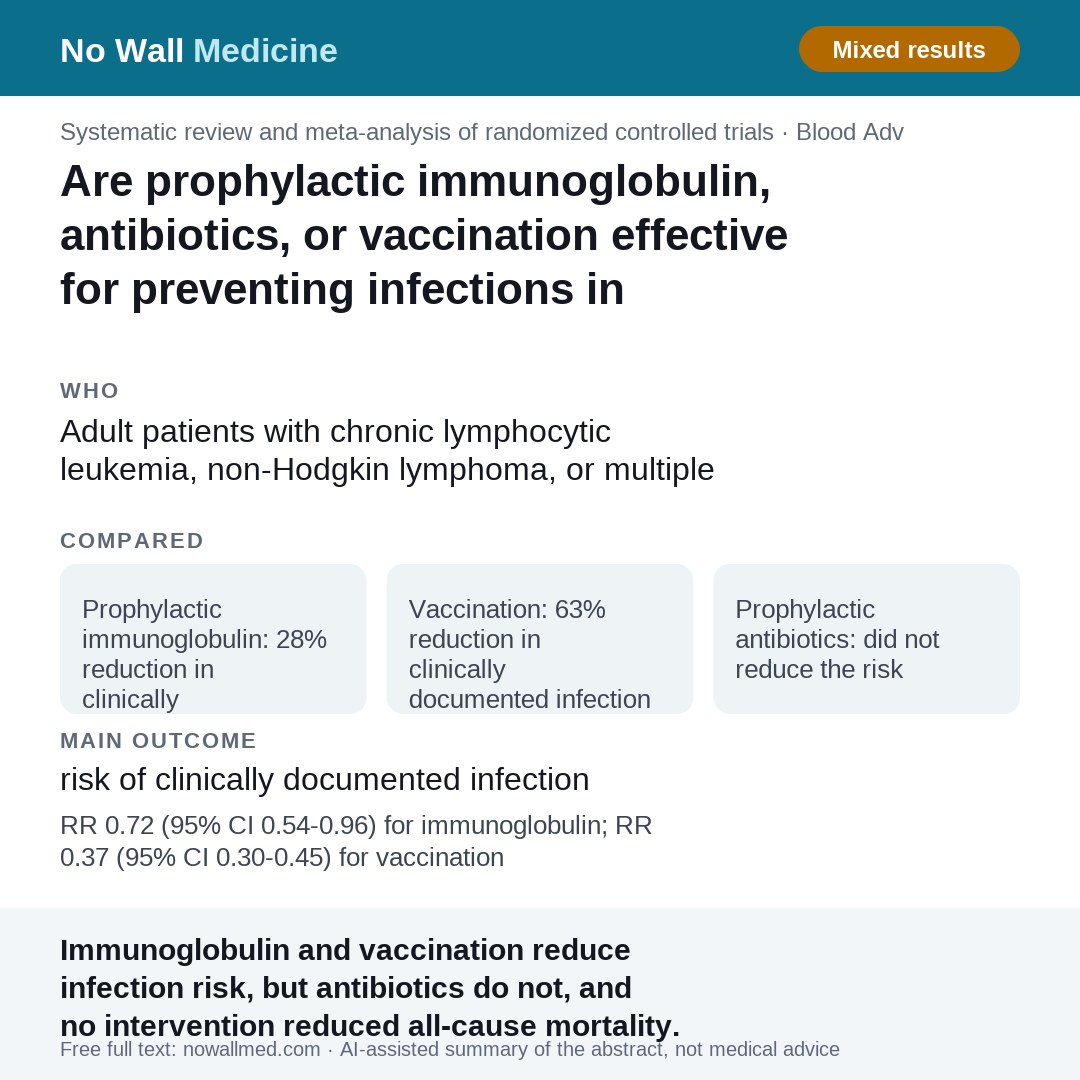
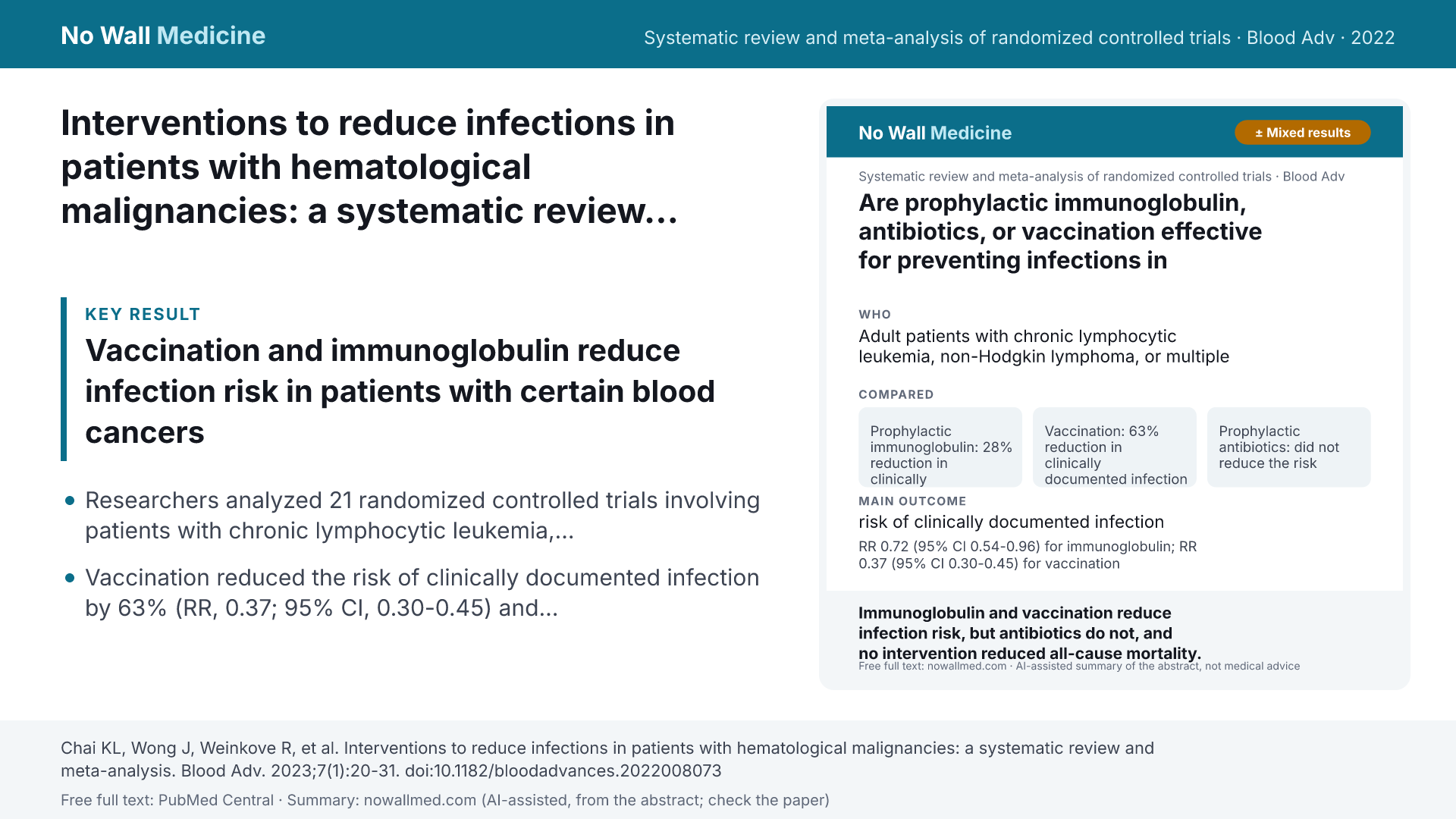
Are prophylactic immunoglobulin, antibiotics, or vaccination effective for preventing infections in hematological malignancies?
Who
Adult patients with chronic lymphocytic leukemia, non-Hodgkin lymphoma, or multiple myeloma
Compared
Prophylactic immunoglobulin: 28% reduction in clinically documented infection
Vaccination: 63% reduction in clinically documented infection
Prophylactic antibiotics: did not reduce the risk
Main outcome
risk of clinically documented infection
Result: RR 0.72 (95% CI 0.54-0.96) for immunoglobulin; RR 0.37 (95% CI 0.30-0.45) for vaccination
Bottom line: Immunoglobulin and vaccination reduce infection risk, but antibiotics do not, and no intervention reduced all-cause mortality.
Limitation: Findings should be interpreted with caution, given the high risk of bias in many studies.
Blood Adv · 2022-07-27Download image
Clinical question: Are prophylactic immunoglobulin, antibiotics, or vaccination effective for preventing infections in hematological malignancies?
Why it matters: It was unknown which approaches, such as immunoglobulin, antibiotics, or vaccination, are most effective for preventing infections in patients with acquired hypogammaglobulinemia.
Key points
- Researchers analyzed 21 randomized controlled trials involving patients with chronic lymphocytic leukemia, non-Hodgkin lymphoma, and multiple myeloma.
- Vaccination reduced the risk of clinically documented infection by 63% (RR, 0.37; 95% CI, 0.30-0.45) and prophylactic immunoglobulin reduced risk by 28% (RR, 0.72; 95% CI, 0.54-0.96).
- Prophylactic antibiotics did not reduce infection risk, and no intervention was linked to a reduction in all-cause mortality.
Limitation the authors note: Findings should be interpreted with caution because many of the included studies had a high risk of bias.
Headline and key points written with AI from the paper’s abstract, with every number checked against it. Read the paper before relying on them.
Was this summary helpful?
Abstract
Acquired hypogammaglobulinemia is common in chronic lymphocytic leukemia (CLL), non-Hodgkin lymphoma (NHL), and multiple myeloma (MM). No previous systematic reviews (SRs) have compared different approaches to infection prevention. We sought to assess the efficacy and safety of prophylactic immunoglobulin, antibiotics, and vaccination in these patients. We performed an SR and meta-analysis of randomized controlled trials (RCTs) evaluating the efficacy and safety of prophylactic immunoglobulin, antibiotics, and vaccination in adult patients with hematological malignancies commonly associated with acquired hypogammaglobulinemia, specifically, CLL, NHL, and MM. We searched PubMed (MEDLINE), EMBASE, and Cochrane Registry up to 9 January 2021. Results for dichotomous data were expressed as relative risk (RR) with 95% confidence interval (CI) and pooled in a random-effects model. This review was registered with PROSPERO CRD42017070825. From 10 576 studies screened, there were 21 completed RCTs and 1 ongoing. Of these, 8 evaluated prophylactic immunoglobulin (n = 370; 7 published before 2000), 5 evaluated prophylactic antibiotics (n = 1587), 7 evaluated vaccination (n = 3996), and 1 compared immunoglobulin to antibiotics (n = 60). Prophylactic immunoglobulin reduced the risk of clinically documented infection (CDI) by 28% (n = 2 trials; RR, 0.72; 95% CI, 0.54-0.96), and vaccination reduced the risk by 63% (RR, 0.37; 95% CI, 0.30-0.45). Prophylactic antibiotics did not reduce the risk. No intervention reduced all-cause mortality. Prophylactic immunoglobulin and antibiotics increased the risk of adverse events. Findings should be interpreted with caution, given the high risk of bias in many studies. There is a clear need for high-quality contemporary trials to establish the effectiveness of different approaches to preventing infection.
Abstract reproduced under the article’s CC BY NC ND licence.
Subject terms
Cite this article
Chai KL, Wong J, Weinkove R, et al. Interventions to reduce infections in patients with hematological malignancies: a systematic review and meta-analysis. Blood Adv. 2022. doi:10.1182/bloodadvances.2022008073
Spotted a mistake? Suggest a correction