Puberty suppression was linked to reduced bone density and changes in height for gender-diverse adolescents
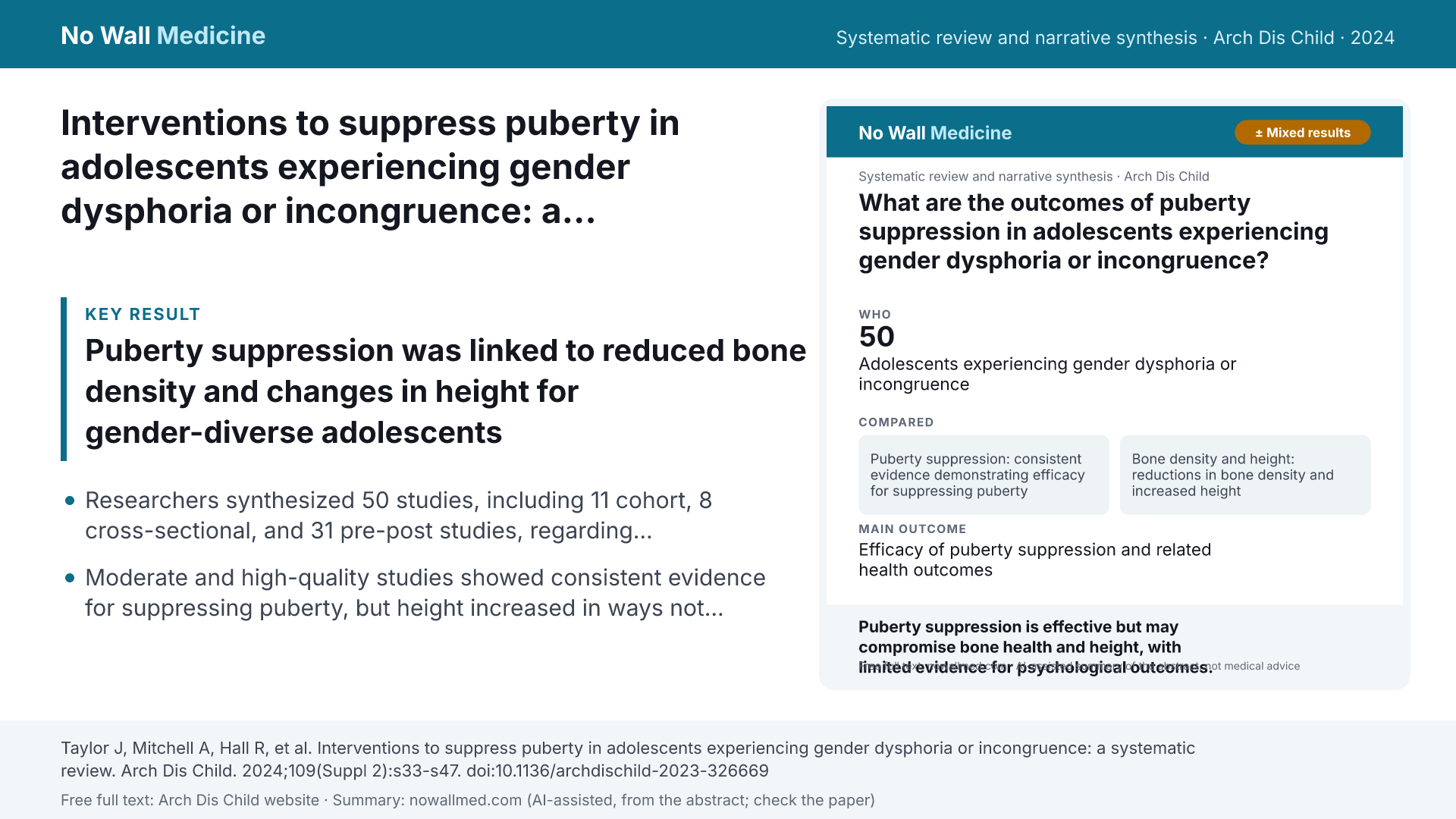
Interventions to suppress puberty in adolescents experiencing gender dysphoria or incongruence: a systematic review
Systematic review and narrative synthesisMixed results
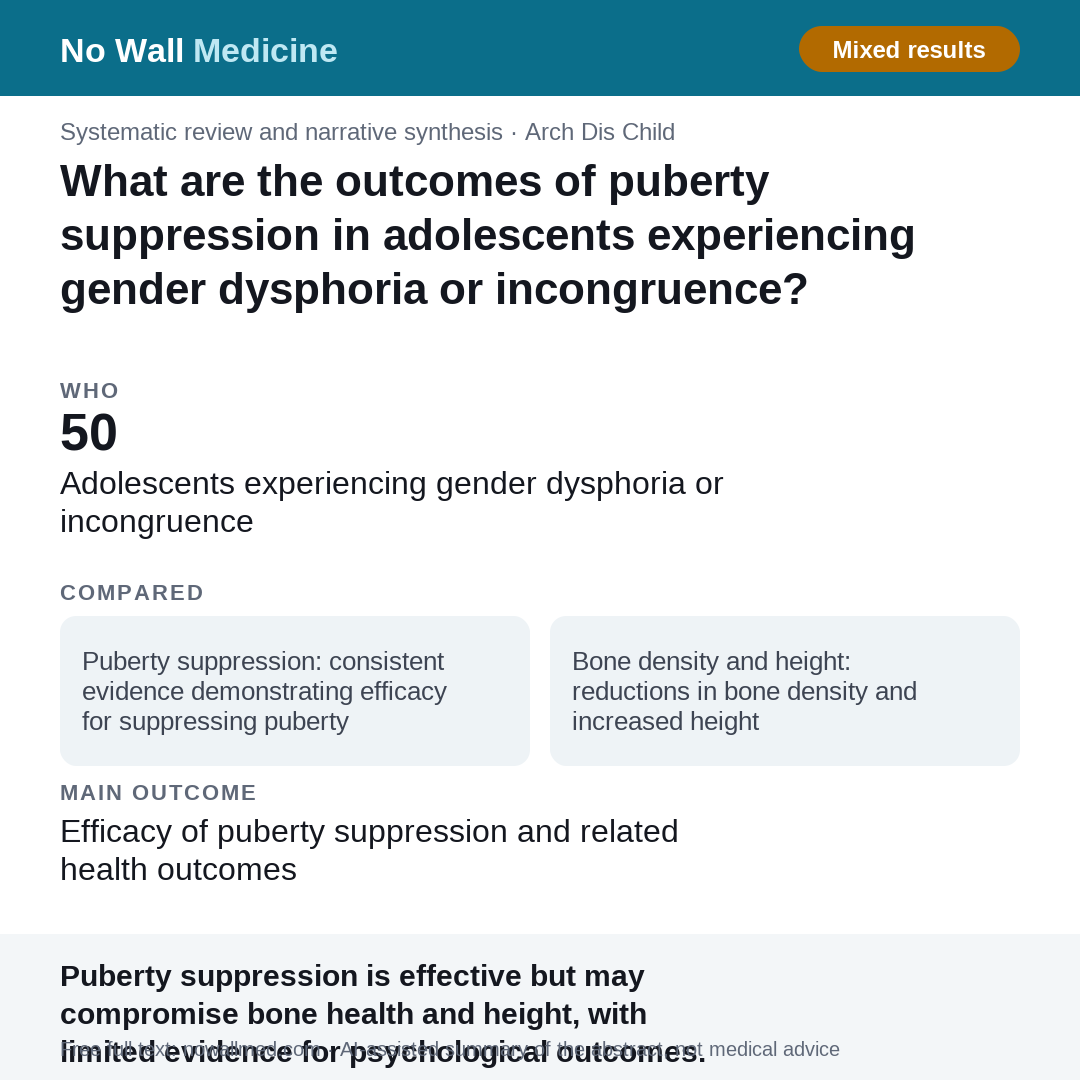
What are the outcomes of puberty suppression in adolescents experiencing gender dysphoria or incongruence?
Who
50
Adolescents experiencing gender dysphoria or incongruence
Compared
Puberty suppression: consistent evidence demonstrating efficacy for suppressing puberty
Bone density and height: reductions in bone density and increased height
Main outcome
Efficacy of puberty suppression and related health outcomes
Bottom line: Puberty suppression is effective but may compromise bone health and height, with limited evidence for psychological outcomes.
Limitation: Lack of high-quality research assessing various health and psychological impacts.
Arch Dis Child · 2024-10-30Download image
Clinical question: What are the outcomes of puberty suppression in adolescents experiencing gender dysphoria or incongruence?
Why it matters: Robust evidence concerning the risks and benefits of suppressing puberty in adolescents experiencing gender dysphoria or incongruence is lacking.
Key points
- Researchers synthesized 50 studies, including 11 cohort, 8 cross-sectional, and 31 pre-post studies, regarding puberty suppression in adolescents with gender dysphoria or incongruence.
- Moderate and high-quality studies showed consistent evidence for suppressing puberty, but height increased in ways not in line with expected growth.
- Multiple studies reported reductions in bone density during treatment, while evidence regarding mental health, fertility, and cognitive development remained limited or inconsistent.
Limitation the authors note: There is a lack of high-quality research assessing the impact of puberty suppression on gender dysphoria, mental health, or cognitive development.
Headline and key points written with AI from the paper’s abstract, with every number checked against it. Read the paper before relying on them.
Was this summary helpful?
Abstract
Background
Treatment to suppress or lessen effects of puberty are outlined in clinical guidelines for adolescents experiencing gender dysphoria/incongruence. Robust evidence concerning risks and benefits is lacking and there is a need to aggregate evidence as new studies are published. Aim
To identify and synthesise studies assessing the outcomes of puberty suppression in adolescents experiencing gender dysphoria/incongruence. Methods
A systematic review and narrative synthesis. Database searches (Medline, Embase, CINAHL, PsycINFO, Web of Science) were performed in April 2022, with results assessed independently by two reviewers. An adapted version of the Newcastle-Ottawa Scale for cohort studies was used to appraise study quality. Only moderate-quality and high-quality studies were synthesised. The Preferred Reporting Items for Systematic Reviews and Meta-Analyses reporting guidelines were used. Results
11 cohort, 8 cross-sectional and 31 pre-post studies were included (n=50). One cross-sectional study was high quality, 25 studies were moderate quality (including 5 cohort studies) and 24 were low quality. Synthesis of moderate-quality and high-quality studies showed consistent evidence demonstrating efficacy for suppressing puberty. Height increased in multiple studies, although not in line with expected growth. Multiple studies reported reductions in bone density during treatment. Limited and/or inconsistent evidence was found in relation to gender dysphoria, psychological and psychosocial health, body satisfaction, cardiometabolic risk, cognitive development and fertility. Conclusions
There is a lack of high-quality research assessing puberty suppression in adolescents experiencing gender dysphoria/incongruence. No conclusions can be drawn about the impact on gender dysphoria, mental and psychosocial health or cognitive development. Bone health and height may be compromised during treatment. More recent studies published since April 2022 until January 2024 also support the conclusions of this review. Prospero registration number
CRD42021289659.
Abstract reproduced under the article’s CC BY NC licence.
Subject terms
Cite this article
Taylor J, Mitchell A, Hall R, et al. Interventions to suppress puberty in adolescents experiencing gender dysphoria or incongruence: a systematic review. Arch Dis Child. 2024. doi:10.1136/archdischild-2023-326669
Spotted a mistake? Suggest a correction