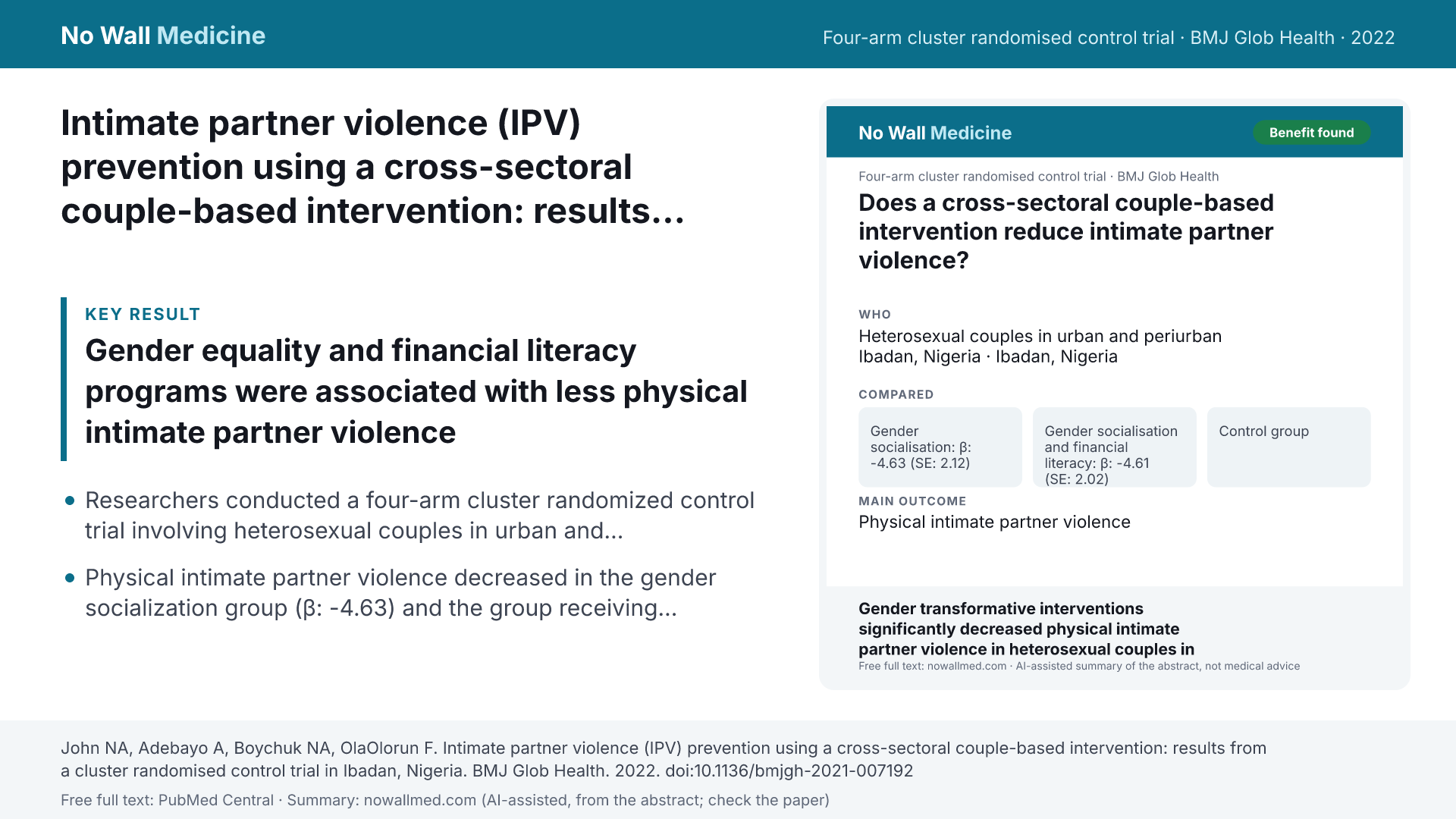
Gender equality and financial literacy programs were associated with less physical intimate partner violence
Intimate partner violence (IPV) prevention using a cross-sectoral couple-based intervention: results from a cluster randomised control trial in Ibadan, Nigeria
Four-arm cluster randomised control trialBenefit found
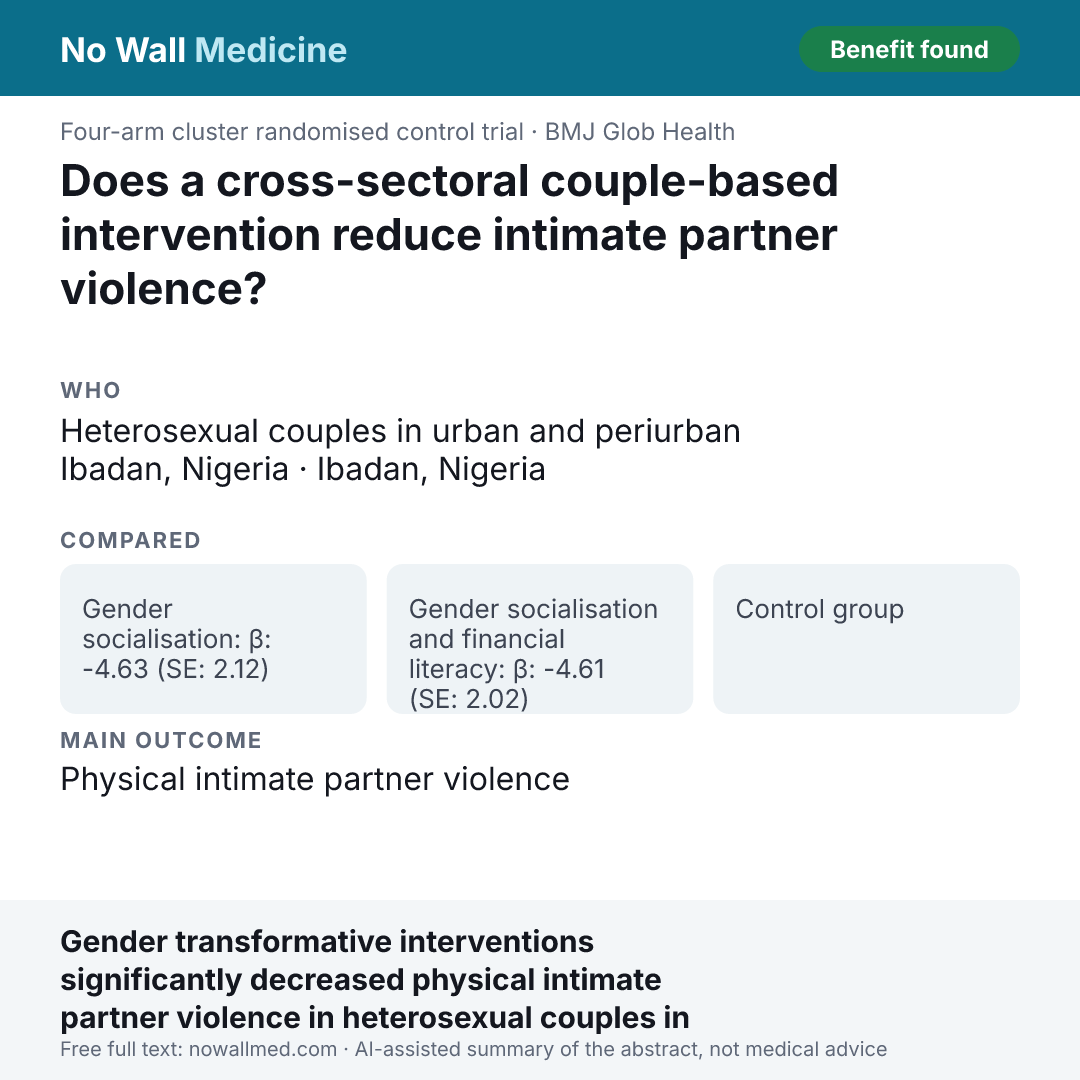
Does a cross-sectoral couple-based intervention reduce intimate partner violence?
Who
Heterosexual couples in urban and periurban Ibadan, Nigeria · Ibadan, Nigeria
Compared
Gender socialisation: β: -4.63 (SE: 2.12)
Gender socialisation and financial literacy: β: -4.61 (SE: 2.02)
Control group
Main outcome
Physical intimate partner violence
Bottom line: Gender transformative interventions significantly decreased physical intimate partner violence in heterosexual couples in Nigeria.
BMJ Glob Health · 2022-02-10 · Save PNG
Clinical question: Does a cross-sectoral couple-based intervention reduce intimate partner violence?
Key points
- Researchers conducted a four-arm cluster randomized control trial involving heterosexual couples in urban and periurban Ibadan, Nigeria.
- Physical intimate partner violence decreased in the gender socialization group (β: -4.63) and the group receiving both gender socialization and financial literacy (β: -4.61) compared to the control group.
- The intervention did not have an impact on non-physical forms of violence, as changes in emotional and sexual intimate partner violence were marginally significant or insignificant.
Headline and key points written with AI from the paper’s abstract, with every number checked against it. Read the paper before relying on them.
Was this summary helpful?
Abstract
Introduction
Intimate partner violence (IPV) is the most common form of violence women experience globally. Economic empowerment interventions have been implemented across countries to prevent and address IPV, with mixed results. A sociological 'male-backlash' model suggests that addressing unequal gender norms is crucial to reduce IPV. This study evaluates the impact of a multipronged intervention among heterosexual couples in urban and periurban Ibadan that aimed at reducing IPV by increasing financial and reproductive literacy, fostering gender equality and improving relationship quality. Methods
A four-arm mixed-methods cluster randomised control trial was employed. Baseline data and end line data six months postintervention were collected to estimate changes in key outcomes. In-depth interviews were conducted with 15 couples 2 years postintervention to explore the drivers of changes in outcomes. Difference-in-differences regression models were estimated to compare changes in IPV levels across the three intervention arms and control arm, and thematic analysis was conducted to understand drivers of change in IPV outcomes. Results
Physical IPV decreased significantly in the gender socialisation (GS) (β: -4.63 (SE: 2.12)) and GS and financial literacy (β: -4.61 (SE: 2.02)) groups as compared with the control group. Changes in emotional and sexual IPV were marginally significant or insignificant, respectively, suggesting that the intervention did not have an impact on non-physical forms of IPV. In the in-depth interviews, couples reported improved communication and trust, enhanced conflict management skills, and increased mutual respect as a result of participation across intervention arms, which may have facilitated the reduction of violence in their relationships. Conclusion
This study highlights the potential utility of gender transformative interventions for improving physical IPV outcomes. Future research should seek to understand the mechanisms that influence sexual and emotional IPV as their aetiology may be different from physical violence. Trail registration number
The study protocol was registered at ClinicalTrials.gov (ID: NCT03888495).
Abstract reproduced under the article’s CC BY licence.
Subject terms
Headline, design, result, key points, caveat and citation as plain text.
Cite this article
John NA, Adebayo A, Boychuk NA, OlaOlorun F. Intimate partner violence (IPV) prevention using a cross-sectoral couple-based intervention: results from a cluster randomised control trial in Ibadan, Nigeria. BMJ Glob Health. 2022. doi:10.1136/bmjgh-2021-007192
Spotted a mistake? Suggest a correction