Sperm morphology does not help identify couples who benefit more from ICSI over conventional IVF
Intracytoplasmic sperm injection versus conventional in vitro fertilization in infertile couples with normal total sperm count and motility: does sperm morphology matter?
Secondary analysis of an open-label, multi-centre, randomized clinical trialNo clear difference
Can sperm morphology identify couples benefiting more from ICSI over conventional in vitro fertilization?
Who
1064
Infertile couples with normal total sperm count and motility · multi-centre
Compared
34.6%intracytoplasmic sperm injection (184/532)
31.2%conventional in vitro fertilization (166/532)
Main outcome
live birth rate
Bottom line: Sperm morphology has limited value as a biomarker to identify couples benefiting more from intracytoplasmic sperm injection over conventional in vitro fertilization.
Limitation: May be underpowered to detect differences at certain sperm morphology levels due to small number of events.
Funded by: My Duc Hospital, Ho Chi Minh City, Vietnam
Hum Reprod · 2024-11-16Download image
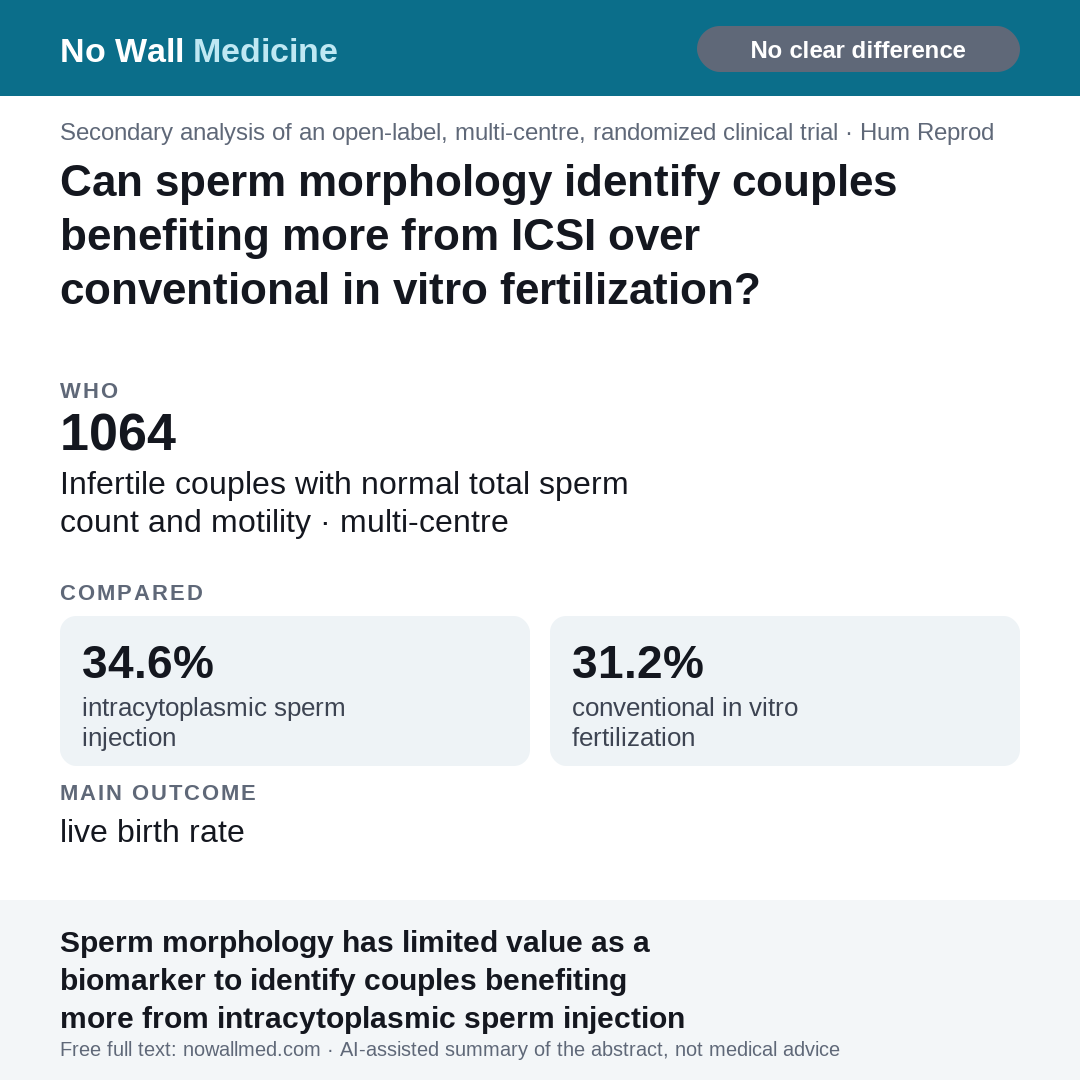
Clinical question: Can sperm morphology identify couples benefiting more from ICSI over conventional in vitro fertilization?
Why it matters: It was unclear whether sperm morphology could serve as a biomarker to identify which couples with normal sperm count and motility might benefit more from ICSI than conventional IVF.
Key points
- Researchers analyzed 1064 couples with infertility and normal total sperm count and motility to compare intracytoplasmic sperm injection (ICSI) and conventional in vitro fertilization (c-IVF).
- The live birth rate was 34.6% for ICSI versus 31.2% for c-IVF, but no significant interaction was found between sperm morphology and treatment effects for any primary outcome.
- The median proportion of sperm with normal morphology in both groups was 3% (Interquartile range 1-6%).
Limitation the authors note: This secondary analysis may be underpowered to detect a difference in treatment effects at different sperm morphology levels due to a relatively small number of events at some levels.
Headline and key points written with AI from the paper’s abstract, with every number checked against it. Read the paper before relying on them.
Topics
Cite this article
Pham TD, Dang VQ, Ho VNA, Tran CT, Nguyen DTP, Vuong LN. Intracytoplasmic sperm injection versus conventional in vitro fertilization in infertile couples with normal total sperm count and motility: does sperm morphology matter?. Hum Reprod. 2024. doi:10.1093/humrep/deae252
Spotted a mistake? Suggest a correction
Top studies every Monday
The week’s key trials and guidelines in your specialties, by email. Free.
Get the weekly digest