Intralymphatic GAD-Alum (Diamyd®) Improves Glycemic Control in Type 1 Diabetes With HLA DR3-DQ2
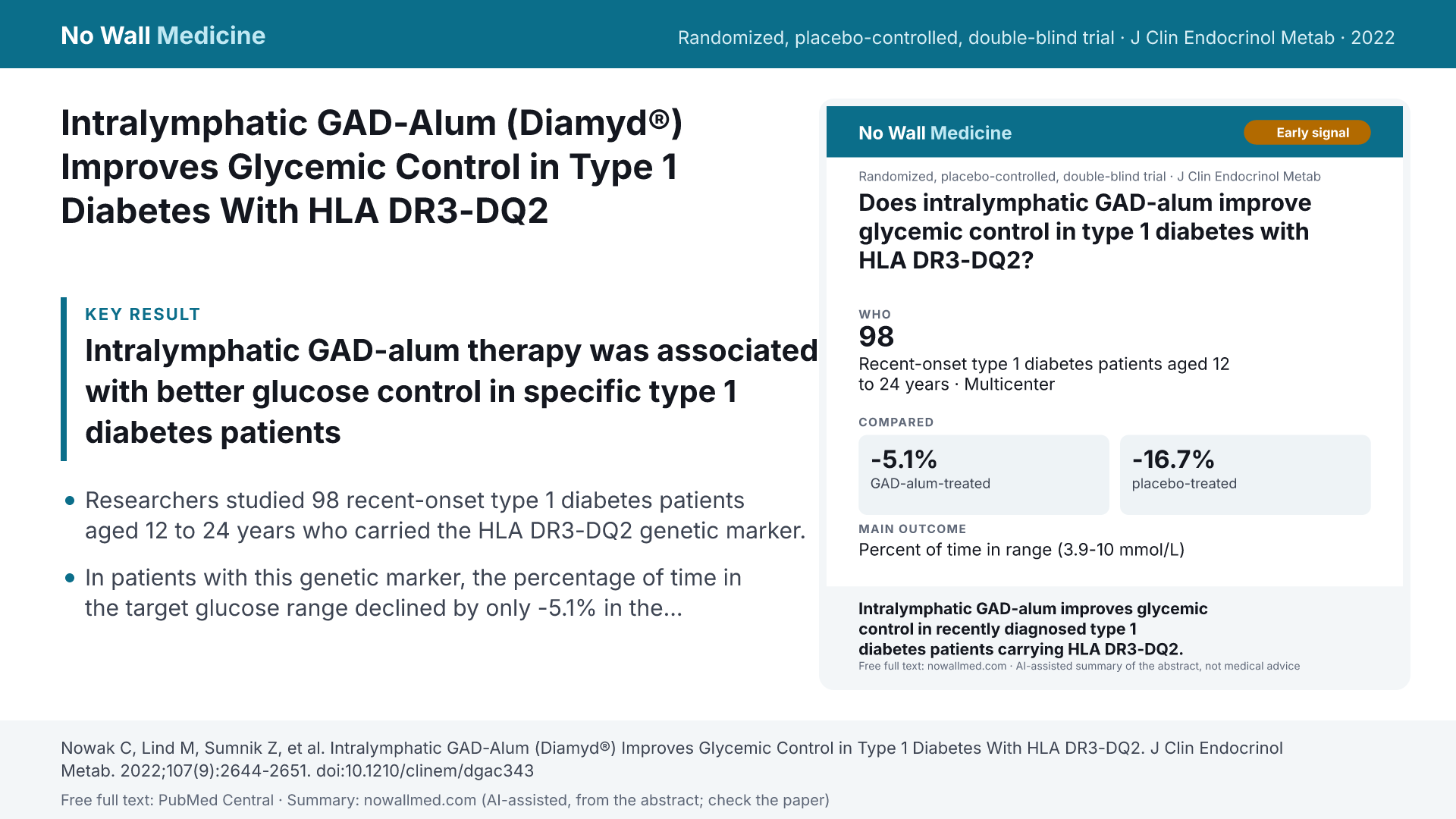
Key result: Intralymphatic GAD-alum therapy was associated with better glucose control in specific type 1 diabetes patients
Randomized, placebo-controlled, double-blind trialEarly signal
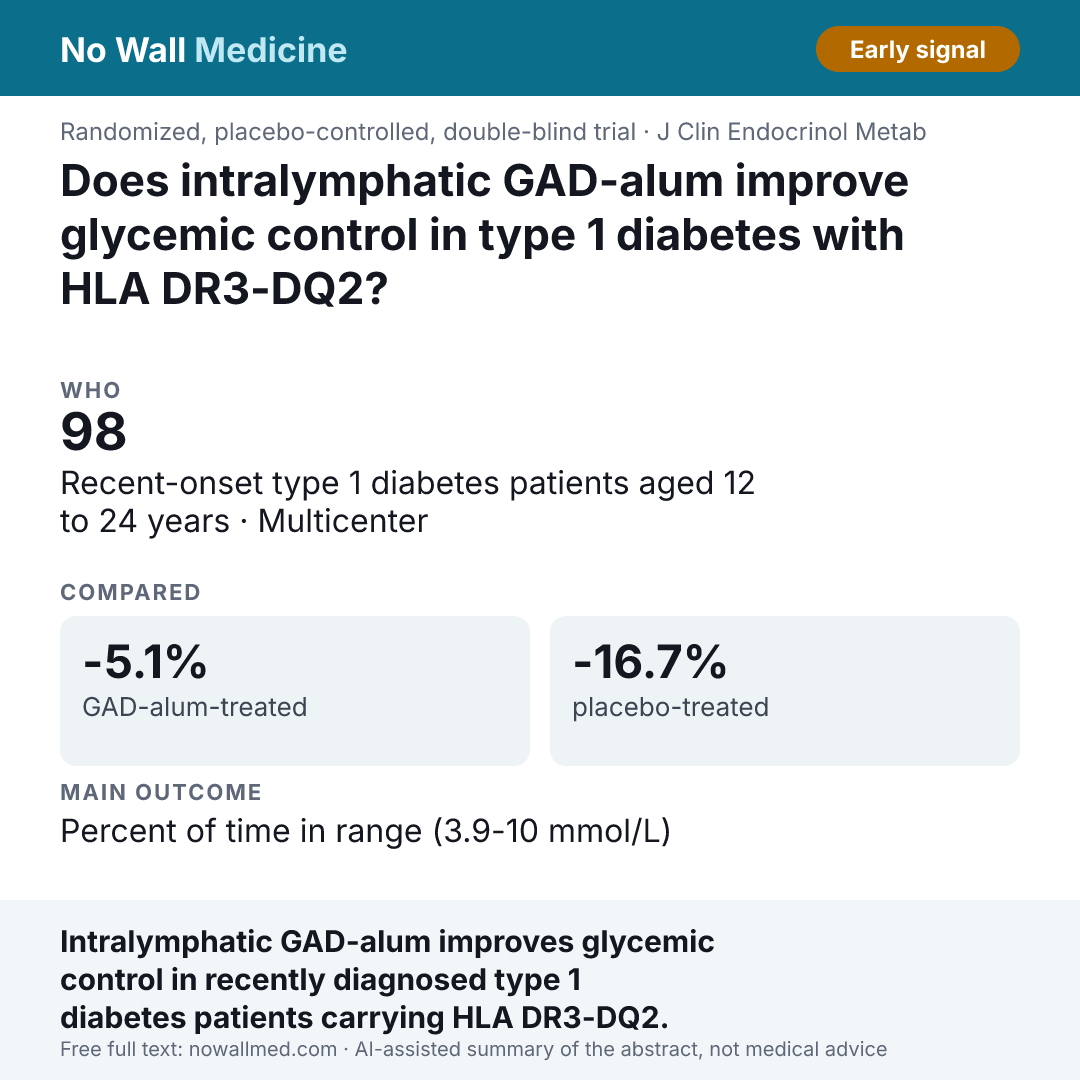
Does intralymphatic GAD-alum improve glycemic control in type 1 diabetes with HLA DR3-DQ2?
Who
98
Recent-onset type 1 diabetes patients aged 12 to 24 years · Multicenter
Compared
-5.1%GAD-alum-treated
-16.7%placebo-treated
Main outcome
Percent of time in range (3.9-10 mmol/L)
Bottom line: Intralymphatic GAD-alum improves glycemic control in recently diagnosed type 1 diabetes patients carrying HLA DR3-DQ2.
J Clin Endocrinol Metab · 2022-06-07 · Save PNG
Key points
- Researchers studied 98 recent-onset type 1 diabetes patients aged 12 to 24 years who carried the HLA DR3-DQ2 genetic marker.
- In patients with this genetic marker, the percentage of time in the target glucose range declined by only -5.1% in the GAD-alum group compared to -16.7% in the placebo group.
- The treatment was associated with reduced time spent with blood glucose above 13.9 mmol/L and a lower increase in glucose variability.
Discussion prompts
- Would these patients look like yours? Who was left out?
- Is the main outcome one that matters to patients?
- Is the difference large enough to change what you do?
Cite: Nowak C, Lind M, Sumnik Z, et al. Intralymphatic GAD-Alum (Diamyd®) Improves Glycemic Control in Type 1 Diabetes With HLA DR3-DQ2. J Clin Endocrinol Metab. 2022;107(9):2644-2651. doi:10.1210/clinem/dgac343
Free full text: PubMed Central · Summary and visual abstract: nowallmed.com/a/intralymphatic-gad-alum-diamyd-improves-glycemic-control-in-type-1-1ym2bgz/ (AI-assisted from the abstract; check the paper before relying on it).