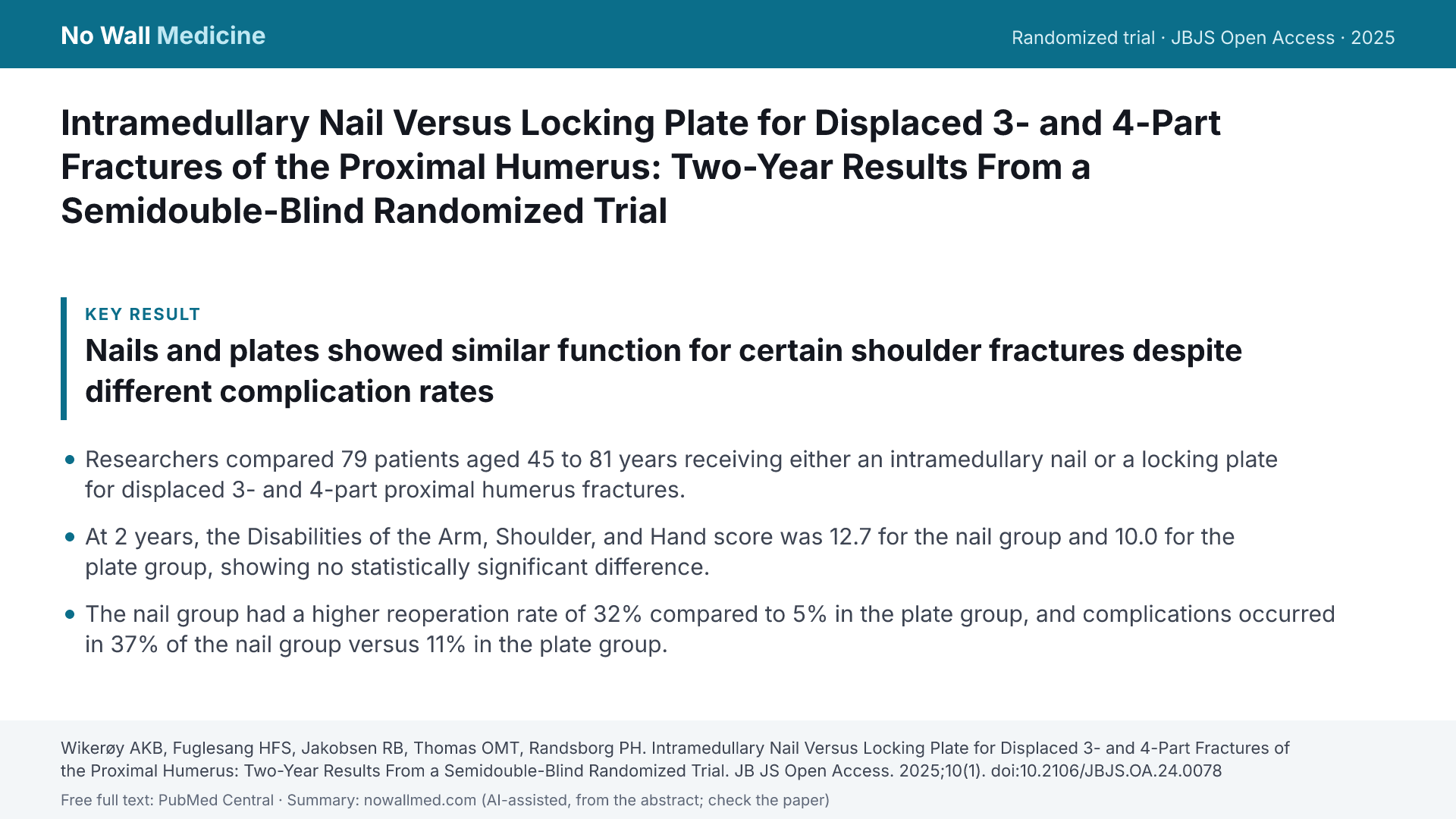
Nails and plates showed similar function for certain shoulder fractures despite different complication rates
Intramedullary Nail Versus Locking Plate for Displaced 3- and 4-Part Fractures of the Proximal Humerus: Two-Year Results From a Semidouble-Blind Randomized Trial
Why it matters: It is unknown whether intramedullary nails or locking plates provide better clinical and radiographic outcomes for displaced 3- and 4-part proximal humerus fractures.
Key points
- Researchers compared 79 patients aged 45 to 81 years receiving either an intramedullary nail or a locking plate for displaced 3- and 4-part proximal humerus fractures.
- At 2 years, the Disabilities of the Arm, Shoulder, and Hand score was 12.7 for the nail group and 10.0 for the plate group, showing no statistically significant difference.
- The nail group had a higher reoperation rate of 32% compared to 5% in the plate group, and complications occurred in 37% of the nail group versus 11% in the plate group.
Headline and key points written with AI from the paper’s abstract, with every number checked against it. Read the paper before relying on them.
Was this summary helpful?
Cite this article
Wikerøy AKB, Fuglesang HFS, Jakobsen RB, Thomas OMT, Randsborg PH. Intramedullary Nail Versus Locking Plate for Displaced 3- and 4-Part Fractures of the Proximal Humerus: Two-Year Results From a Semidouble-Blind Randomized Trial. JBJS Open Access. 2025. doi:10.2106/JBJS.OA.24.0078
Spotted a mistake? Suggest a correction
Top studies every Monday
The week’s key trials and guidelines in your specialties, plus any topics you follow. By email, free.
Get the weekly digest