Intramedullary Nail Versus Locking Plate for Displaced 3- and 4-Part Fractures of the Proximal Humerus: Two-Year Results From a Semidouble-Blind Randomized Trial
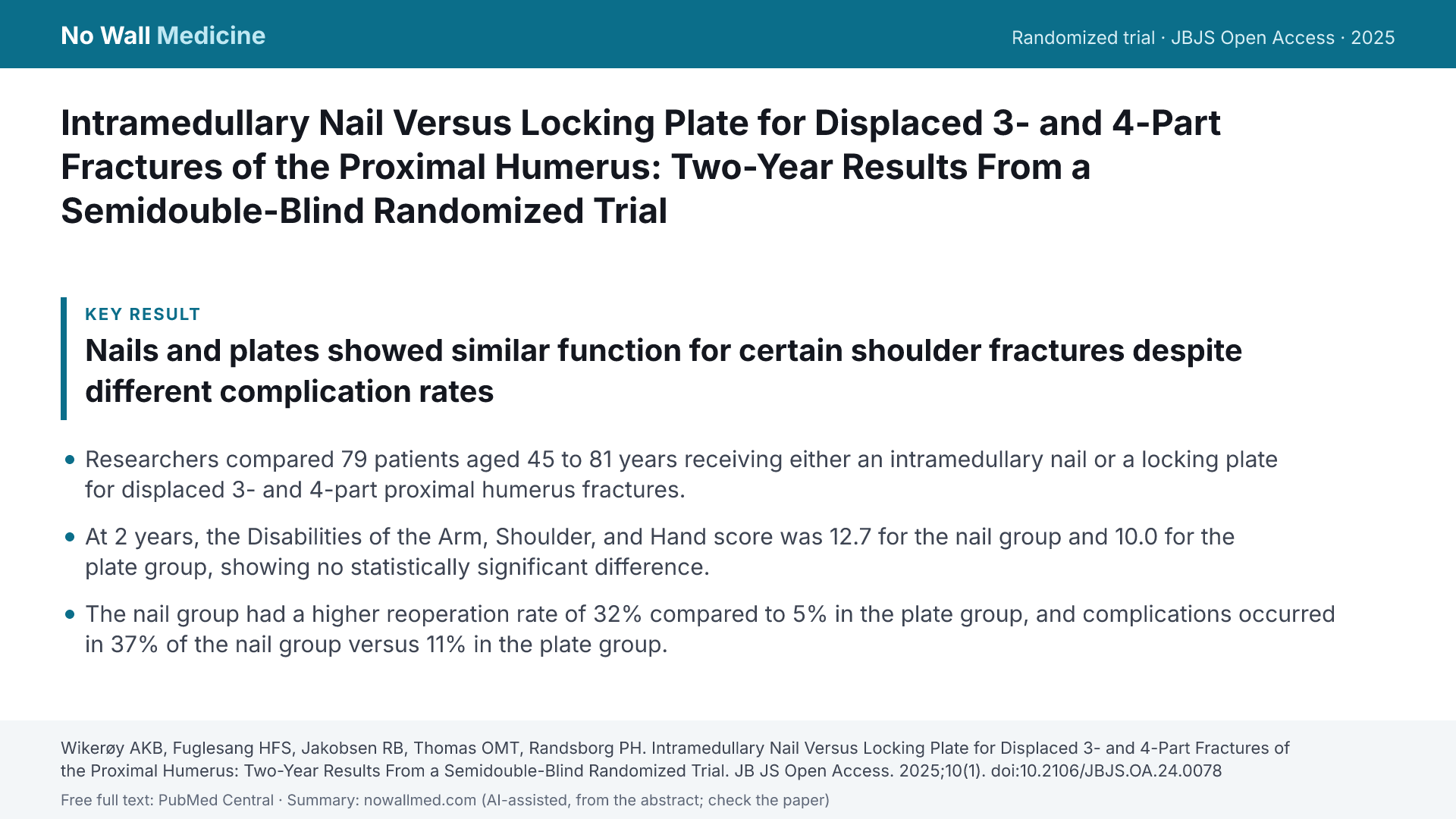
Key result: Nails and plates showed similar function for certain shoulder fractures despite different complication rates
Key points
- Researchers compared 79 patients aged 45 to 81 years receiving either an intramedullary nail or a locking plate for displaced 3- and 4-part proximal humerus fractures.
- At 2 years, the Disabilities of the Arm, Shoulder, and Hand score was 12.7 for the nail group and 10.0 for the plate group, showing no statistically significant difference.
- The nail group had a higher reoperation rate of 32% compared to 5% in the plate group, and complications occurred in 37% of the nail group versus 11% in the plate group.
Discussion prompts
- Would these patients look like yours? Who was left out?
- Is the main outcome one that matters to patients?
- Is the difference large enough to change what you do?
Cite: Wikerøy AKB, Fuglesang HFS, Jakobsen RB, Thomas OMT, Randsborg PH. Intramedullary Nail Versus Locking Plate for Displaced 3- and 4-Part Fractures of the Proximal Humerus: Two-Year Results From a Semidouble-Blind Randomized Trial. JB JS Open Access. 2025;10(1). doi:10.2106/JBJS.OA.24.0078
Free full text: PubMed Central · Summary and visual abstract: nowallmed.com/a/intramedullary-nail-versus-locking-plate-for-displaced-3-and-4-part-w0apw8/ (AI-assisted from the abstract; check the paper before relying on it).