Intranasal kisspeptin administration rapidly stimulates gonadotropin release in healthy people and patients
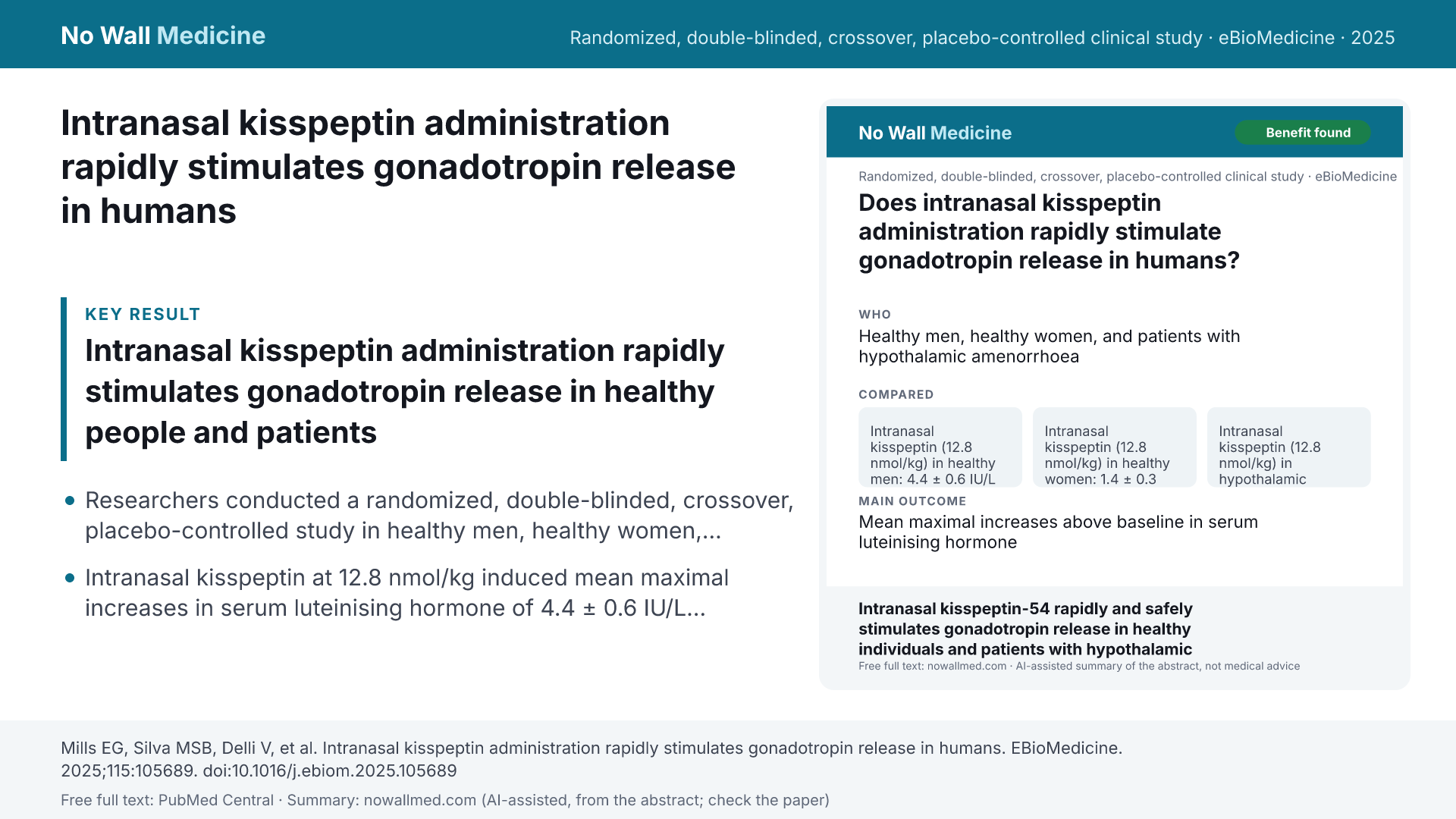
Intranasal kisspeptin administration rapidly stimulates gonadotropin release in humans
Randomized, double-blinded, crossover, placebo-controlled clinical studyBenefit found
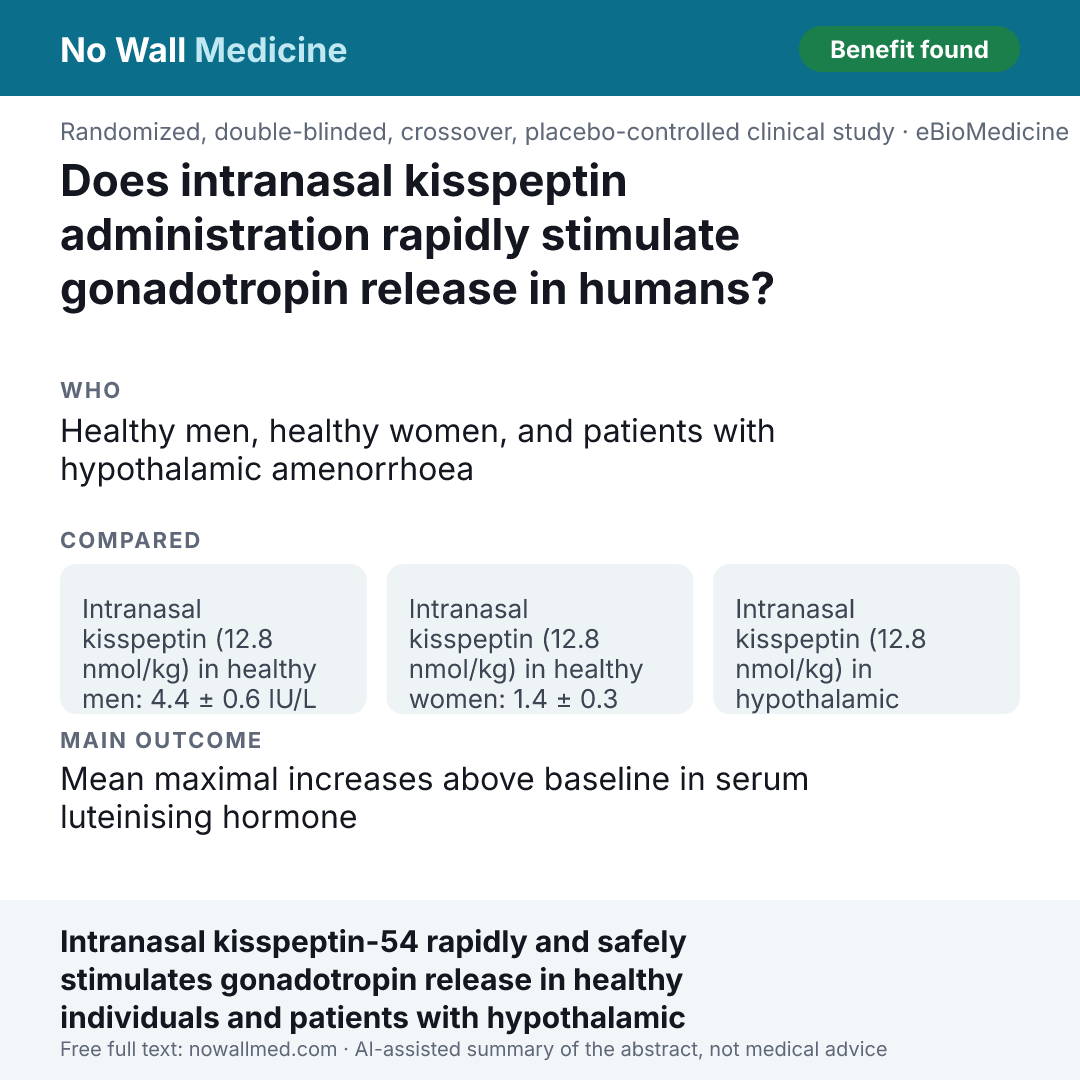
Does intranasal kisspeptin administration rapidly stimulate gonadotropin release in humans?
Who
Healthy men, healthy women, and patients with hypothalamic amenorrhoea
Compared
Intranasal kisspeptin (12.8 nmol/kg) in healthy men: 4.4 ± 0.6 IU/L
Intranasal kisspeptin (12.8 nmol/kg) in healthy women: 1.4 ± 0.3 IU/L
Intranasal kisspeptin (12.8 nmol/kg) in hypothalamic amenorrhoea: 4.4 ± 0.2 IU/L
Main outcome
Mean maximal increases above baseline in serum luteinising hormone
Bottom line: Intranasal kisspeptin-54 rapidly and safely stimulates gonadotropin release in healthy individuals and patients with hypothalamic amenorrhoea.
Funded by: NIHR, Imperial Biomedical Research Centre, Medical Research Council
eBioMedicine · 2025-04-11 · Save PNG
Clinical question: Does intranasal kisspeptin administration rapidly stimulate gonadotropin release in humans?
Why it matters: Intravenous or subcutaneous routes for kisspeptin administration are invasive and may limit patient acceptability and clinical use for treating reproductive disorders.
Key points
- Researchers conducted a randomized, double-blinded, crossover, placebo-controlled study in healthy men, healthy women, and patients with hypothalamic amenorrhoea.
- Intranasal kisspeptin at 12.8 nmol/kg induced mean maximal increases in serum luteinising hormone of 4.4 ± 0.6 IU/L in men, 1.4 ± 0.3 IU/L in women, and 4.4 ± 0.2 IU/L in patients.
- The nasal spray was stable for up to 60 days at 4 °C and no side effects or adverse events were encountered.
Headline and key points written with AI from the paper’s abstract, with every number checked against it. Read the paper before relying on them.
Was this summary helpful?
Subject terms
Headline, design, result, key points, caveat and citation as plain text.
Cite this article
Mills EG, Silva MSB, Delli V, et al. Intranasal kisspeptin administration rapidly stimulates gonadotropin release in humans. EBioMedicine. 2025;115:105689. doi:10.1016/j.ebiom.2025.105689
Spotted a mistake? Suggest a correction