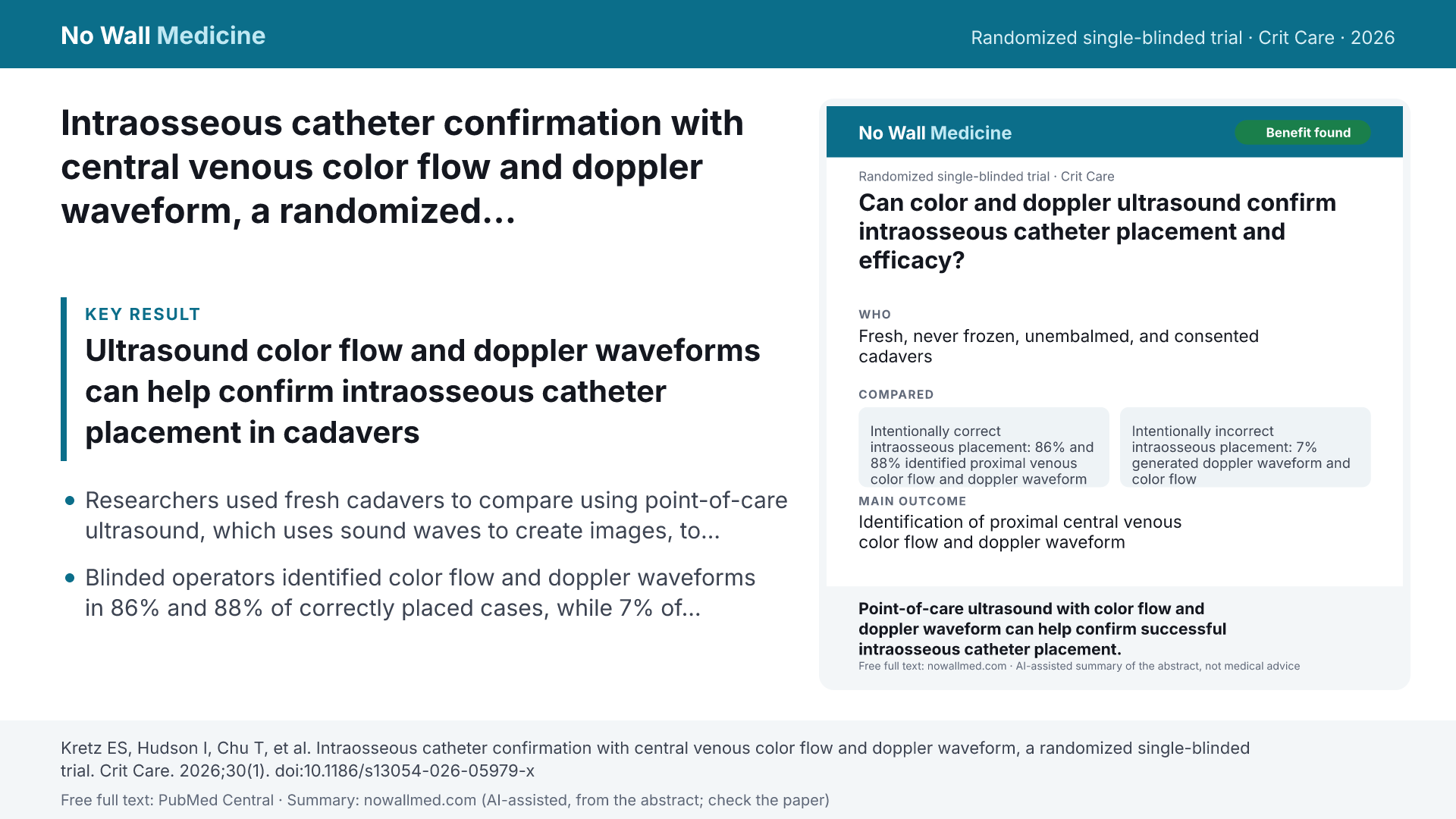
Ultrasound color flow and doppler waveforms can help confirm intraosseous catheter placement in cadavers
Intraosseous catheter confirmation with central venous color flow and doppler waveform, a randomized single-blinded trial
Randomized single-blinded trialBenefit found
Can color and doppler ultrasound confirm intraosseous catheter placement and efficacy?
Who
Fresh, never frozen, unembalmed, and consented cadavers
Compared
Intentionally correct intraosseous placement: 86% and 88% identified proximal venous color flow and doppler waveform
Intentionally incorrect intraosseous placement: 7% generated doppler waveform and color flow
Main outcome
Identification of proximal central venous color flow and doppler waveform
Bottom line: Point-of-care ultrasound with color flow and doppler waveform can help confirm successful intraosseous catheter placement.
Crit Care · 2026-04-07 · Save PNG
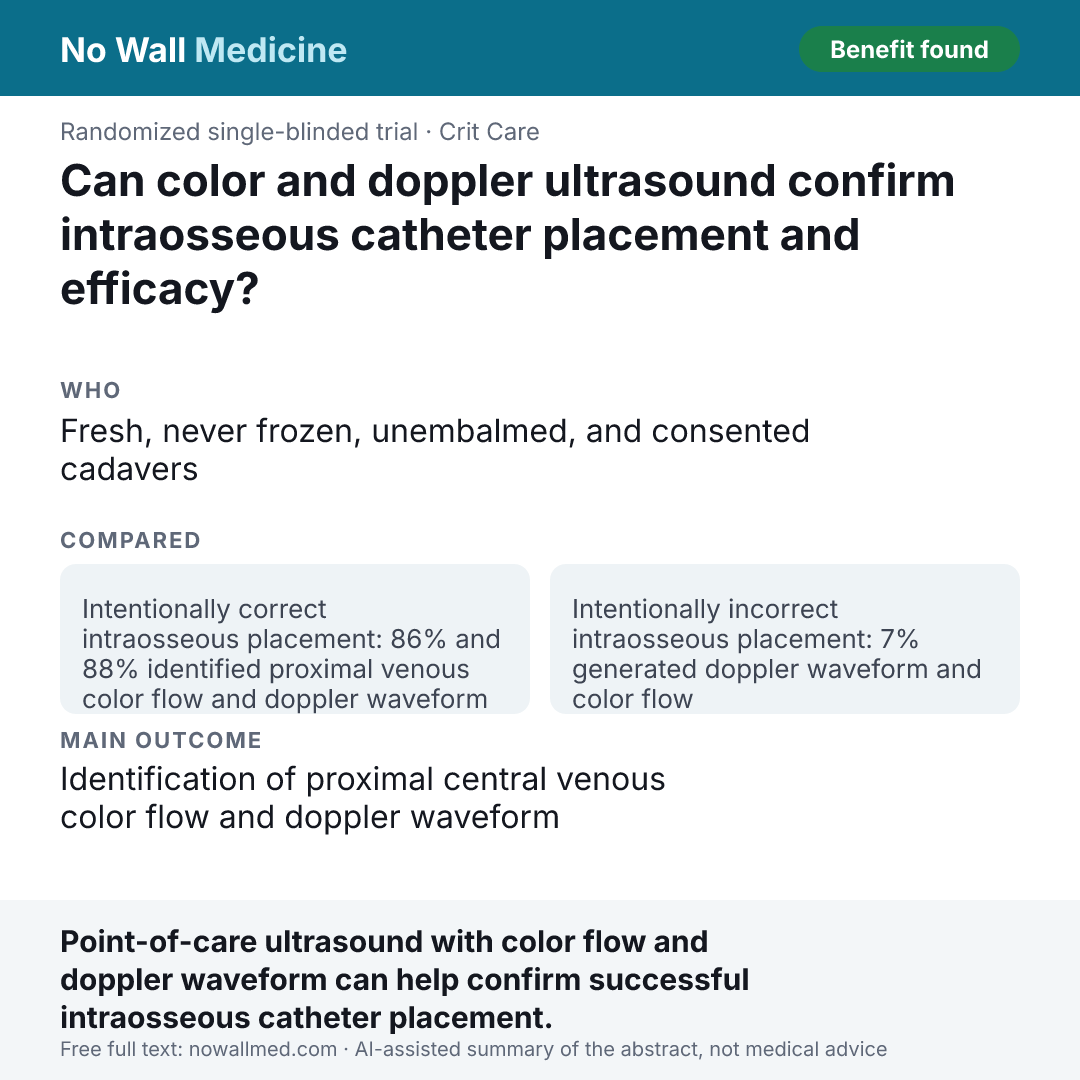
Clinical question: Can color and doppler ultrasound confirm intraosseous catheter placement and efficacy?
Why it matters: Current methods for confirming that an intraosseous catheter is correctly placed and functioning lack objectivity and do not use modern technology.
Key points
- Researchers used fresh cadavers to compare using point-of-care ultrasound, which uses sound waves to create images, to confirm correct versus incorrect intraosseous catheter placement.
- Blinded operators identified color flow and doppler waveforms in 86% and 88% of correctly placed cases, while 7% of misplaced catheters also showed these signals.
- Correctly placed catheters in the tibia required more fluid volume on average to produce color and doppler flow than those in the humerus.
Headline and key points written with AI from the paper’s abstract, with every number checked against it. Read the paper before relying on them.
Was this summary helpful?
Subject terms
Headline, design, result, key points, caveat and citation as plain text.
Cite this article
Kretz ES, Hudson I, Chu T, et al. Intraosseous catheter confirmation with central venous color flow and doppler waveform, a randomized single-blinded trial. Crit Care. 2026;30(1). doi:10.1186/s13054-026-05979-x
Spotted a mistake? Suggest a correction