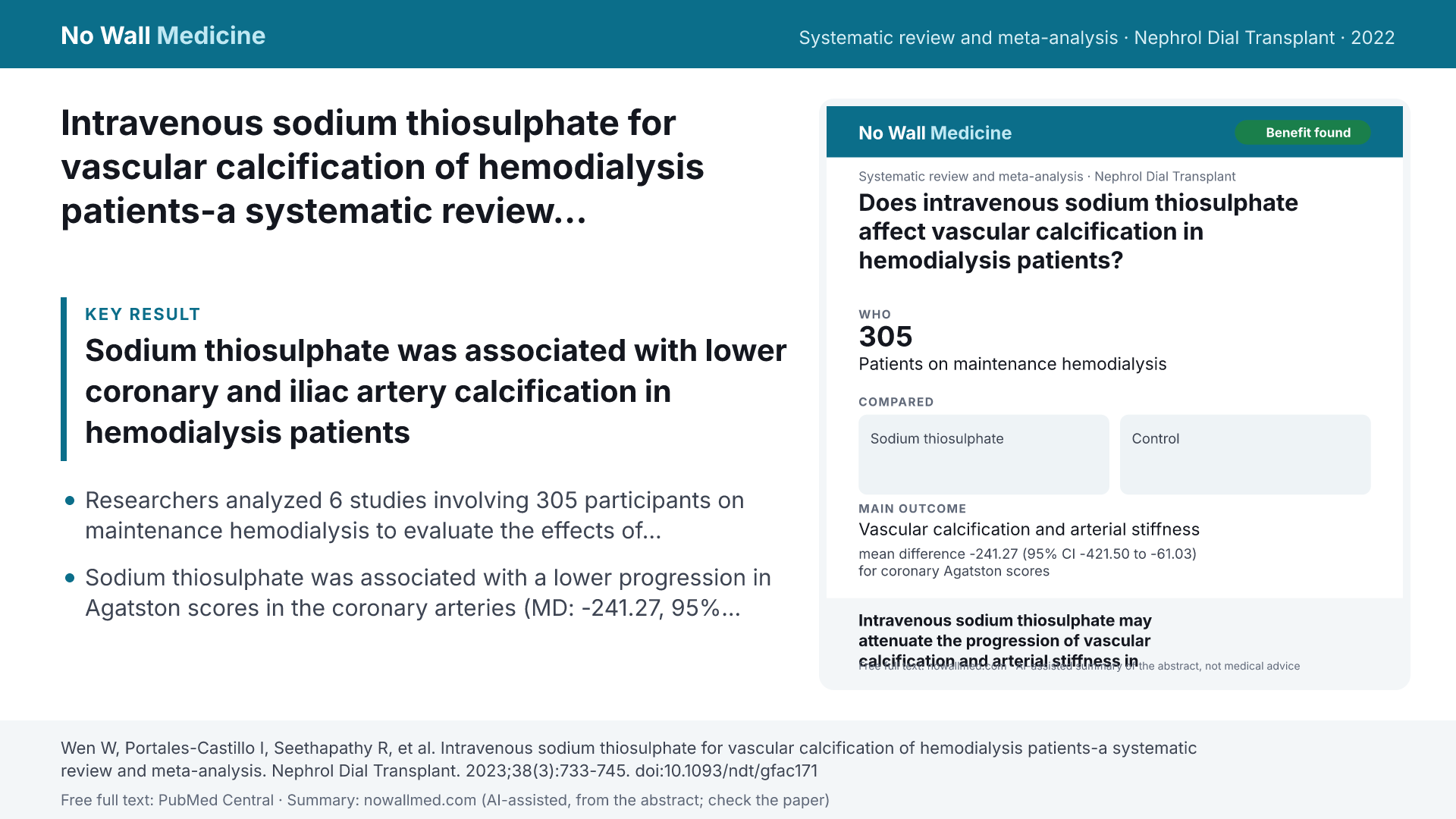
Sodium thiosulphate was associated with lower coronary and iliac artery calcification in hemodialysis patients
Intravenous sodium thiosulphate for vascular calcification of hemodialysis patients-a systematic review and meta-analysis
Systematic review and meta-analysisBenefit found
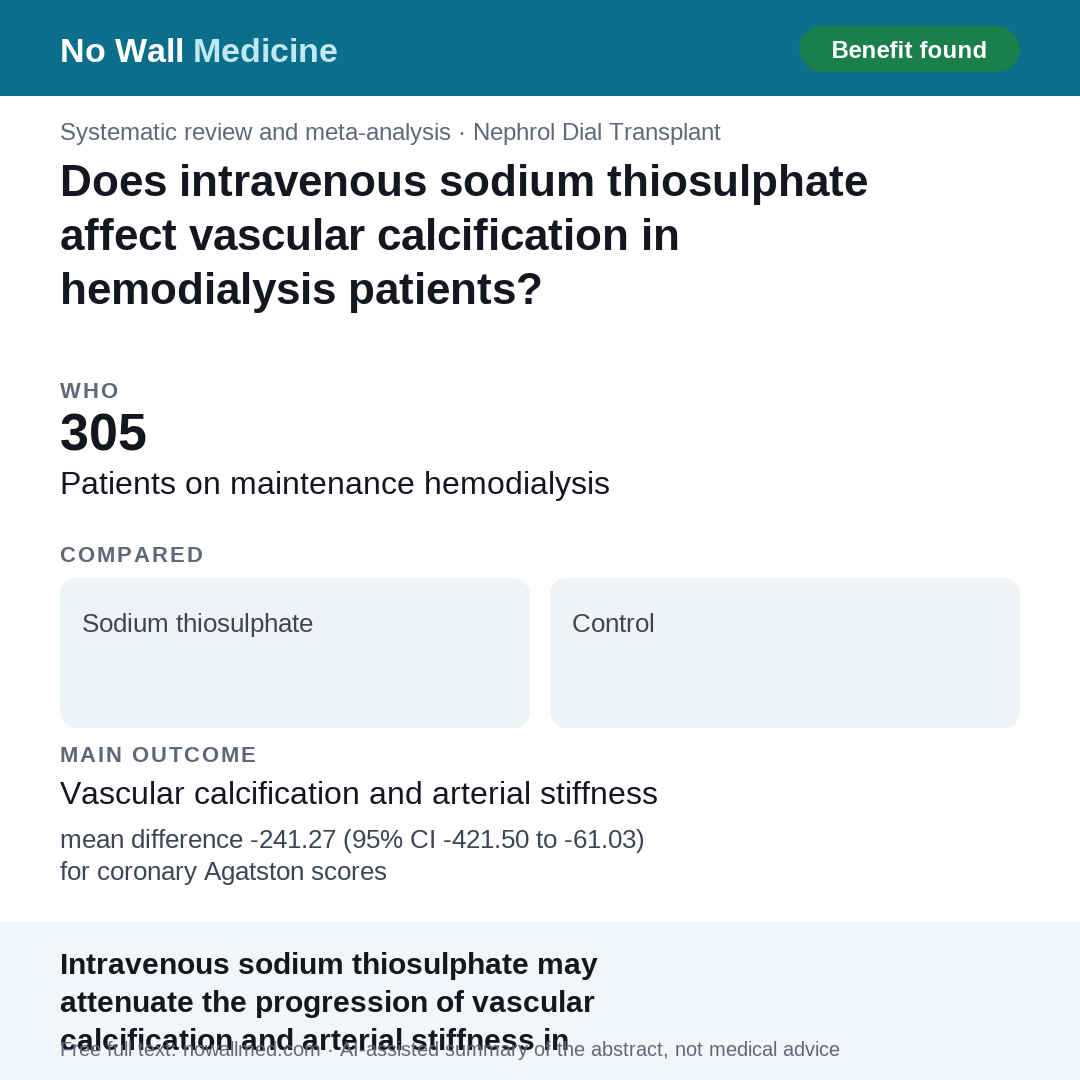
Does intravenous sodium thiosulphate affect vascular calcification in hemodialysis patients?
Who
305
Patients on maintenance hemodialysis
Compared
Sodium thiosulphate
Control
Main outcome
Vascular calcification and arterial stiffness
Result: mean difference -241.27 (95% CI -421.50 to -61.03) for coronary Agatston scores
Bottom line: Intravenous sodium thiosulphate may attenuate the progression of vascular calcification and arterial stiffness in hemodialysis patients.
Limitation: Large and well-designed randomized controlled trials are warranted.
Nephrol Dial Transplant · 2022-05-07Download image
Clinical question: Does intravenous sodium thiosulphate affect vascular calcification in hemodialysis patients?
Why it matters: The effects and safety of intravenous sodium thiosulphate for treating vascular calcification in patients with chronic kidney disease were not clearly established.
Key points
- Researchers analyzed 6 studies involving 305 participants on maintenance hemodialysis to evaluate the effects of intravenous sodium thiosulphate on vascular calcification, which is the hardening of blood vessels.
- Sodium thiosulphate was associated with a lower progression in Agatston scores in the coronary arteries (MD: -241.27, 95% CI: -421.50 to -61.03) and iliac arteries (MD: -382.00, 95% CI: -751.07 to -12.93).
- The treatment was associated with a lower increase in pulse wave velocity (MD: -1.29 m/s, 95% CI: -2.24 to -0.34 m/s), but was linked to gastrointestinal symptoms and increased anion gap acidosis.
Limitation the authors note: The authors state that large and well-designed randomized controlled trials are warranted.
Headline and key points written with AI from the paper’s abstract, with every number checked against it. Read the paper before relying on them.
Was this summary helpful?
Subject terms
Cite this article
Wen W, Portales-Castillo I, Seethapathy R, et al. Intravenous sodium thiosulphate for vascular calcification of hemodialysis patients-a systematic review and meta-analysis. Nephrol Dial Transplant. 2022. doi:10.1093/ndt/gfac171
Spotted a mistake? Suggest a correction