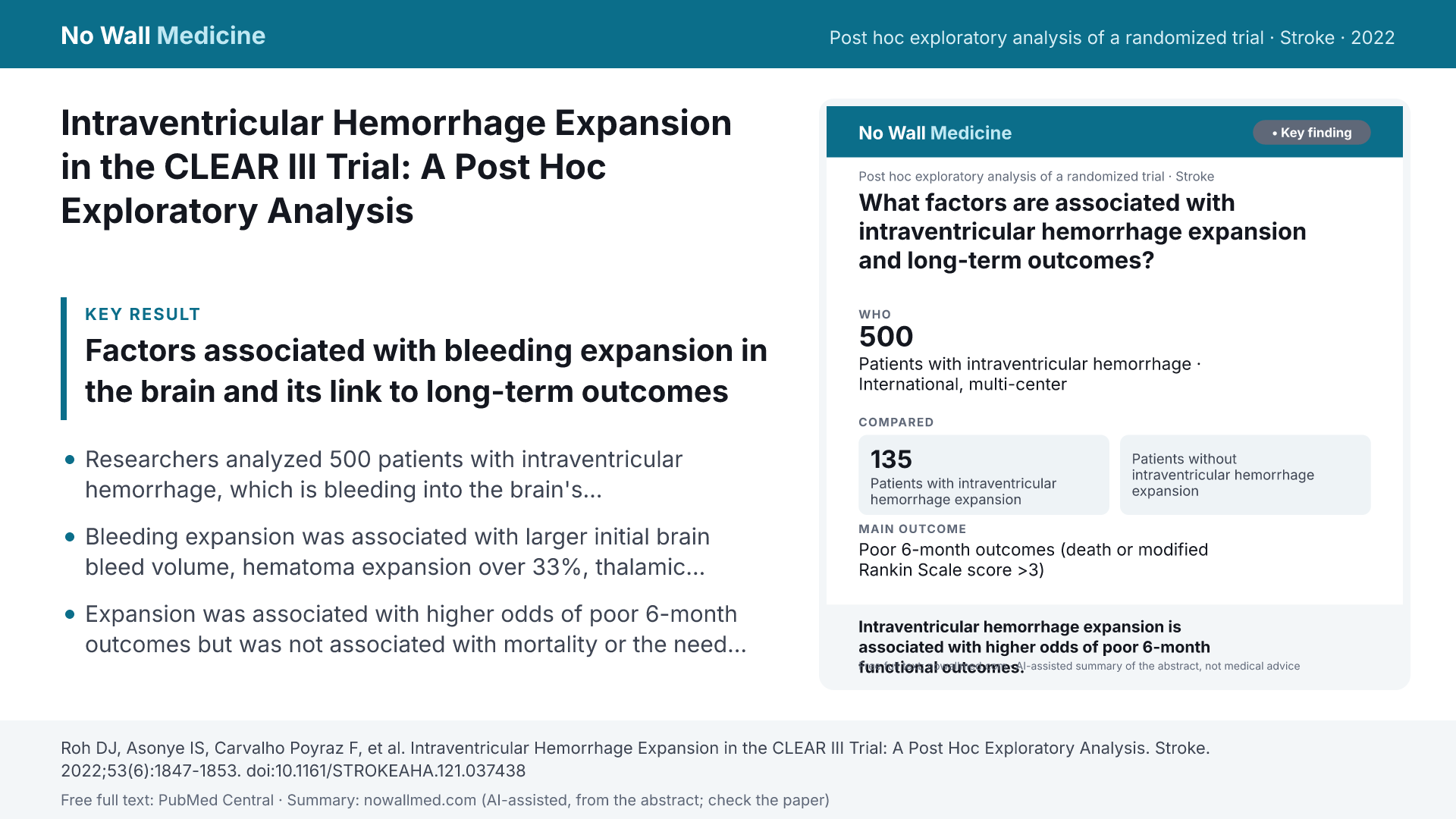
Factors associated with bleeding expansion in the brain and its link to long-term outcomes
Intraventricular Hemorrhage Expansion in the CLEAR III Trial: A Post Hoc Exploratory Analysis
Post hoc exploratory analysis of a randomized trialKey finding
What factors are associated with intraventricular hemorrhage expansion and long-term outcomes?
Who
500
Patients with intraventricular hemorrhage · International, multi-center
Compared
135Patients with intraventricular hemorrhage expansion (27%)
Patients without intraventricular hemorrhage expansion
Main outcome
Poor 6-month outcomes (death or modified Rankin Scale score >3)
Result: adjusted odds ratio 1.84 (95% CI 1.12-3.02)
Bottom line: Intraventricular hemorrhage expansion is associated with higher odds of poor 6-month functional outcomes.
Limitation: This was a post hoc exploratory analysis of a clinical trial cohort.
Stroke · 2022-01-28Download image
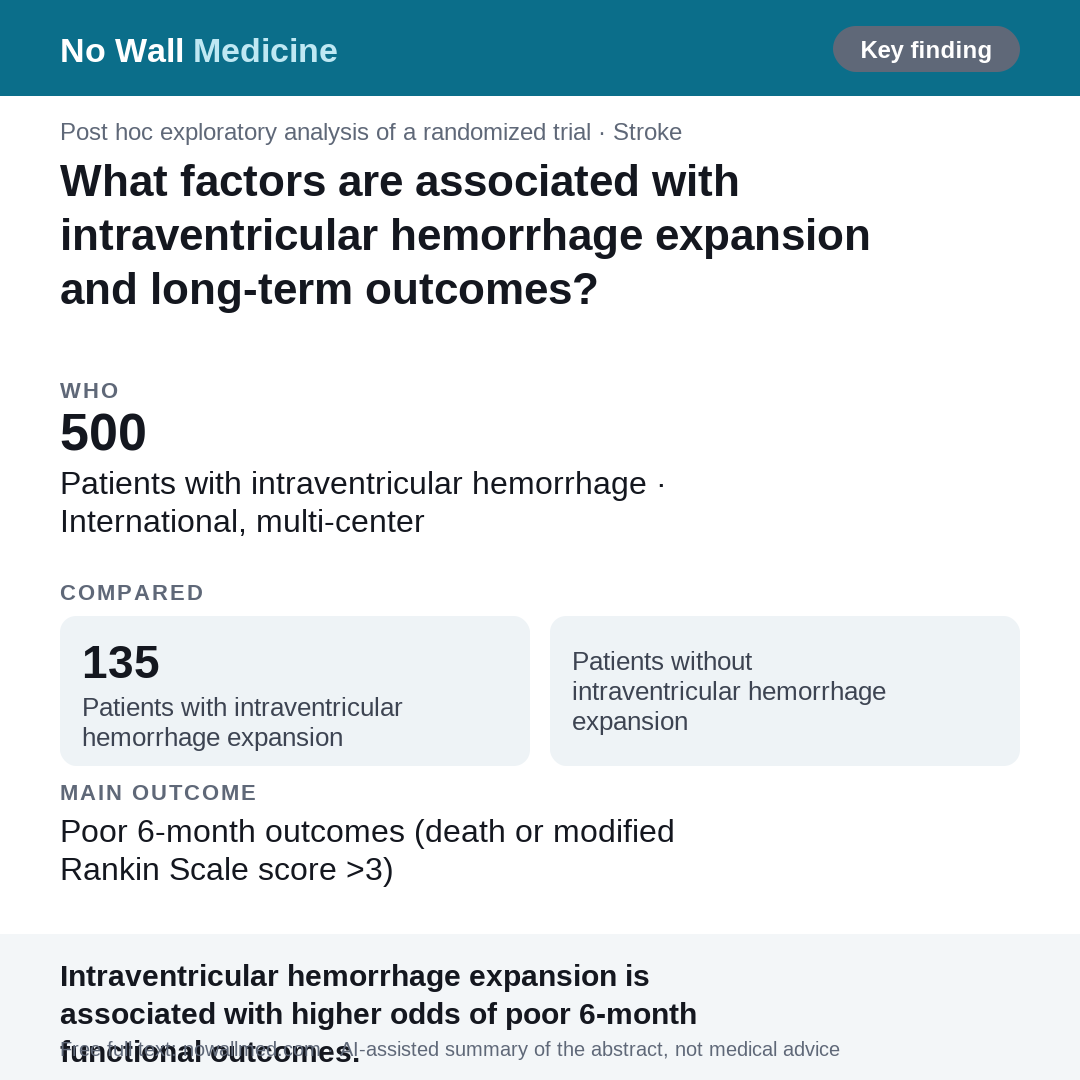
Clinical question: What factors are associated with intraventricular hemorrhage expansion and long-term outcomes?
Key points
- Researchers analyzed 500 patients with intraventricular hemorrhage, which is bleeding into the brain's fluid-filled cavities, to identify factors linked to bleeding expansion.
- Bleeding expansion was associated with larger initial brain bleed volume, hematoma expansion over 33%, thalamic location, and longer time to stable scans.
- Expansion was associated with higher odds of poor 6-month outcomes but was not associated with mortality or the need for a ventriculoperitoneal shunt.
Headline and key points written with AI from the paper’s abstract, with every number checked against it. Read the paper before relying on them.
Was this summary helpful?
Subject terms
Headline, design, result, key points, caveat and citation as plain text.
Cite this article
Roh DJ, Asonye IS, Carvalho Poyraz F, et al. Intraventricular Hemorrhage Expansion in the CLEAR III Trial: A Post Hoc Exploratory Analysis. Stroke. 2022. doi:10.1161/STROKEAHA.121.037438
Spotted a mistake? Suggest a correction