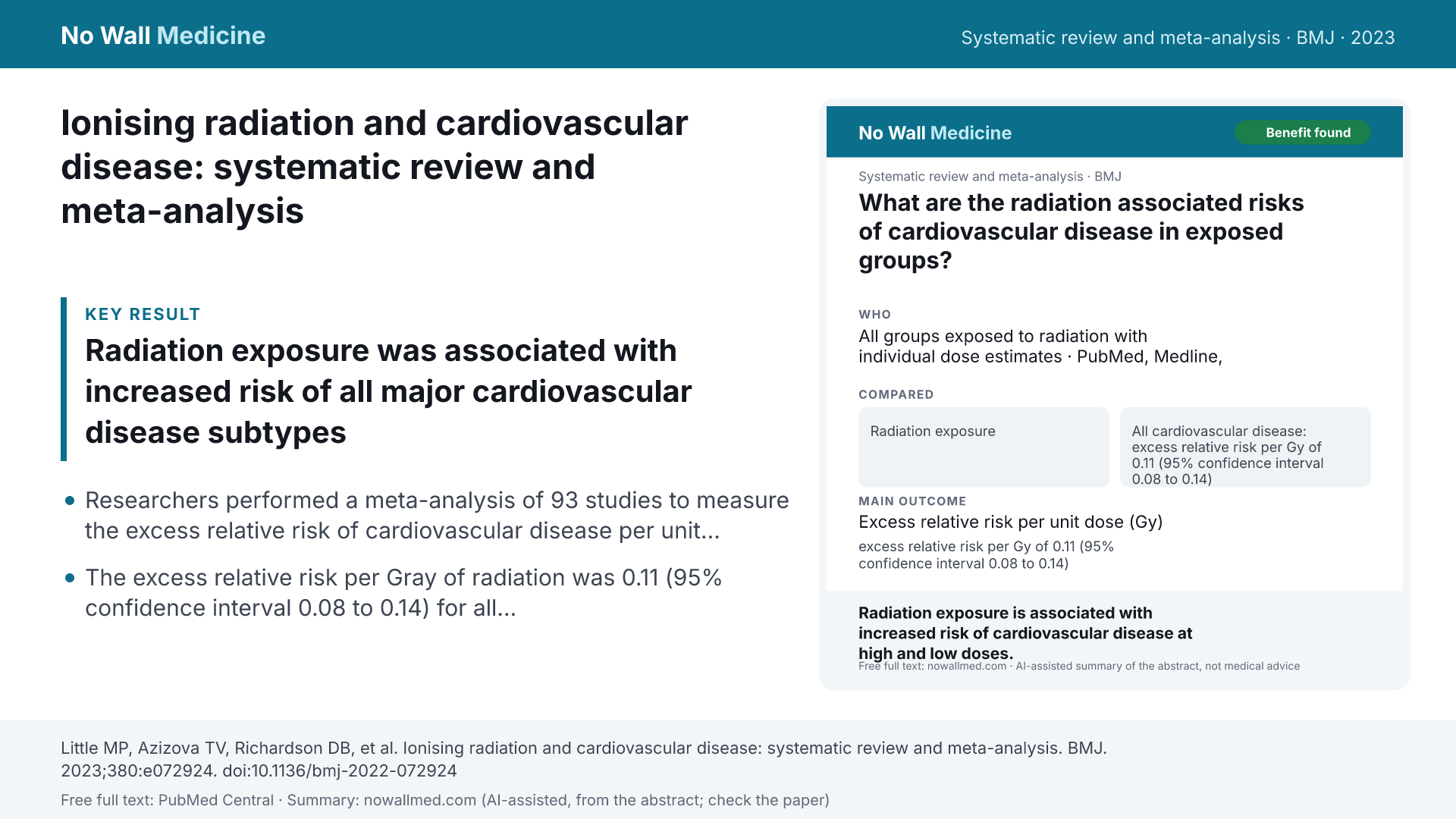
Radiation exposure was associated with increased risk of all major cardiovascular disease subtypes
Ionising radiation and cardiovascular disease: systematic review and meta-analysis
Systematic review and meta-analysisBenefit found
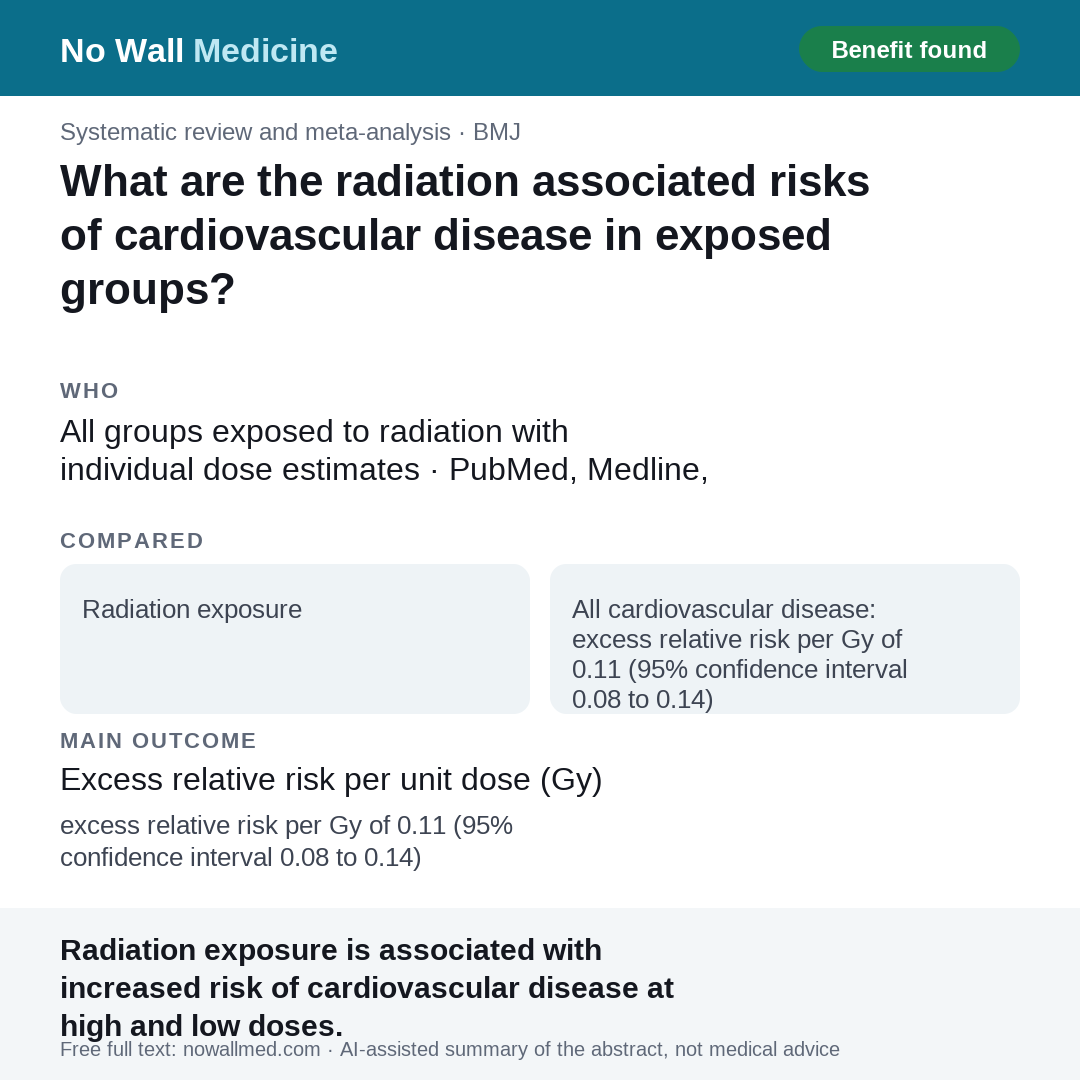
What are the radiation associated risks of cardiovascular disease in exposed groups?
Who
All groups exposed to radiation with individual dose estimates · PubMed, Medline, Embase, Scopus, and Web of Science
Compared
Radiation exposure
All cardiovascular disease: excess relative risk per Gy of 0.11 (95% confidence interval 0.08 to 0.14)
Main outcome
Excess relative risk per unit dose (Gy)
Result: excess relative risk per Gy of 0.11 (95% confidence interval 0.08 to 0.14)
Bottom line: Radiation exposure is associated with increased risk of cardiovascular disease at high and low doses.
Limitation: Interstudy heterogeneity possibly resulting from unmeasured confounders or effect modifiers.
BMJ · 2023-03-08Download image
Clinical question: What are the radiation associated risks of cardiovascular disease in exposed groups?
Why it matters: The relationship between ionizing radiation exposure and the risk of developing various cardiovascular diseases needed systematic review and quantification.
Key points
- Researchers performed a meta-analysis of 93 studies to measure the excess relative risk of cardiovascular disease per unit of radiation dose.
- The excess relative risk per Gray of radiation was 0.11 (95% confidence interval 0.08 to 0.14) for all cardiovascular disease.
- Estimated absolute risks per Gray ranged from 2.33% (95% confidence interval 1.69% to 2.98%) in England and Wales to 3.66% (95% confidence interval 2.65% to 4.68%) in Germany.
Limitation the authors note: Interstudy heterogeneity was noted, which may result from variation in unmeasured confounders or effect modifiers.
Headline and key points written with AI from the paper’s abstract, with every number checked against it. Read the paper before relying on them.
Was this summary helpful?
Abstract
Objective
To systematically review and perform a meta-analysis of radiation associated risks of cardiovascular disease in all groups exposed to radiation with individual radiation dose estimates. Design
Systematic review and meta-analysis. Main outcome measures
Excess relative risk per unit dose (Gy), estimated by restricted maximum likelihood methods. Data sources
PubMed and Medline, Embase, Scopus, Web of Science Core collection databases. Eligibility criteria for selecting studies
Databases were searched on 6 October 2022, with no limits on date of publication or language. Animal studies and studies without an abstract were excluded. Results
The meta-analysis yielded 93 relevant studies. Relative risk per Gy increased for all cardiovascular disease (excess relative risk per Gy of 0.11 (95% confidence interval 0.08 to 0.14)) and for the four major subtypes of cardiovascular disease (ischaemic heart disease, other heart disease, cerebrovascular disease, all other cardiovascular disease). However, interstudy heterogeneity was noted (P<0.05 for all endpoints except for other heart disease), possibly resulting from interstudy variation in unmeasured confounders or effect modifiers, which is markedly reduced if attention is restricted to higher quality studies or those at moderate doses (<0.5 Gy) or low dose rates (<5 mGy/h). For ischaemic heart disease and all cardiovascular disease, risks were larger per unit dose for lower dose (inverse dose effect) and for fractionated exposures (inverse dose fractionation effect). Population based excess absolute risks are estimated for a number of national populations (Canada, England and Wales, France, Germany, Japan, USA) and range from 2.33% per Gy (95% confidence interval 1.69% to 2.98%) for England and Wales to 3.66% per Gy (2.65% to 4.68%) for Germany, largely reflecting the underlying rates of cardiovascular disease mortality in these populations. Estimated risk of mortality from cardiovascular disease are generally dominated by cerebrovascular disease (around 0.94-1.26% per Gy), with the next largest contribution from ischaemic heart disease (around 0.30-1.20% per Gy). Conclusions
Results provide evidence supporting a causal association between radiation exposure and cardiovascular disease at high dose, and to a lesser extent at low dose, with some indications of differences in risk between acute and chronic exposures, which require further investigation. The observed heterogeneity complicates a causal interpretation of these findings, although this heterogeneity is much reduced if only higher quality studies or those at moderate doses or low dose rates are considered. Studies are needed to assess in more detail modifications of radiation effect by lifestyle and medical risk factors. Systematic review registration
PROSPERO CRD42020202036.
Abstract reproduced under the article’s CC BY NC licence.
Subject terms
Cite this article
Little MP, Azizova TV, Richardson DB, et al. Ionising radiation and cardiovascular disease: systematic review and meta-analysis. BMJ. 2023. doi:10.1136/bmj-2022-072924
Spotted a mistake? Suggest a correction