Smaller coupler sizes were associated with higher rates of blood clots in tissue flap connections
Is there a difference in venous thrombosis rate in free flap anastomoses based on coupler diameter? A systematic review. Does Size Really Matter?
Systematic review of 11 retrospective case-seriesKey finding
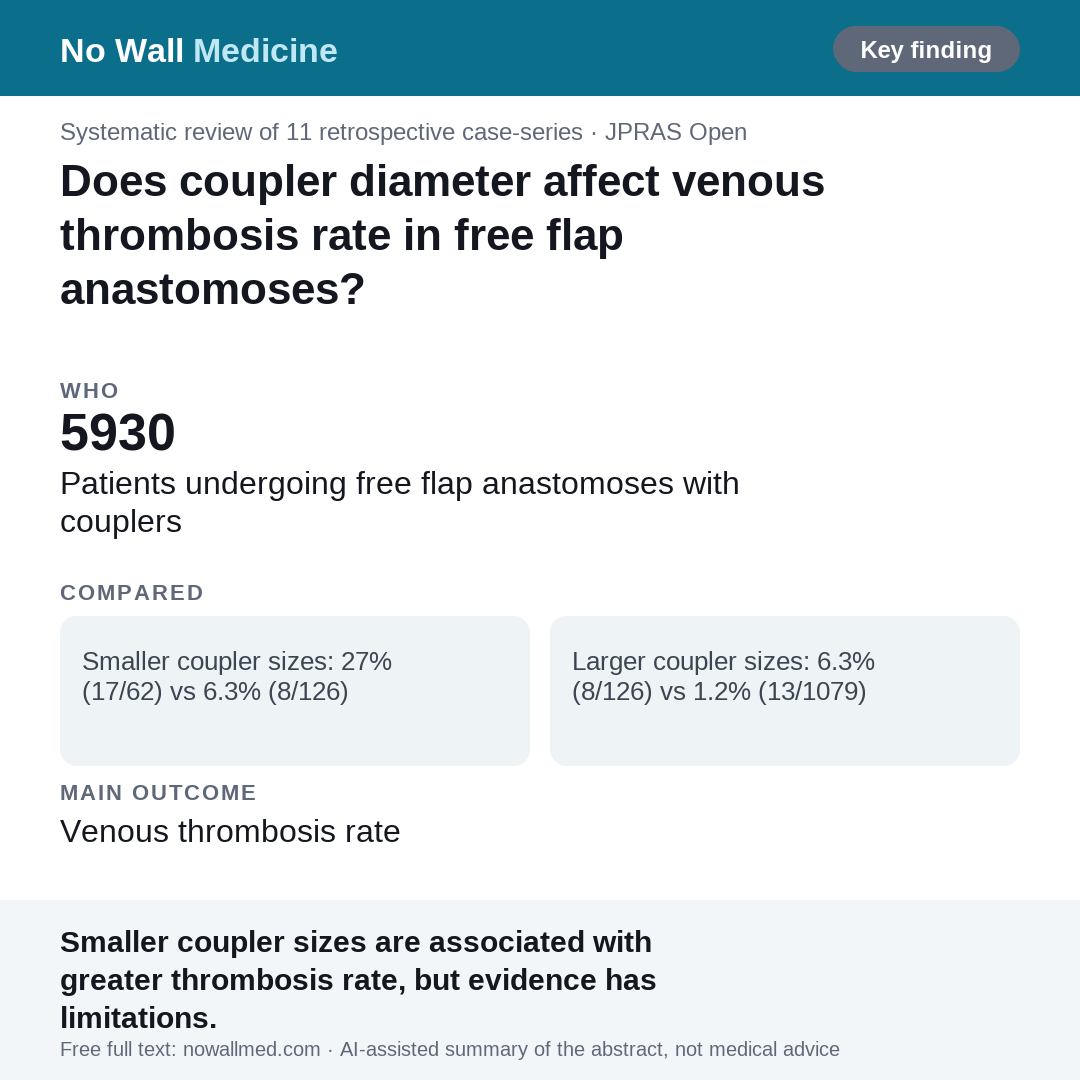
Does coupler diameter affect venous thrombosis rate in free flap anastomoses?
Who
5930
Patients undergoing free flap anastomoses with couplers
Compared
Smaller coupler sizes: 27% (17/62) vs 6.3% (8/126)
Larger coupler sizes: 6.3% (8/126) vs 1.2% (13/1079)
Main outcome
Venous thrombosis rate
Bottom line: Smaller coupler sizes are associated with greater thrombosis rate, but evidence has limitations.
Limitation: Quality score ranged from 2 to 4 and funnel plots indicated publication bias
JPRAS Open · 2021-08-11Download image
Clinical question: Does coupler diameter affect venous thrombosis rate in free flap anastomoses?
Key points
- Researchers analyzed 11 retrospective case-series involving a total of 5930 coupled anastomoses, which are surgical connections used in tissue flap transfers.
- Two studies showed higher thrombosis, or blood clot, rates in smaller sizes: 2.0 mm at 27% versus 3.0 mm at 6.3%, and 1.5 mm at 6.9% versus 3.0 mm at 1.2%.
- Nine of the included studies reported no difference in the rate of blood clots based on the diameter of the coupler device used.
Limitation the authors note: The included studies were retrospective case-series with quality scores ranging from 2 to 4 out of 5 and showed evidence of publication bias.
Headline and key points written with AI from the paper’s abstract, with every number checked against it. Read the paper before relying on them.
Was this summary helpful?
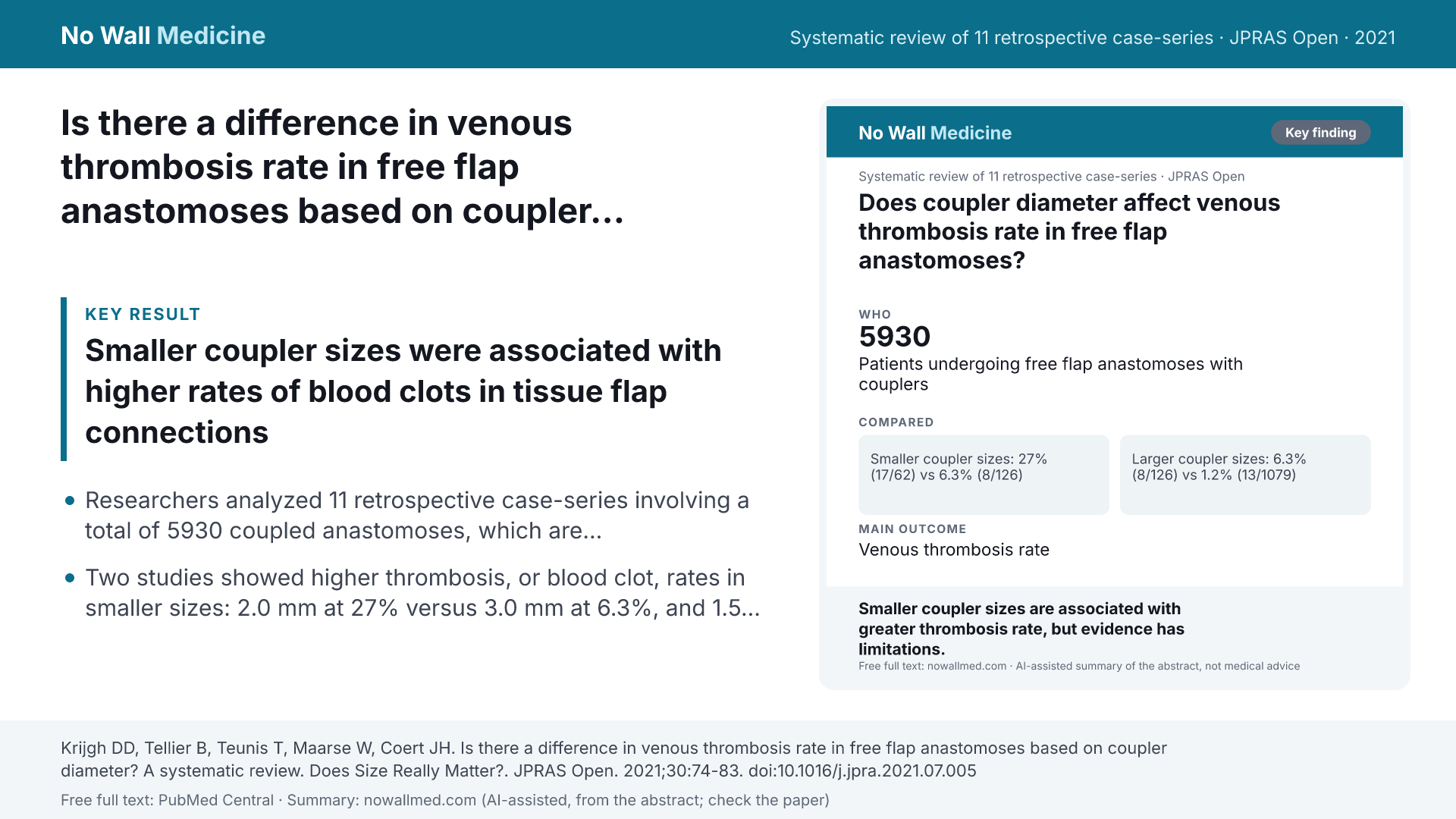
Headline, design, result, key points, caveat and citation as plain text.
Cite this article
Krijgh DD, Tellier B, Teunis T, Maarse W, Coert JH. Is there a difference in venous thrombosis rate in free flap anastomoses based on coupler diameter? A systematic review. Does Size Really Matter?. JPRAS Open. 2021. doi:10.1016/j.jpra.2021.07.005
Spotted a mistake? Suggest a correction