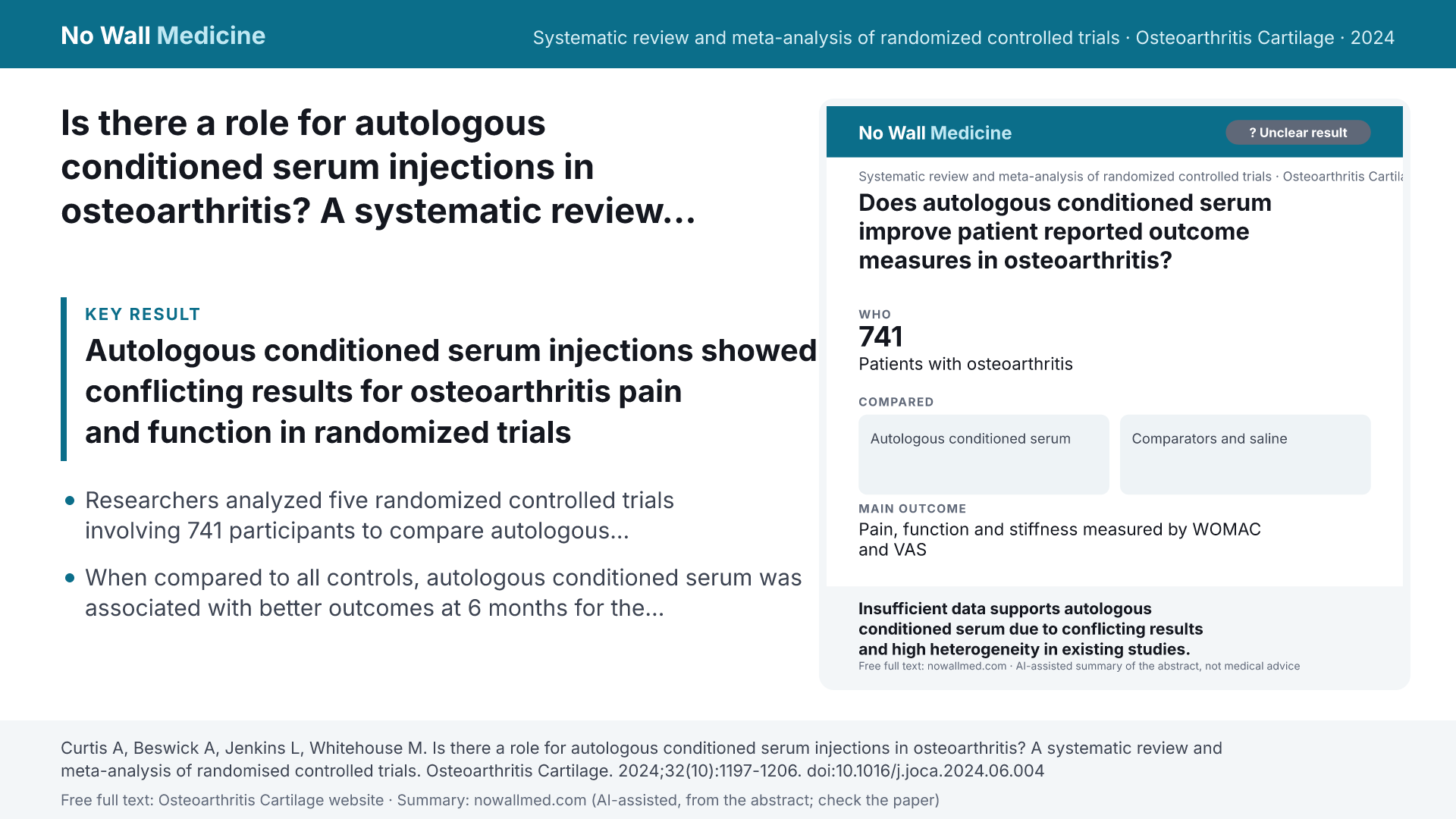
Is there a role for autologous conditioned serum injections in osteoarthritis? A systematic review and meta-analysis of randomised controlled trials
Key result: Autologous conditioned serum injections showed conflicting results for osteoarthritis pain and function in randomized trials
Key points
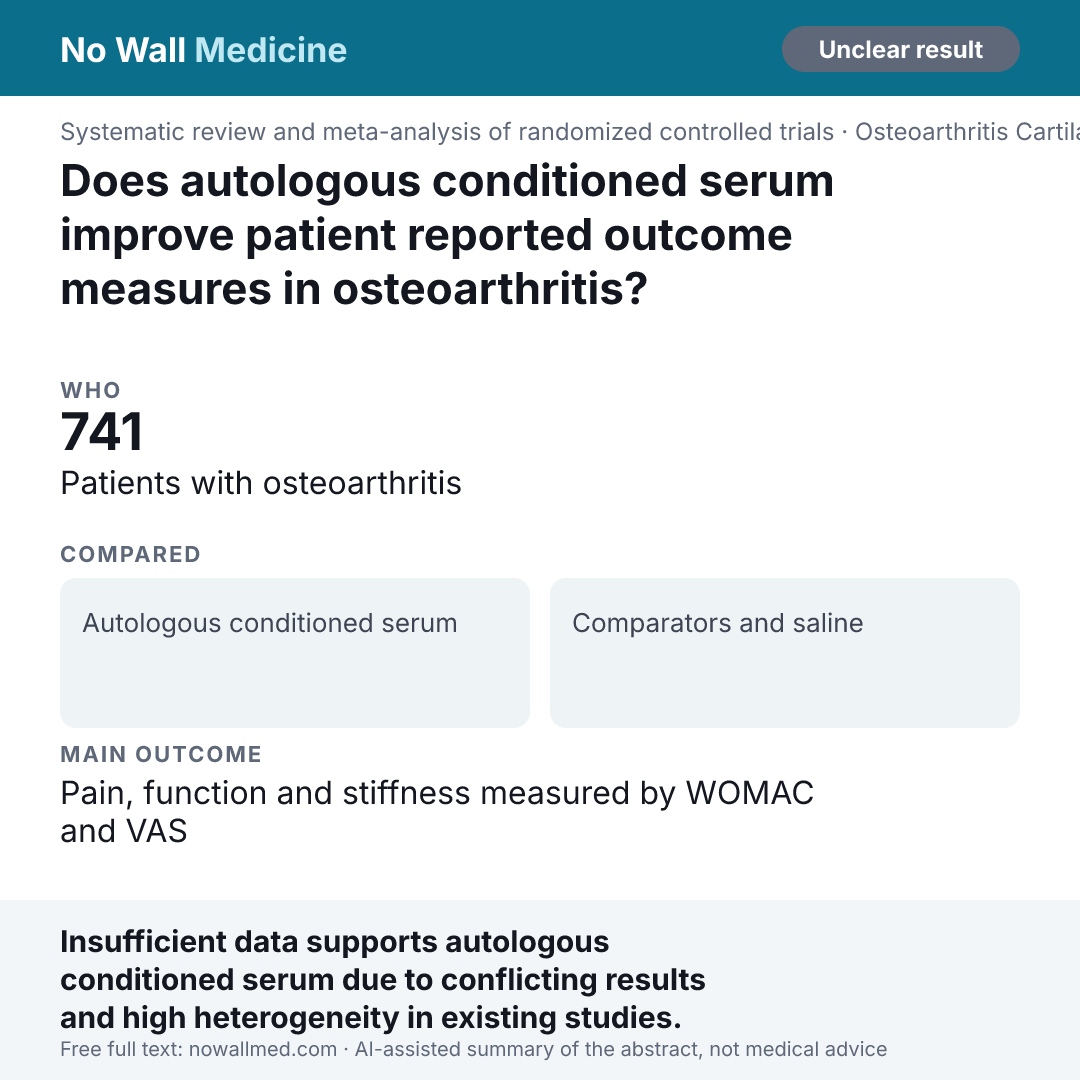
- Researchers analyzed five randomized controlled trials involving 741 participants to compare autologous conditioned serum, which is a patient's own processed blood serum, against various controls.
- When compared to all controls, autologous conditioned serum was associated with better outcomes at 6 months for the Western Ontario and McMaster Universities Osteoarthritis Index (SMD -0.61) and visual analogue scale (SMD -1.24).
- When compared specifically to saline placebo, there was no significant difference in Western Ontario and McMaster Universities Osteoarthritis Index (MD -9.87) or visual analogue scale at 6 months.
Limitation the authors note: The meta-analysis was limited by high heterogeneity and studies that were rated as having some concern or high risk of bias.
Discussion prompts
- Would these patients look like yours? Who was left out?
- Is the main outcome one that matters to patients?
- Is the difference large enough to change what you do?
Cite: Curtis A, Beswick A, Jenkins L, Whitehouse M. Is there a role for autologous conditioned serum injections in osteoarthritis? A systematic review and meta-analysis of randomised controlled trials. Osteoarthritis Cartilage. 2024;32(10):1197-1206. doi:10.1016/j.joca.2024.06.004
Free full text: Osteoarthritis Cartilage website · Summary and visual abstract: nowallmed.com/a/is-there-a-role-for-autologous-conditioned-serum-injections-in-1rhcus2/ (AI-assisted from the abstract; check the paper before relying on it).