Isoquercetin for thromboinflammation in sickle cell disease: a randomized double-blind placebo-controlled trial
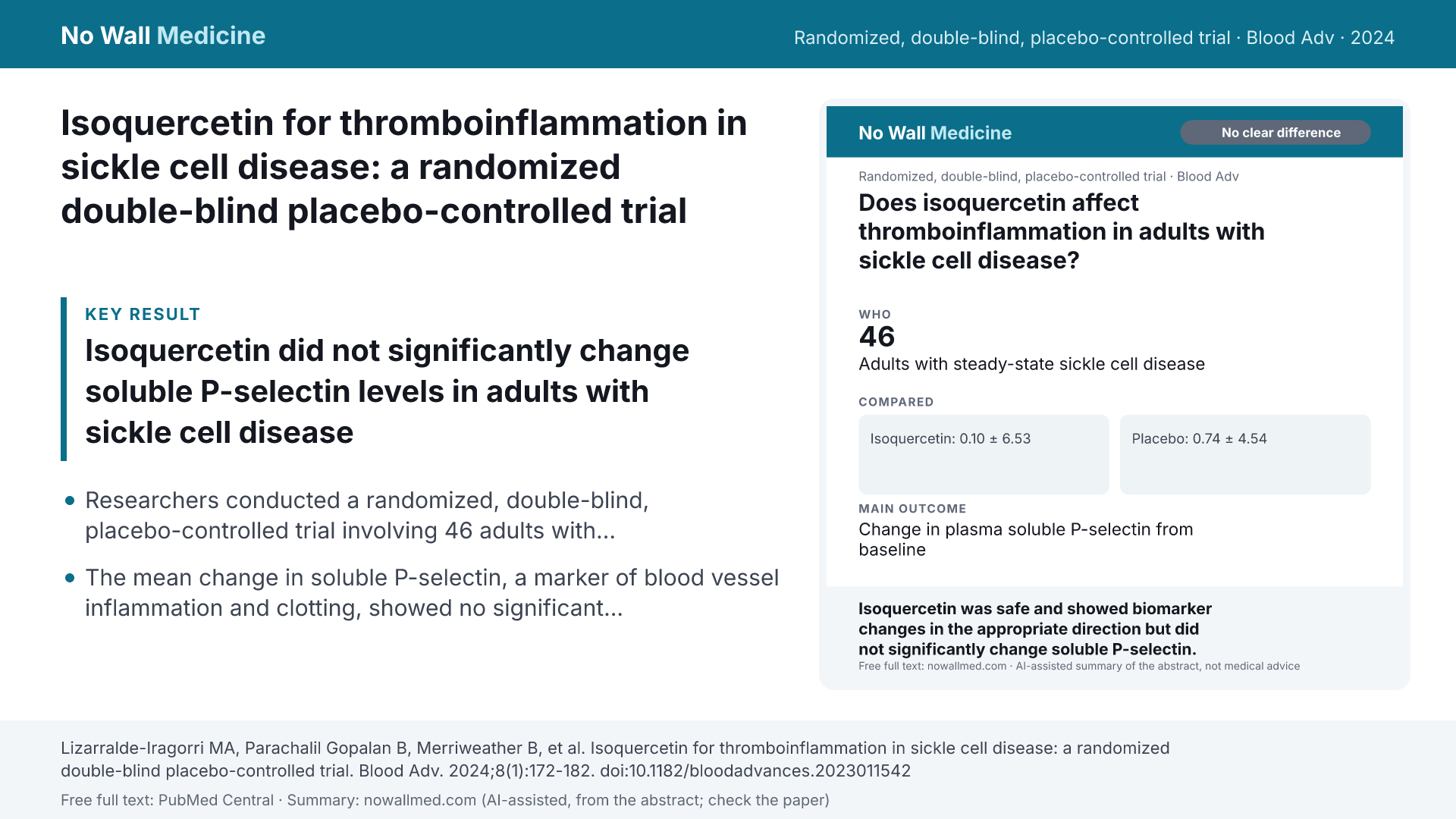
Key result: Isoquercetin did not significantly change soluble P-selectin levels in adults with sickle cell disease
Randomized, double-blind, placebo-controlled trialNo clear difference
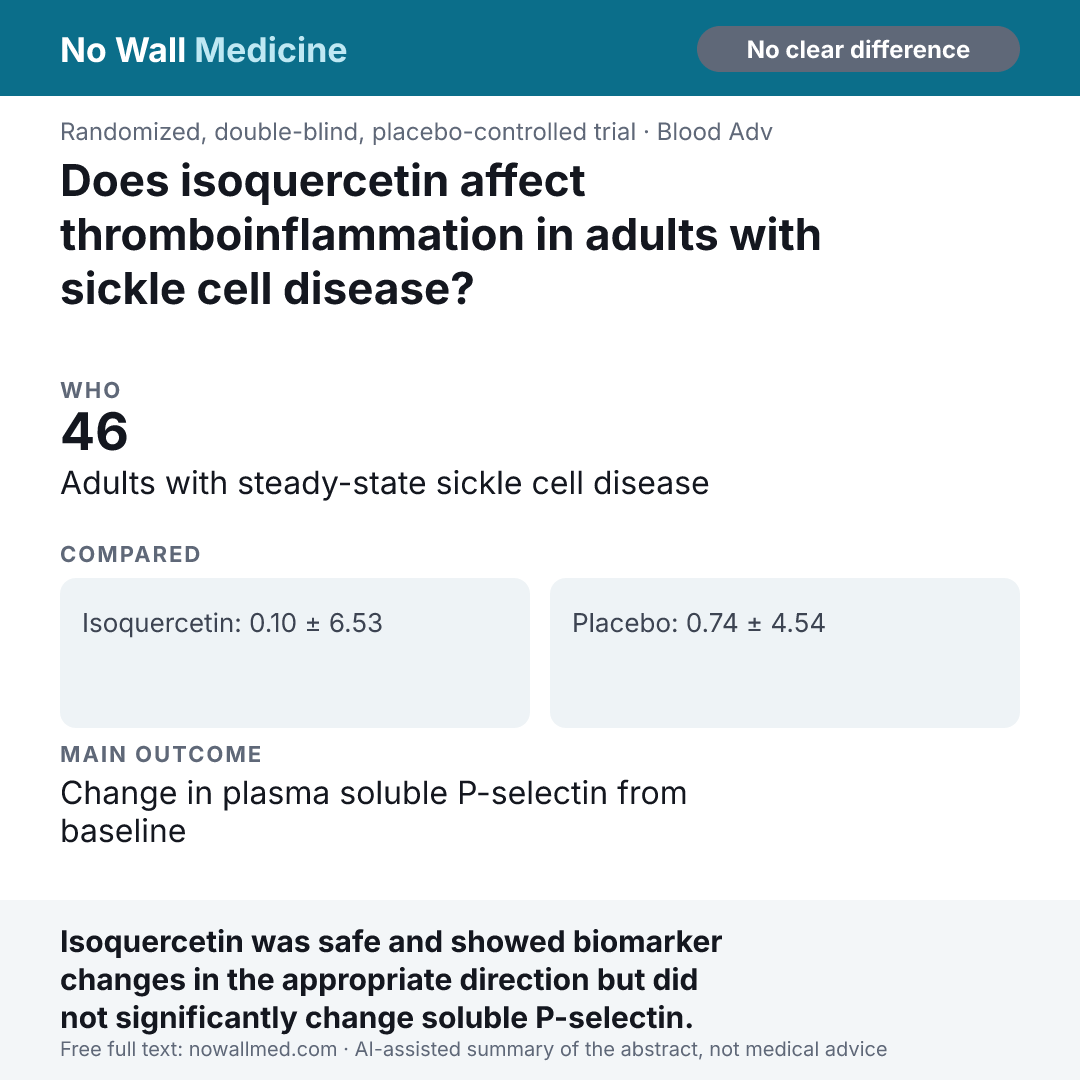
Does isoquercetin affect thromboinflammation in adults with sickle cell disease?
Who
46
Adults with steady-state sickle cell disease
Compared
Isoquercetin: 0.10 ± 6.53
Placebo: 0.74 ± 4.54
Main outcome
Change in plasma soluble P-selectin from baseline
Bottom line: Isoquercetin was safe and showed biomarker changes in the appropriate direction but did not significantly change soluble P-selectin.
Blood Adv · 2024-01-02 · Save PNG
Key points
- Researchers conducted a randomized, double-blind, placebo-controlled trial involving 46 adults with steady-state sickle cell disease.
- The mean change in soluble P-selectin, a marker of blood vessel inflammation and clotting, showed no significant difference between isoquercetin (0.10 ± 6.53) and placebo (0.74 ± 4.54).
- In the isoquercetin group, whole-blood coagulation and collagen-induced platelet aggregation, which measures how much blood cells clump together, were significantly reduced from baseline.
Discussion prompts
- Would these patients look like yours? Who was left out?
- Is the main outcome one that matters to patients?
- Is the difference large enough to change what you do?
Cite: Lizarralde-Iragorri MA, Parachalil Gopalan B, Merriweather B, et al. Isoquercetin for thromboinflammation in sickle cell disease: a randomized double-blind placebo-controlled trial. Blood Adv. 2024;8(1):172-182. doi:10.1182/bloodadvances.2023011542
Free full text: PubMed Central · Summary and visual abstract: nowallmed.com/a/isoquercetin-for-thromboinflammation-in-sickle-cell-disease-a-19h2l4i/ (AI-assisted from the abstract; check the paper before relying on it).