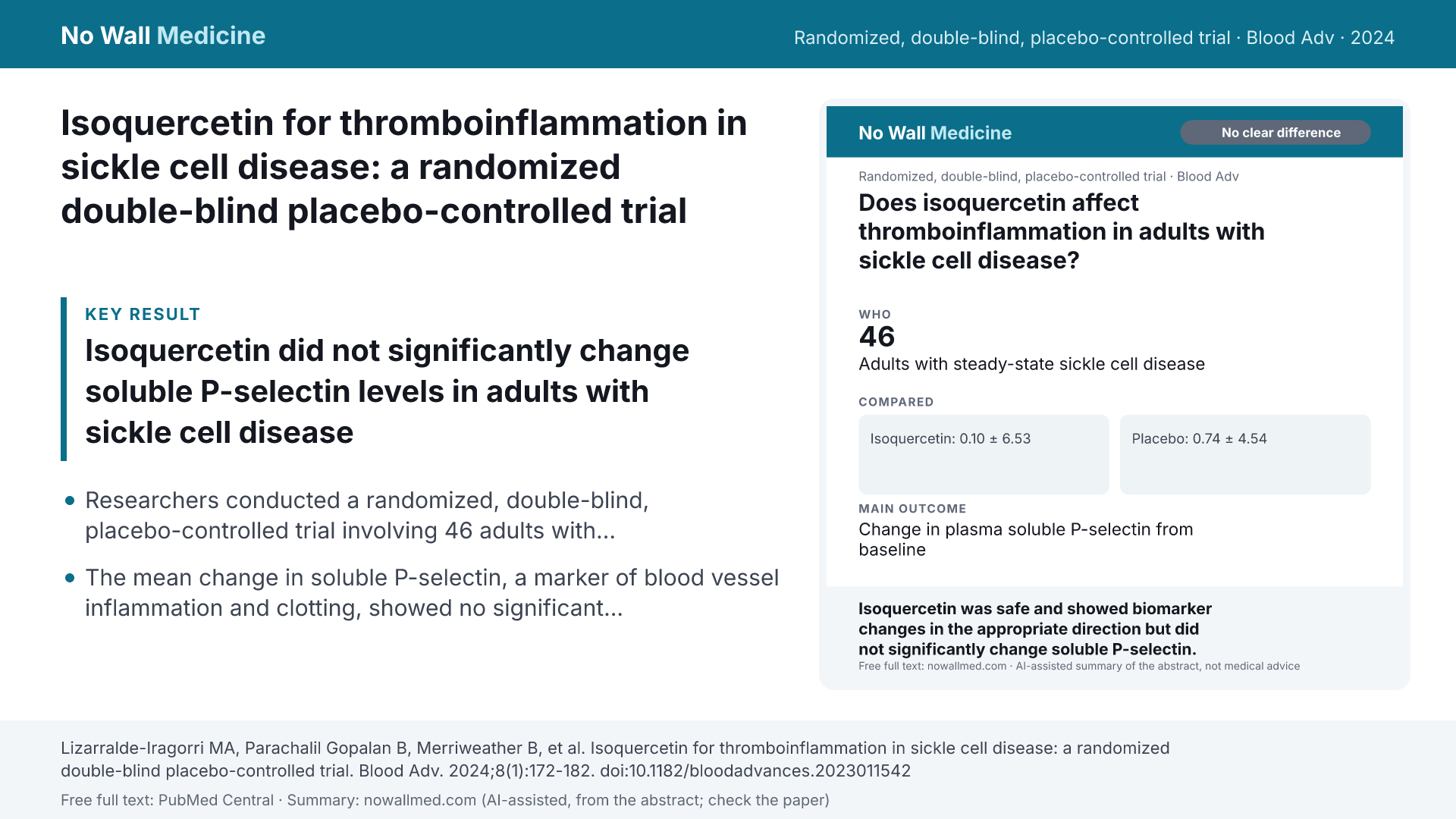
Isoquercetin did not significantly change soluble P-selectin levels in adults with sickle cell disease
Isoquercetin for thromboinflammation in sickle cell disease: a randomized double-blind placebo-controlled trial
Randomized, double-blind, placebo-controlled trialNo clear difference
Does isoquercetin affect thromboinflammation in adults with sickle cell disease?
Who
46
Adults with steady-state sickle cell disease
Compared
Isoquercetin: 0.10 ± 6.53
Placebo: 0.74 ± 4.54
Main outcome
Change in plasma soluble P-selectin from baseline
Bottom line: Isoquercetin was safe and showed biomarker changes in the appropriate direction but did not significantly change soluble P-selectin.
Blood Adv · 2024-01-02Download image
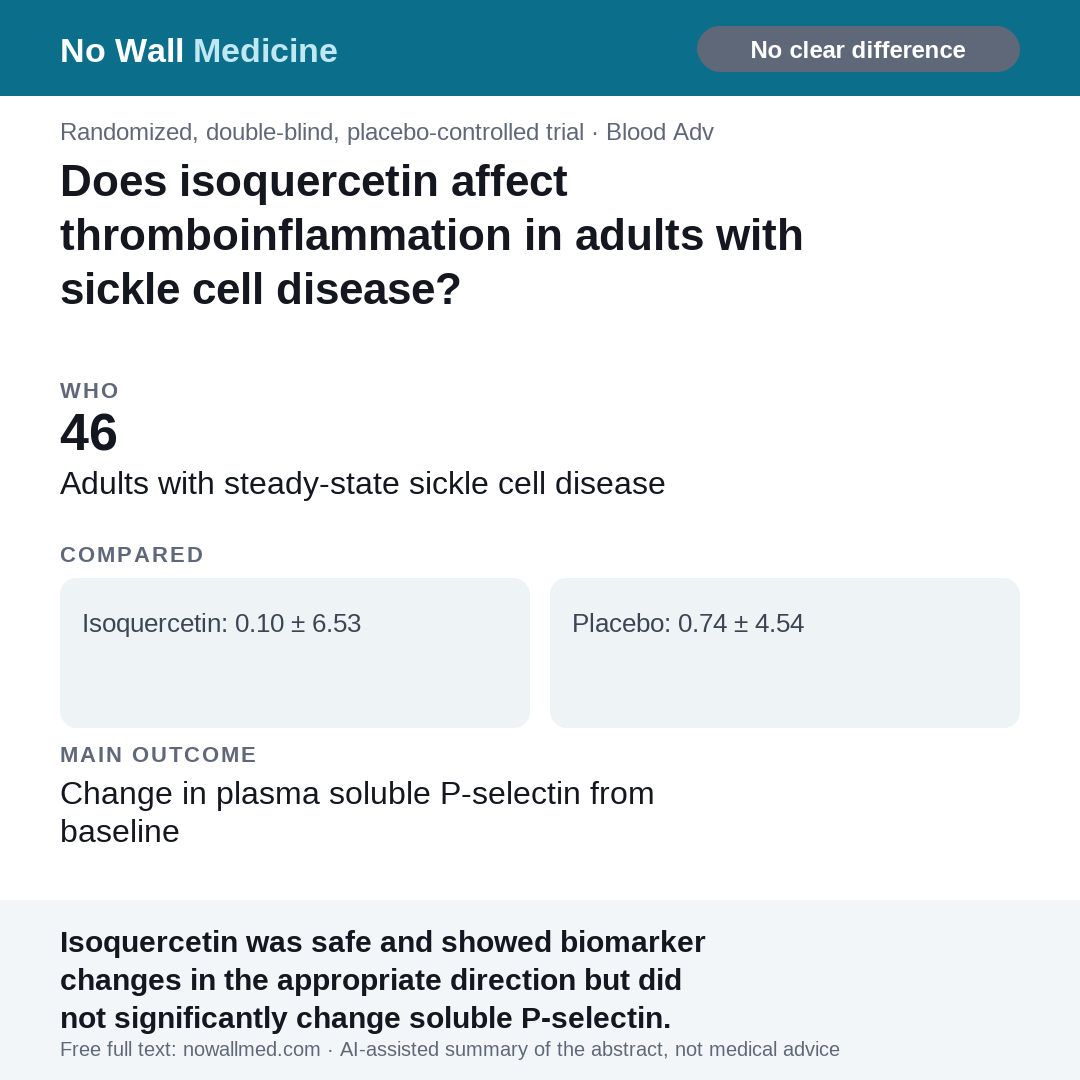
Clinical question: Does isoquercetin affect thromboinflammation in adults with sickle cell disease?
Why it matters: It was unknown if isoquercetin could target thromboinflammation, which is the combination of blood clotting and inflammation, in adults with sickle cell disease.
Key points
- Researchers conducted a randomized, double-blind, placebo-controlled trial involving 46 adults with steady-state sickle cell disease.
- The mean change in soluble P-selectin, a marker of blood vessel inflammation and clotting, showed no significant difference between isoquercetin (0.10 ± 6.53) and placebo (0.74 ± 4.54).
- In the isoquercetin group, whole-blood coagulation and collagen-induced platelet aggregation, which measures how much blood cells clump together, were significantly reduced from baseline.
Headline and key points written with AI from the paper’s abstract, with every number checked against it. Read the paper before relying on them.
Was this summary helpful?
Abstract
Data from a small trial in patients with cancer suggest that isoquercetin (IQ) treatment lowered thrombosis biomarkers and prevented clinical thrombosis, but, to our knowledge, no studies of IQ have been conducted to target thromboinflammation in adults with sickle cell disease (SCD). We conducted a randomized, double-blind, placebo-controlled trial in adults with steady-state SCD (hemoglobin SS [HbSS], HbSβ0thal, HbSβ+thal, or HbSC). The primary outcome was the change in plasma soluble P-selectin (sP-selectin) after treatment compared with baseline, analyzed in the intention-to-treat population. Between November 2019 and July 2022, 46 patients (aged 40 ± 11 years, 56% female, 75% under hydroxyurea treatment) were randomized to receive IQ (n = 23) or placebo (n = 23). IQ was well tolerated and all the adverse events (AEs; n = 21) or serious AEs (n = 14) recorded were not attributable to the study drug. The mean posttreatment change for sP-selectin showed no significant difference between the treatment groups (IQ, 0.10 ± 6.53 vs placebo, 0.74 ± 4.54; P = .64). In patients treated with IQ, whole-blood coagulation (P = .03) and collagen-induced platelet aggregation (P = .03) were significantly reduced from the baseline. Inducible mononuclear cell tissue factor gene expression and plasma protein disulfide isomerase reductase activity were also significantly inhibited (P = .003 and P = .02, respectively). Short-term fixed-dose IQ in patients with SCD was safe with no off-target bleeding and was associated with changes from the baseline in the appropriate direction for several biomarkers of thromboinflammation. The trial was registered at www.clinicaltrials.gov as #NCT04514510.
Abstract reproduced under the article’s CC BY NC ND licence.
Subject terms
Cite this article
Lizarralde-Iragorri MA, Parachalil Gopalan B, Merriweather B, Brooks J, Hill M, Lovins D. Isoquercetin for thromboinflammation in sickle cell disease: a randomized double-blind placebo-controlled trial. Blood Adv. 2024. doi:10.1182/bloodadvances.2023011542
Spotted a mistake? Suggest a correction
Top studies every Monday
The week’s key trials and guidelines in your specialties, plus any topics you follow. By email, free.
Get the weekly digest