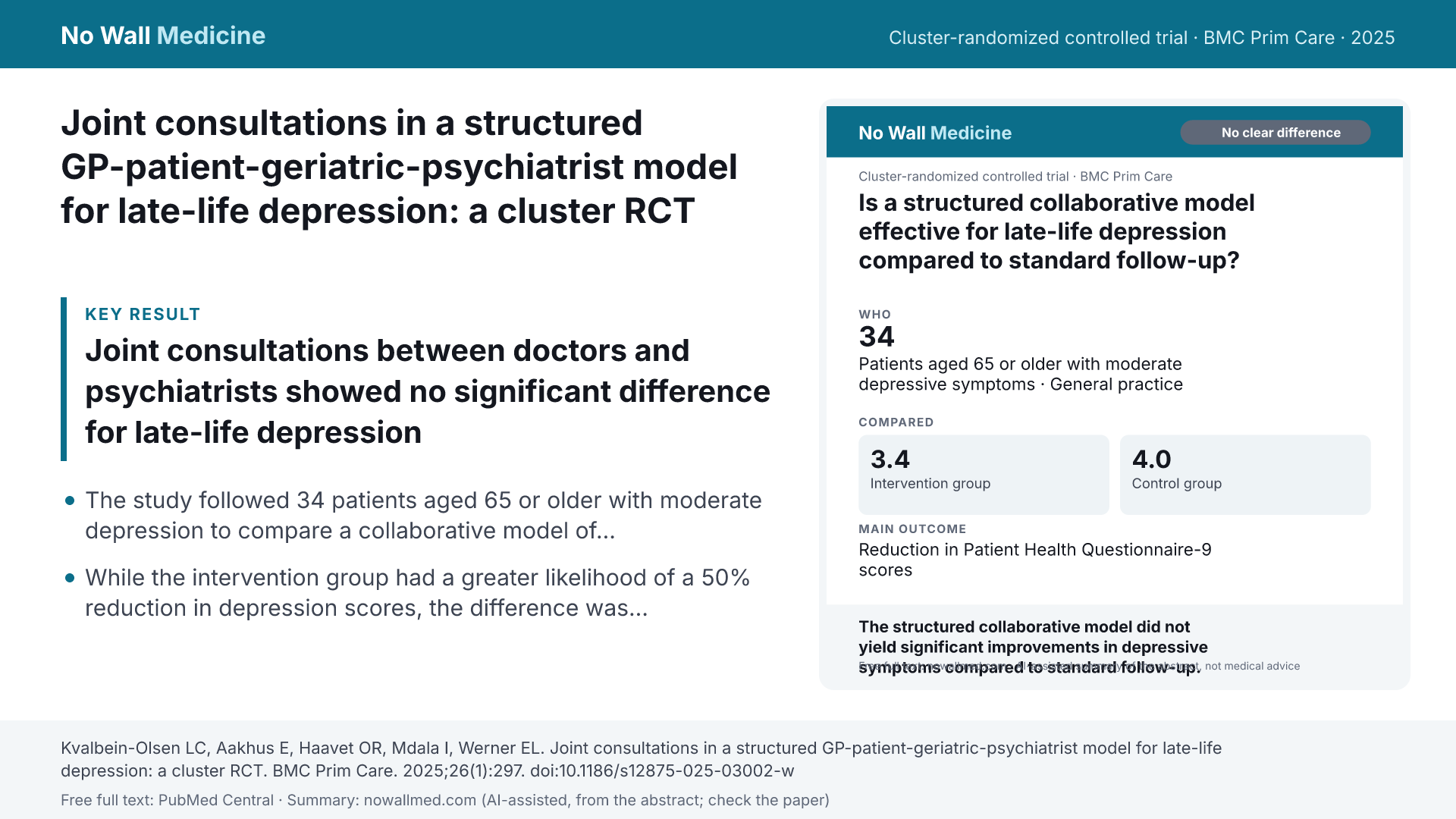
Joint consultations between doctors and psychiatrists showed no significant difference for late-life depression
Joint consultations in a structured GP-patient-geriatric-psychiatrist model for late-life depression: a cluster RCT
Cluster-randomized controlled trialNo clear difference
Is a structured collaborative model effective for late-life depression compared to standard follow-up?
Who
34
Patients aged 65 or older with moderate depressive symptoms · General practice
Compared
3.4Intervention group
4.0Control group
Main outcome
Reduction in Patient Health Questionnaire-9 scores
Bottom line: The structured collaborative model did not yield significant improvements in depressive symptoms compared to standard follow-up.
Limitation: Major challenges in the recruitment process likely contributed to the low participation rate.
BMC Prim Care · 2025-09-29Download image
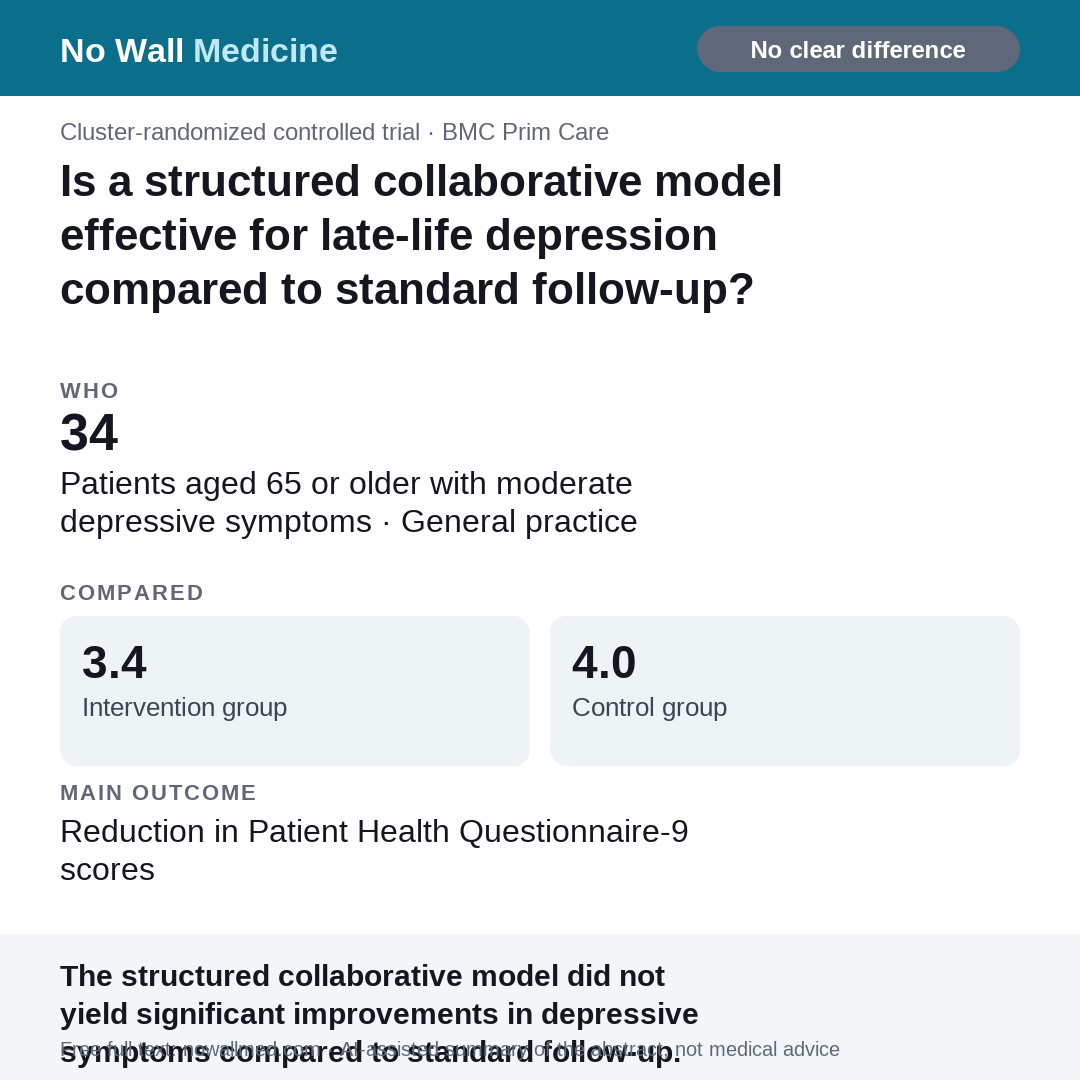
Clinical question: Is a structured collaborative model effective for late-life depression compared to standard follow-up?
Why it matters: Primary care resources are often limited and access to specialized psychiatric assistance for older adults with depression can be suboptimal.
Key points
- The study followed 34 patients aged 65 or older with moderate depression to compare a collaborative model of joint consultations against standard follow-up.
- While the intervention group had a greater likelihood of a 50% reduction in depression scores, the difference was not statistically significant.
- At 18 months, mean depression scores decreased by 3.4 in the intervention group and 4.0 in the control group, with no significant difference between them.
Limitation the authors note: The authors state that major challenges in the recruitment process likely contributed to a low participation rate.
Headline and key points written with AI from the paper’s abstract, with every number checked against it. Read the paper before relying on them.
Was this summary helpful?
Subject terms
Cite this article
Kvalbein-Olsen LC, Aakhus E, Haavet OR, Mdala I, Werner EL. Joint consultations in a structured GP-patient-geriatric-psychiatrist model for late-life depression: a cluster RCT. BMC Prim Care. 2025. doi:10.1186/s12875-025-03002-w
Spotted a mistake? Suggest a correction