Ketamine showed an 83.2% probability of reducing mortality compared to etomidate during intubation
Ketamine versus etomidate as an induction agent for tracheal intubation in critically ill adults: a Bayesian meta-analysis
Bayesian meta-analysisBenefit found
Does ketamine reduce mortality compared to etomidate in critically ill patients undergoing intubation?
Who
2978
Critically ill adults undergoing tracheal intubation
Compared
25%Ketamine (376/1475)
27%Etomidate (411/1503)
Main outcome
Mortality at the longest follow-up available
Result: risk ratio 0.93 (95% CrI 0.79-1.08)
Bottom line: Ketamine showed a moderate probability of reducing mortality compared to etomidate in critically ill patients.
Crit Care · 2024-02-17Download image
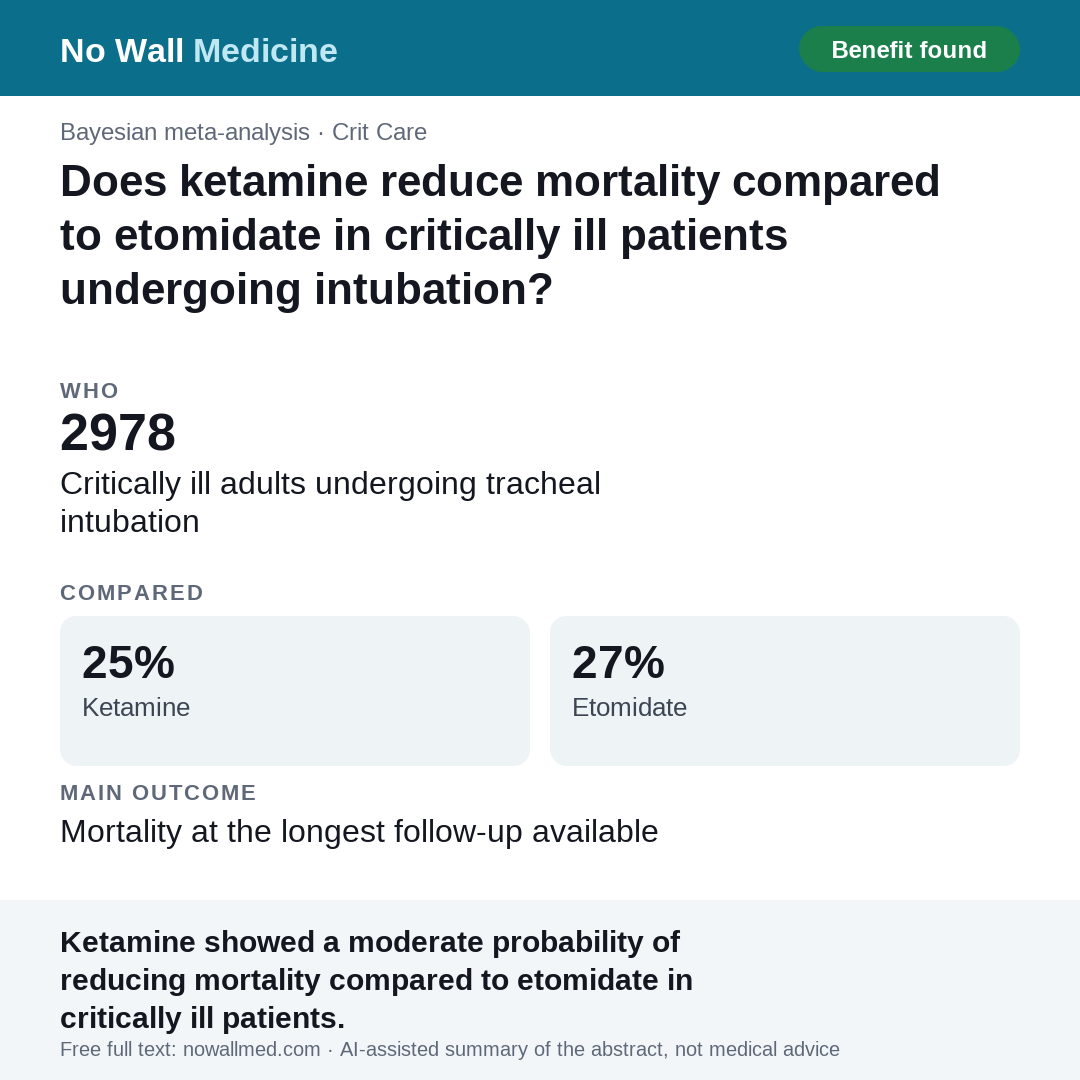
Clinical question: Does ketamine reduce mortality compared to etomidate in critically ill patients undergoing intubation?
Why it matters: It was unknown whether using ketamine instead of other agents like etomidate reduces mortality in critically ill patients undergoing tracheal intubation.
Key points
- Researchers analyzed 2978 patients from seven randomized trials and one propensity-matched study comparing ketamine to etomidate for tracheal intubation.
- The probability that ketamine reduced mortality was 83.2%, with 376/1475 [25%] deaths in the ketamine group versus 411/1503 [27%] in the etomidate group.
- No significant difference was observed in secondary outcomes including Sequential Organ Failure Assessment scores, ventilator-free days, or successful first-attempt intubations.
Headline and key points written with AI from the paper’s abstract, with every number checked against it. Read the paper before relying on them.
Topics
Cite this article
Koroki T, Kotani Y, Yaguchi T, Shibata T, Fujii M, Fresilli S. Ketamine versus etomidate as an induction agent for tracheal intubation in critically ill adults: a Bayesian meta-analysis. Crit Care. 2024. doi:10.1186/s13054-024-04831-4
Spotted a mistake? Suggest a correction
Top studies every Monday
The week’s key trials and guidelines in your specialties, plus any topics you follow. By email, free.
Get the weekly digest