Laparoscopic lavage for Hinchey III perforated diverticulitis: factors for treatment failure in two randomized clinical trials
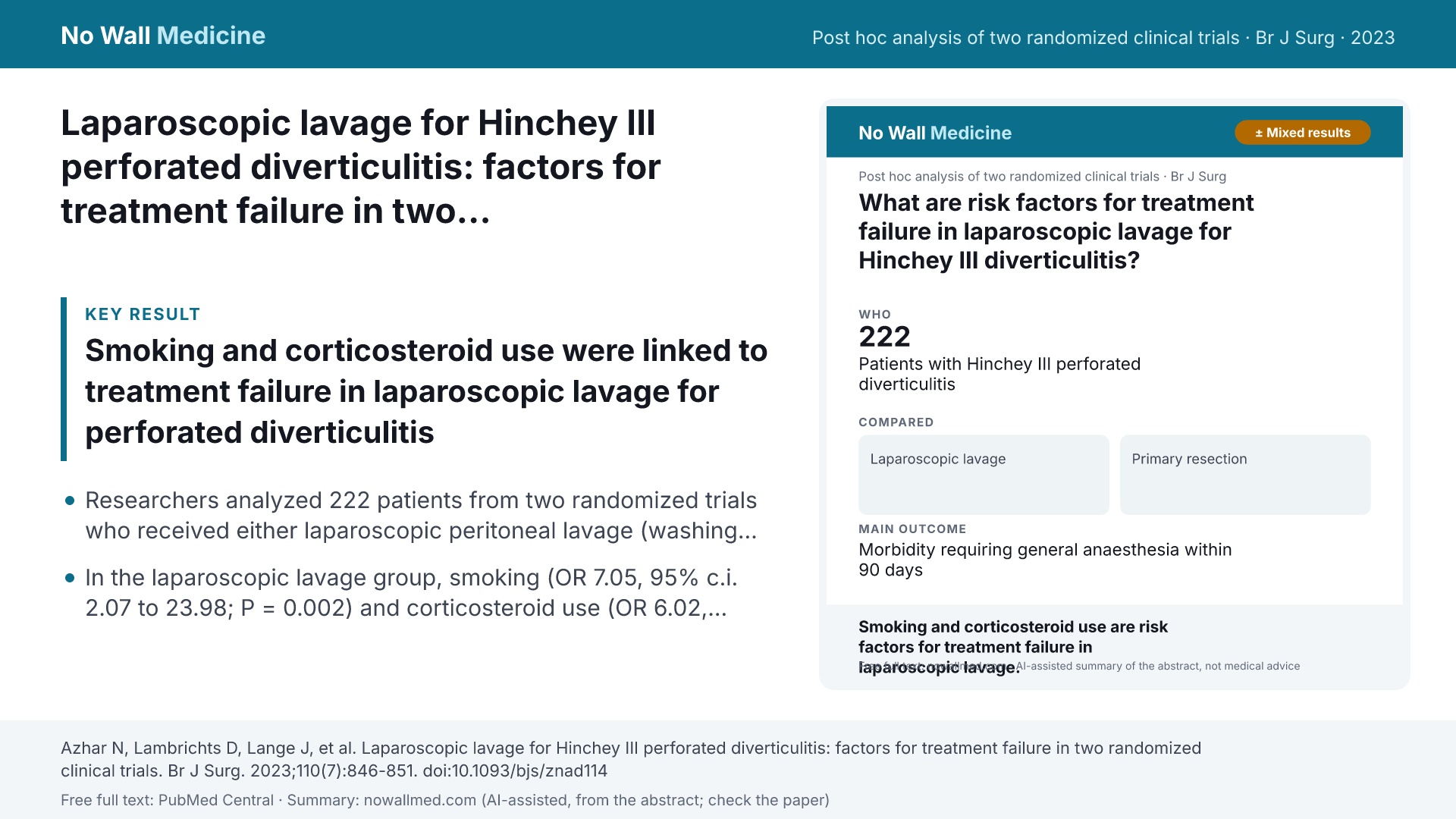
Key result: Smoking and corticosteroid use were linked to treatment failure in laparoscopic lavage for perforated diverticulitis
Post hoc analysis of two randomized clinical trialsMixed results
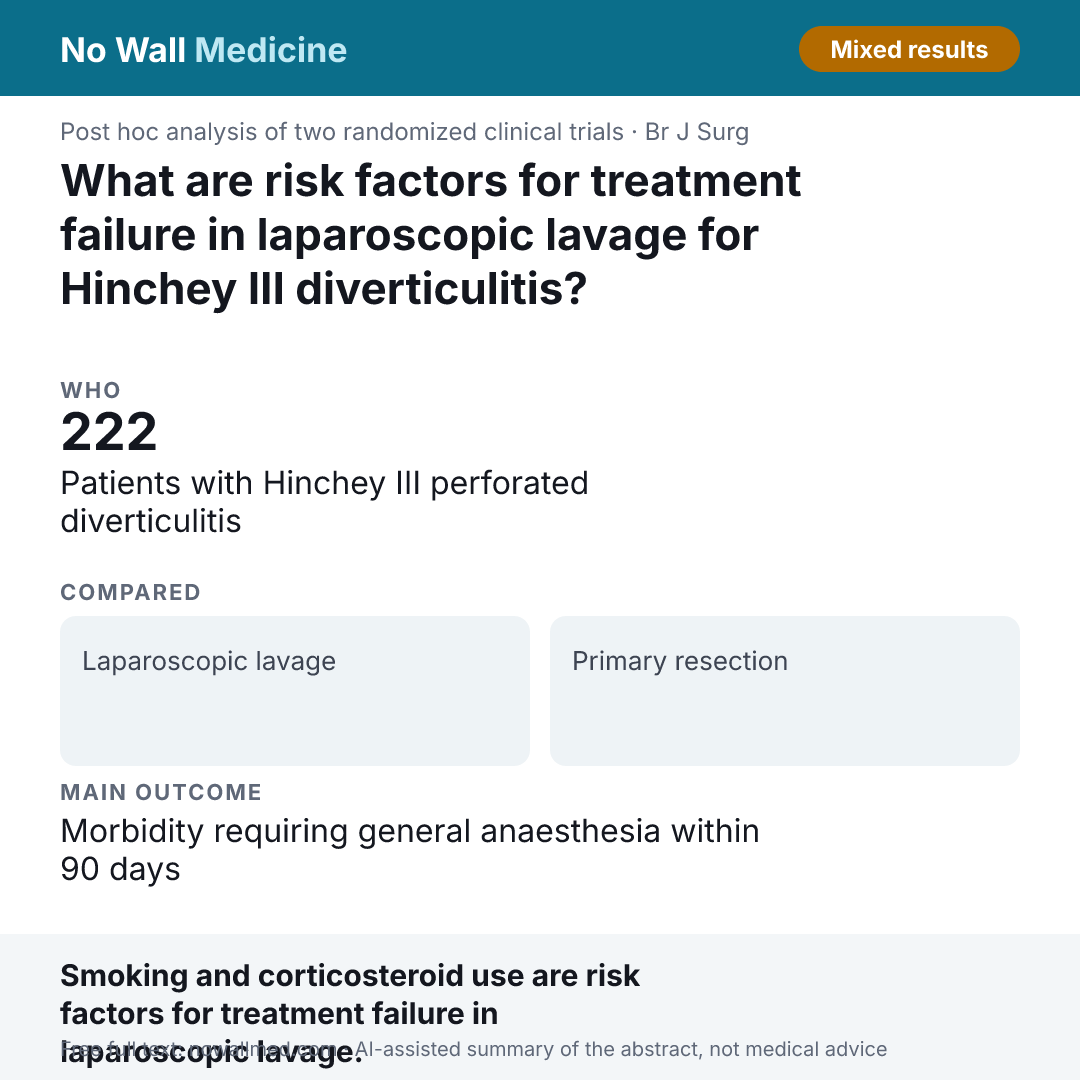
What are risk factors for treatment failure in laparoscopic lavage for Hinchey III diverticulitis?
Who
222
Patients with Hinchey III perforated diverticulitis
Compared
Laparoscopic lavage
Primary resection
Main outcome
Morbidity requiring general anaesthesia within 90 days
Bottom line: Smoking and corticosteroid use are risk factors for treatment failure in laparoscopic lavage.
Br J Surg · 2023-05-19 · Save PNG
Key points
- Researchers analyzed 222 patients from two randomized trials who received either laparoscopic peritoneal lavage (washing out the abdominal cavity) or sigmoid resection (removing part of the colon).
- In the laparoscopic lavage group, smoking (OR 7.05, 95% c.i. 2.07 to 23.98; P = 0.002) and corticosteroid use (OR 6.02, 1.54 to 23.51; P = 0.010) were associated with advanced morbidity.
- Treatment failure was defined as complications requiring general anesthesia within 90 days.
Discussion prompts
- Would these patients look like yours? Who was left out?
- Is the main outcome one that matters to patients?
- Is the difference large enough to change what you do?
Cite: Azhar N, Lambrichts D, Lange J, et al. Laparoscopic lavage for Hinchey III perforated diverticulitis: factors for treatment failure in two randomized clinical trials. Br J Surg. 2023;110(7):846-851. doi:10.1093/bjs/znad114
Free full text: PubMed Central · Summary and visual abstract: nowallmed.com/a/laparoscopic-lavage-for-hinchey-iii-perforated-diverticulitis-factors-yswpnb/ (AI-assisted from the abstract; check the paper before relying on it).