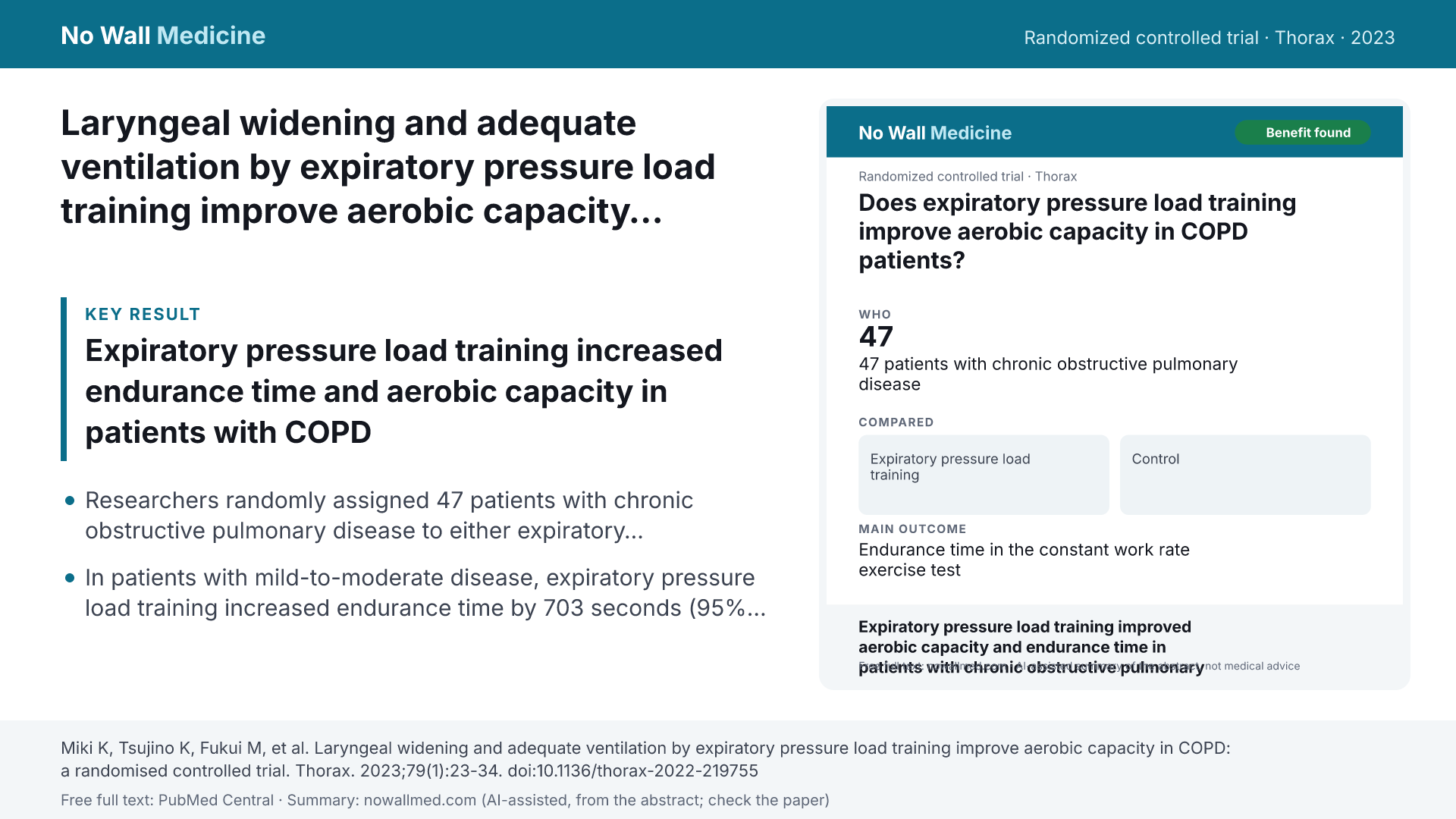
Expiratory pressure load training increased endurance time and aerobic capacity in patients with COPD
Laryngeal widening and adequate ventilation by expiratory pressure load training improve aerobic capacity in COPD: a randomised controlled trial
Randomized controlled trialBenefit found
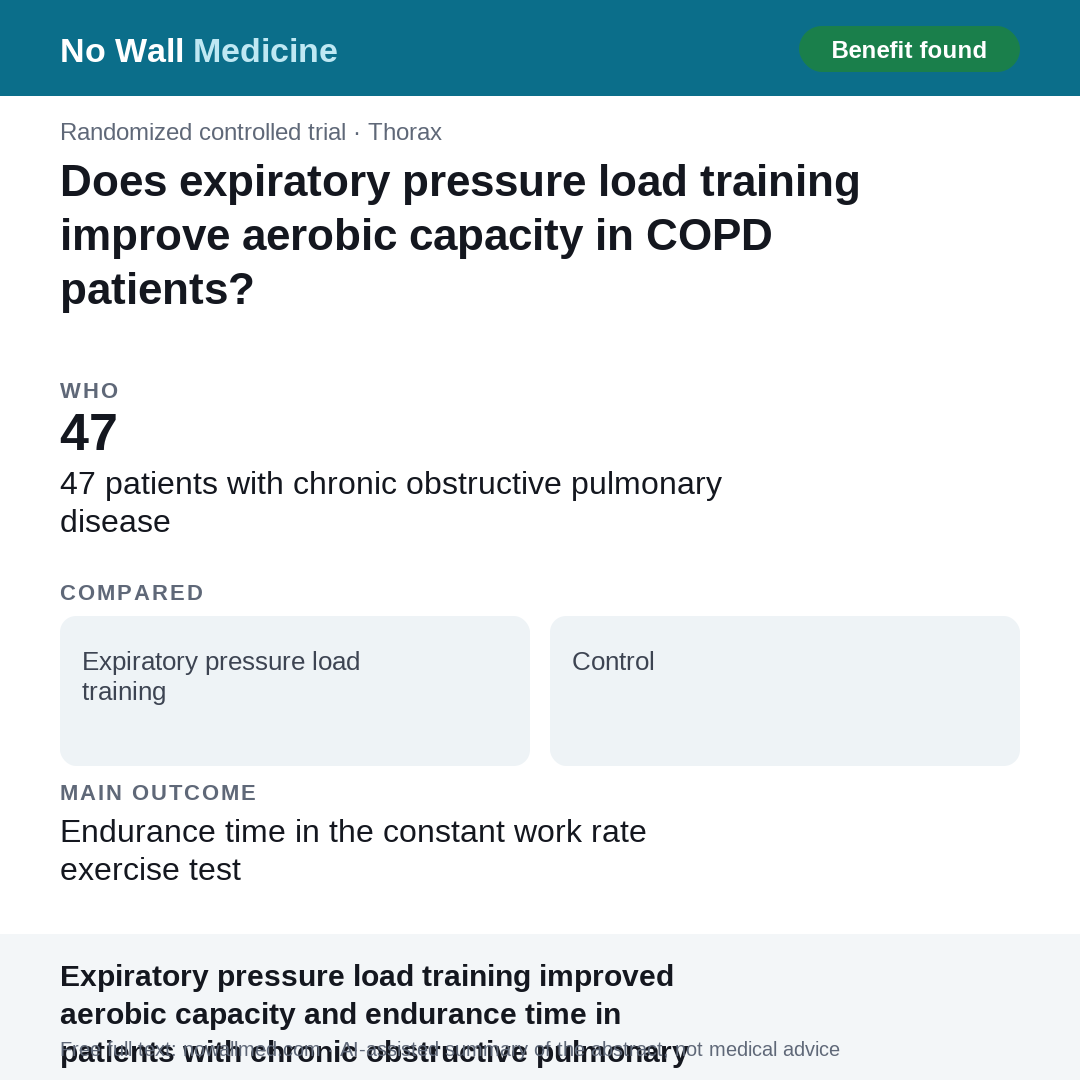
Does expiratory pressure load training improve aerobic capacity in COPD patients?
Who
47
47 patients with chronic obstructive pulmonary disease
Compared
Expiratory pressure load training
Control
Main outcome
Endurance time in the constant work rate exercise test
Result: +390 (95% CI: 205 to 574) s in GOLD III-IV
Bottom line: Expiratory pressure load training improved aerobic capacity and endurance time in patients with chronic obstructive pulmonary disease.
Thorax · 2023-12-15Download image
Clinical question: Does expiratory pressure load training improve aerobic capacity in COPD patients?
Why it matters: Exercise intolerance remains inadequately improved despite existing strategies that target peripheral airway obstruction in chronic obstructive pulmonary disease.
Key points
- Researchers randomly assigned 47 patients with chronic obstructive pulmonary disease to either expiratory pressure load training or a control group for 3 months.
- In patients with mild-to-moderate disease, expiratory pressure load training increased endurance time by 703 seconds (95% CI: 379 to 1031) and improved peak oxygen uptake.
- In patients with severe-to-very severe disease, training increased endurance time by 390 seconds (95% CI: 205 to 574) and improved peak oxygen uptake.
Headline and key points written with AI from the paper’s abstract, with every number checked against it. Read the paper before relying on them.
Was this summary helpful?
Abstract
Rationale
Despite strategies acting on peripheral airway obstruction in chronic obstructive pulmonary disease (COPD), exercise intolerance remains inadequately improved. We hypothesised that laryngeal narrowing is a potential treatment target of expiratory pressure load training (EPT) to improve exercise intolerance in COPD. Methods
The effect of 3-month EPT was assessed in 47 patients with COPD divided into Global Initiative for Chronic Obstructive Lung Disease (GOLD) mild-to-moderate (I-II) and severe-to-very severe (III-IV), randomly allocating 1:1 to EPT or control groups. The primary outcome was endurance time in the constant work rate exercise test in GOLD III-IV patients. Results
Compared with controls, EPT increased: (1) endurance time, with estimated treatment effect: +703 (95% CI: 379 to 1031) s, p=0.0008 (GOLD I-II); +390 (95% CI: 205 to 574) s, p=0.0006 (GOLD III-IV); (2) peak oxygen uptake (p=0.0086 in GOLD I-II; p=0.0004 in GOLD III-IV); (3) glottic dilatation ratio at maximum collapse on laryngoscopy in the submaximal exercise (p=0.0062 in GOLD I-II; p=0.0001 in GOLD III-IV); and (4) the inflection point of expiratory tidal volume relative to minute ventilation during the incremental exercise (p=0.0015 in GOLD I-II; p=0.0075 in GOLD III-IV). Across GOLD grades, the responses of glottic dilatation ratio at maximum collapse and the expiratory tidal volume at the inflection point were selected as more influential variables correlating with the improvement in peak oxygen uptake and endurance time, respectively. Conclusion
These results show that EPT improved aerobic capacity and endurance time with larger laryngeal widening and adequate ventilation despite advanced COPD. Trial registration number
UMIN000041250.
Abstract reproduced under the article’s CC BY NC licence.
Subject terms
Cite this article
Miki K, Tsujino K, Fukui M, Miki M, Kitajima T, Sumitani H. Laryngeal widening and adequate ventilation by expiratory pressure load training improve aerobic capacity in COPD: a randomised controlled trial. Thorax. 2023. doi:10.1136/thorax-2022-219755
Spotted a mistake? Suggest a correction