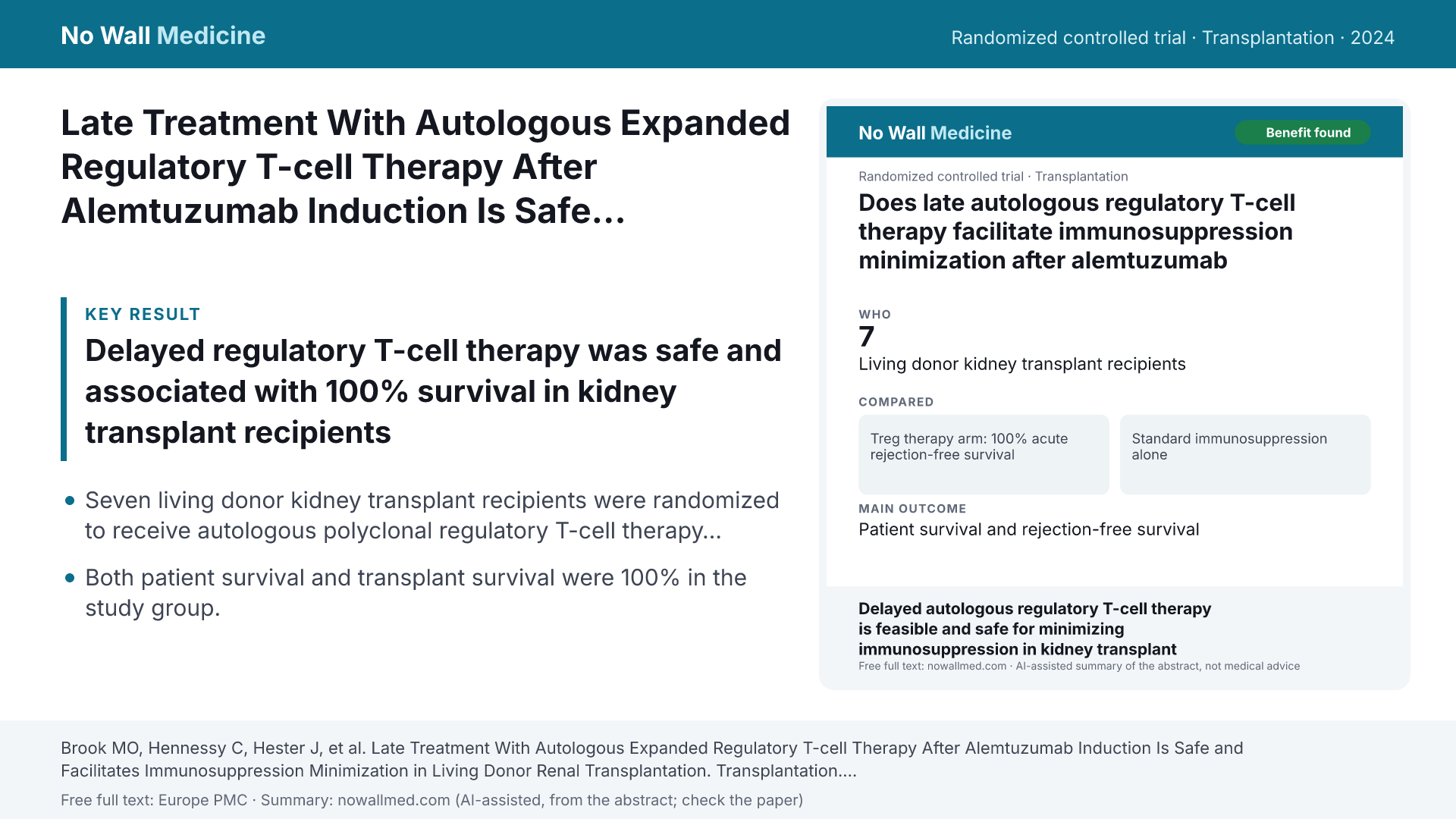
Delayed regulatory T-cell therapy was safe and associated with 100% survival in kidney transplant recipients
Late Treatment With Autologous Expanded Regulatory T-cell Therapy After Alemtuzumab Induction Is Safe and Facilitates Immunosuppression Minimization in Living Donor Renal Transplantation
Randomized controlled trialBenefit found
Does late autologous regulatory T-cell therapy facilitate immunosuppression minimization after alemtuzumab induction?
Who
7
Living donor kidney transplant recipients
Compared
Treg therapy arm: 100% acute rejection-free survival
Standard immunosuppression alone
Main outcome
Patient survival and rejection-free survival
Bottom line: Delayed autologous regulatory T-cell therapy is feasible and safe for minimizing immunosuppression in kidney transplant recipients.
Transplantation · 2024-10-22Download image
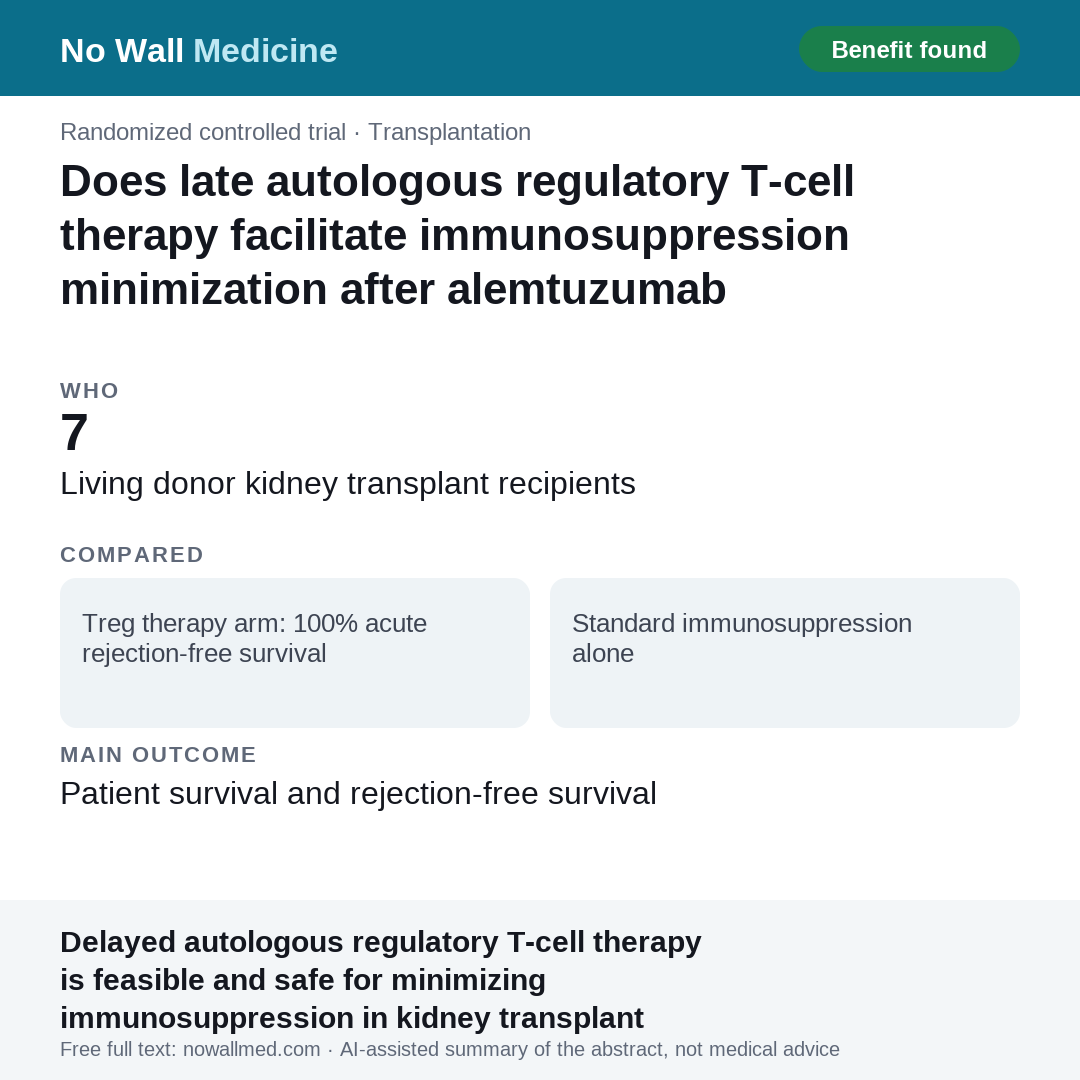
Clinical question: Does late autologous regulatory T-cell therapy facilitate immunosuppression minimization after alemtuzumab induction?
Key points
- Seven living donor kidney transplant recipients were randomized to receive autologous polyclonal regulatory T-cell therapy at week 26 or standard immunosuppression alone.
- Both patient survival and transplant survival were 100% in the study group.
- Acute rejection-free survival was 100% in the regulatory T-cell treated group at 18 mo after transplantation.
Headline and key points written with AI from the paper’s abstract, with every number checked against it. Read the paper before relying on them.
Was this summary helpful?
Abstract
Background
The TWO Study (Transplantation Without Overimmunosuppression) aimed to investigate a novel approach to regulatory T-cell (Treg) therapy in renal transplant patients, using a delayed infusion protocol at 6 mo posttransplant to promote a Treg-skewed lymphocyte repopulation after alemtuzumab induction. We hypothesized that this would allow safe weaning of immunosuppression to tacrolimus alone. The COVID-19 pandemic led to the suspension of alemtuzumab use, and therefore, we report the unique cohort of 7 patients who underwent the original randomized controlled trial protocol. This study presents a unique insight into Treg therapy combined with alemtuzumab and is therefore an important proof of concept for studies in other diseases that are considering lymphodepletion.Methods
Living donor kidney transplant recipients were randomized to receive autologous polyclonal Treg at week 26 posttransplantation, coupled with weaning doses of tacrolimus, (Treg therapy arm) or standard immunosuppression alone (tacrolimus and mycophenolate mofetil). Primary outcomes were patient survival and rejection-free survival.Results
Successful cell manufacturing and cryopreservation until the 6-mo infusion were achieved. Patient and transplant survival was 100%. Acute rejection-free survival was 100% in the Treg-treated group at 18 mo after transplantation. Although alemtuzumab caused a profound depletion of all lymphocytes, including Treg, after cell therapy infusion, there was a transient increase in peripheral Treg numbers.Conclusions
The study establishes that delayed autologous Treg therapy is both feasible and safe, even 12 mo after cell production. The findings present a new treatment protocol for Treg therapy, potentially expanding its applications to other indications.
Abstract reproduced under the article’s CC BY-NC-ND licence.
Subject terms
Cite this article
Brook MO, Hennessy C, Hester J, et al. Late Treatment With Autologous Expanded Regulatory T-cell Therapy After Alemtuzumab Induction Is Safe and Facilitates Immunosuppression Minimization in Living Donor Renal Transplantation. Transplantation. 2024. doi:10.1097/tp.0000000000005065
Spotted a mistake? Suggest a correction