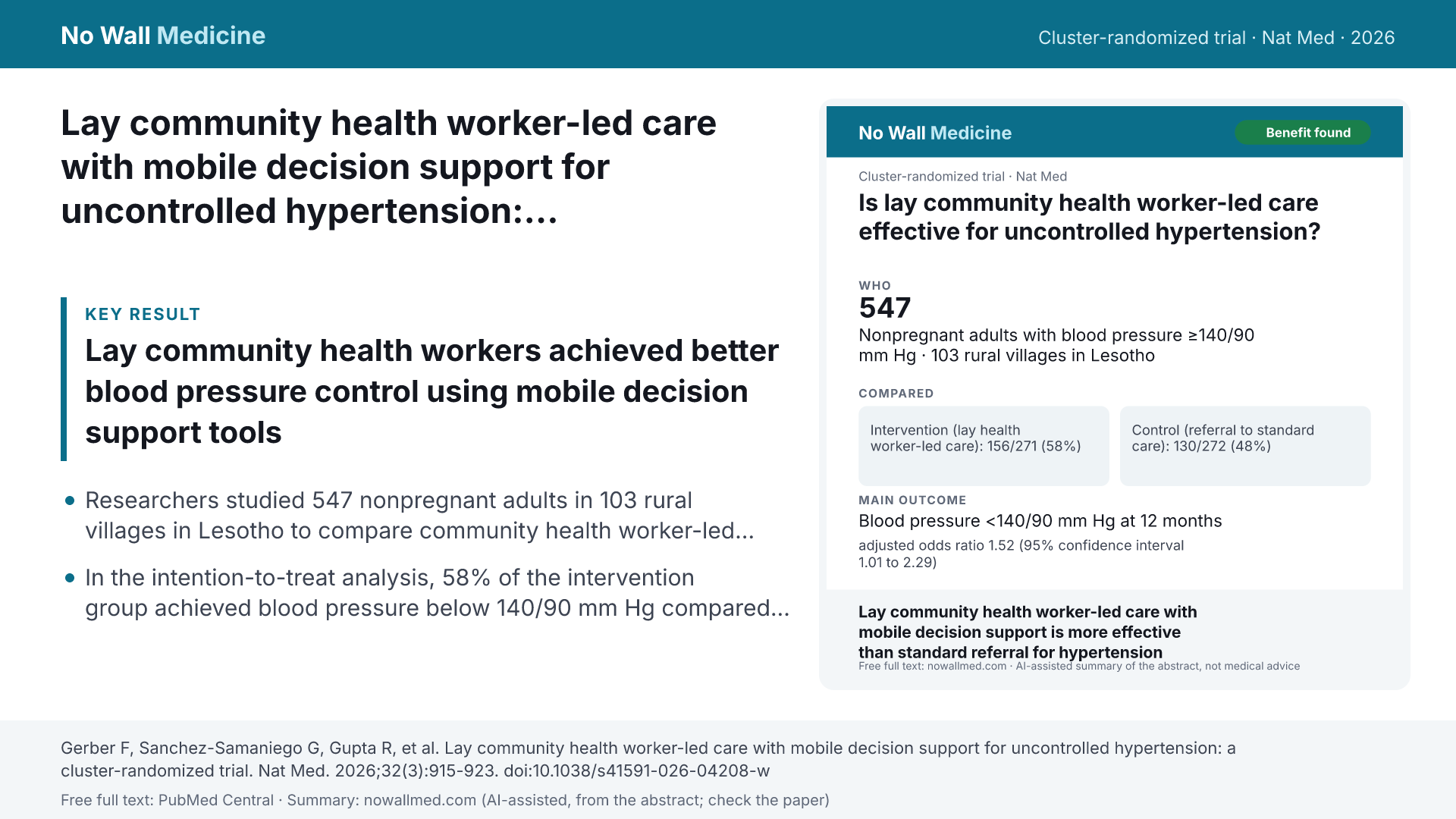
Lay community health workers achieved better blood pressure control using mobile decision support tools
Lay community health worker-led care with mobile decision support for uncontrolled hypertension: a cluster-randomized trial
Cluster-randomized trialBenefit found
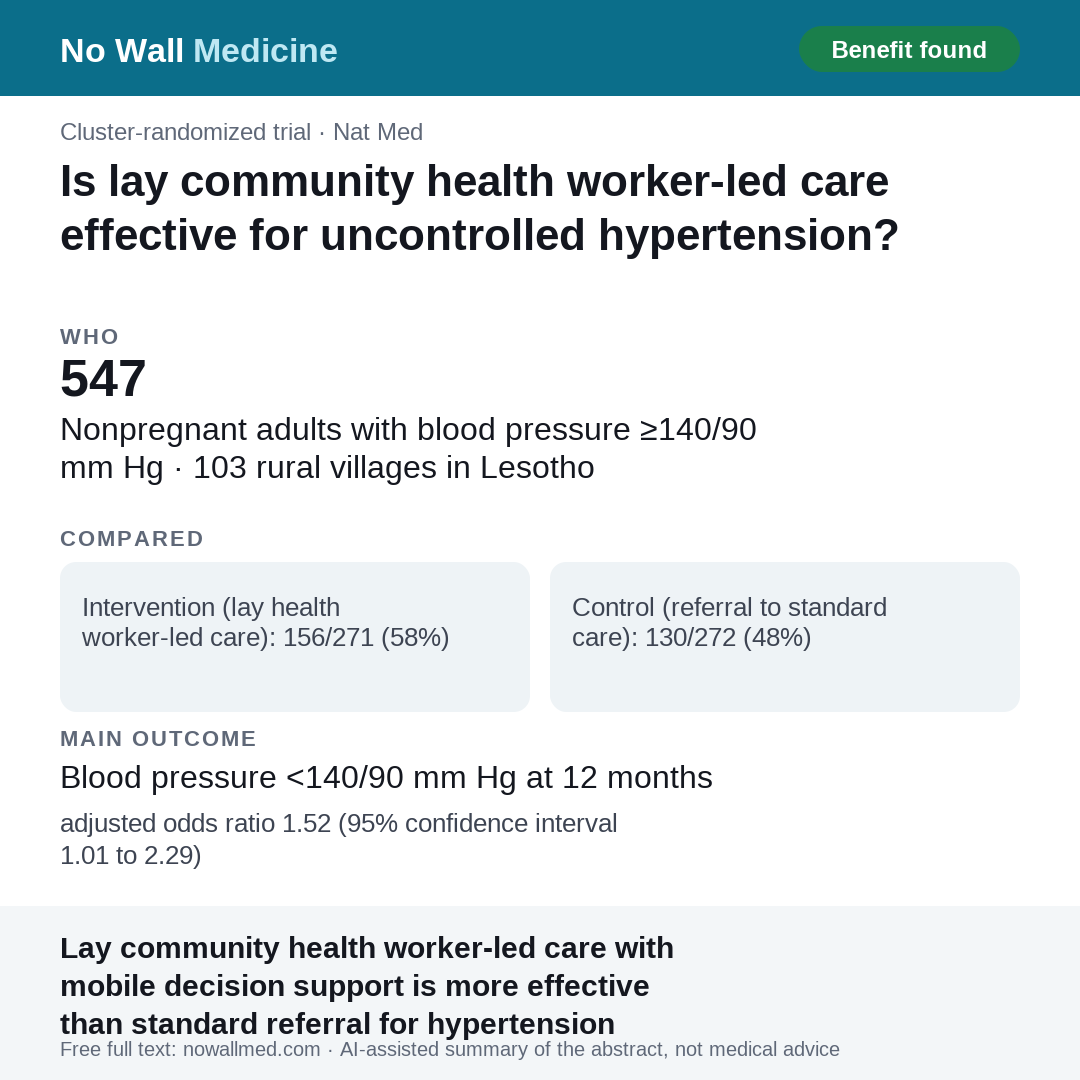
Is lay community health worker-led care effective for uncontrolled hypertension?
Who
547
Nonpregnant adults with blood pressure ≥140/90 mm Hg · 103 rural villages in Lesotho
Compared
Intervention (lay health worker-led care): 156/271 (58%)
Control (referral to standard care): 130/272 (48%)
Main outcome
Blood pressure <140/90 mm Hg at 12 months
Result: adjusted odds ratio 1.52 (95% confidence interval 1.01 to 2.29)
Bottom line: Lay community health worker-led care with mobile decision support is more effective than standard referral for hypertension control.
Nat Med · 2026-02-12Download image
Clinical question: Is lay community health worker-led care effective for uncontrolled hypertension?
Why it matters: The effectiveness and safety of lay community health workers independently starting and adjusting blood pressure medications remain uncertain in resource-limited settings.
Key points
- Researchers studied 547 nonpregnant adults in 103 rural villages in Lesotho to compare community health worker-led care with standard facility-based referrals.
- In the intention-to-treat analysis, 58% of the intervention group achieved blood pressure below 140/90 mm Hg compared to 48% in the control group.
- The study found no relevant differences in safety outcomes between the two different care approaches.
Headline and key points written with AI from the paper’s abstract, with every number checked against it. Read the paper before relying on them.
Was this summary helpful?
Subject terms
Cite this article
Gerber F, Sanchez-Samaniego G, Gupta R, et al. Lay community health worker-led care with mobile decision support for uncontrolled hypertension: a cluster-randomized trial. Nat Med. 2026. doi:10.1038/s41591-026-04208-w
Spotted a mistake? Suggest a correction