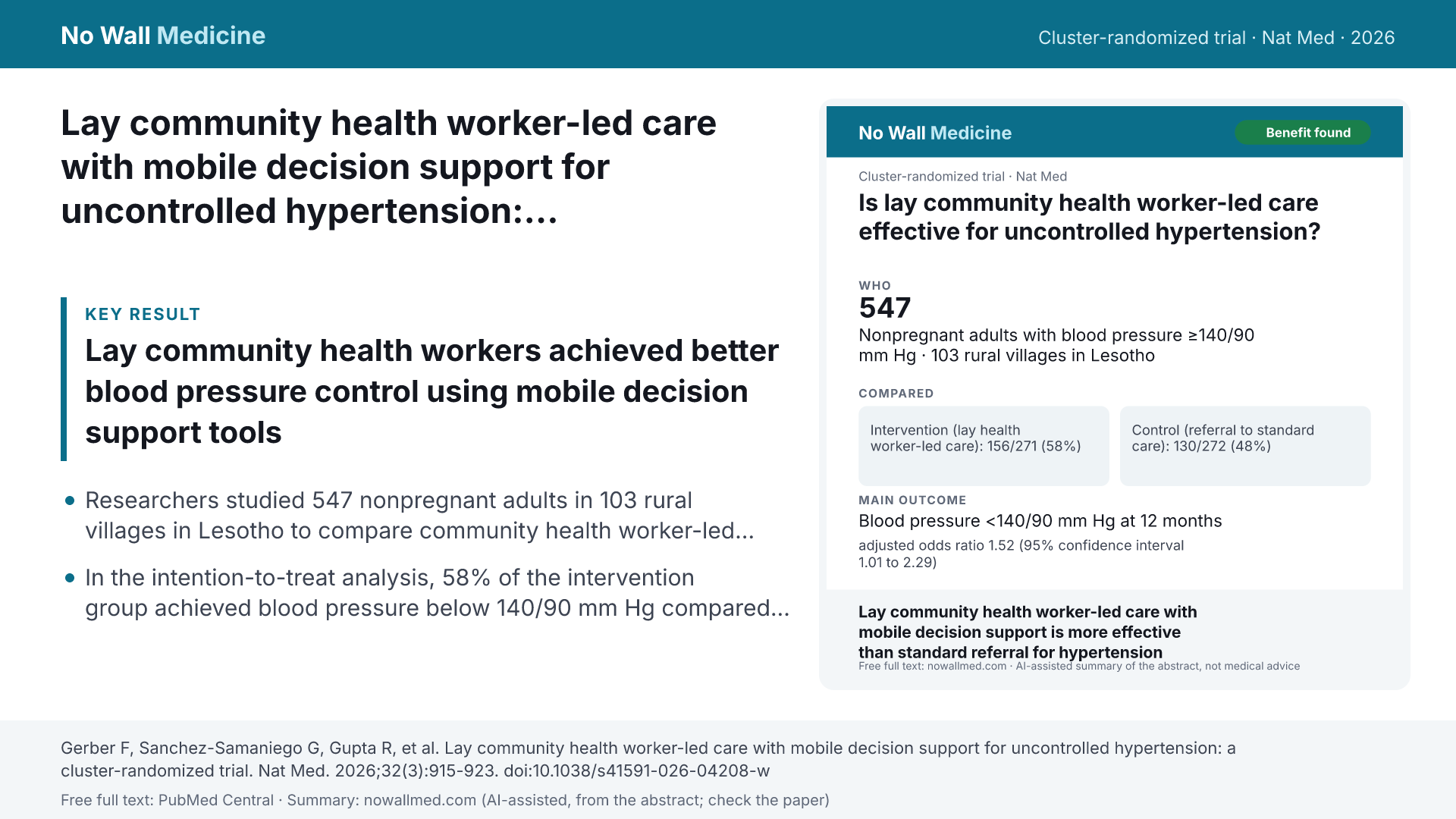
Lay community health worker-led care with mobile decision support for uncontrolled hypertension: a cluster-randomized trial
Key result: Lay community health workers achieved better blood pressure control using mobile decision support tools
Key points
- Researchers studied 547 nonpregnant adults in 103 rural villages in Lesotho to compare community health worker-led care with standard facility-based referrals.
- In the intention-to-treat analysis, 58% of the intervention group achieved blood pressure below 140/90 mm Hg compared to 48% in the control group.
- The study found no relevant differences in safety outcomes between the two different care approaches.
Why it matters: The effectiveness and safety of lay community health workers independently starting and adjusting blood pressure medications remain uncertain in resource-limited settings.
Discussion prompts
- Would these patients look like yours? Who was left out?
- Is the main outcome one that matters to patients?
- Is the difference large enough to change what you do?
Cite: Gerber F, Sanchez-Samaniego G, Gupta R, et al. Lay community health worker-led care with mobile decision support for uncontrolled hypertension: a cluster-randomized trial. Nat Med. 2026;32(3):915-923. doi:10.1038/s41591-026-04208-w
Free full text: PubMed Central · Summary and visual abstract: nowallmed.com/a/lay-community-health-worker-led-care-with-mobile-decision-support-for-kym0pk/ (AI-assisted from the abstract; check the paper before relying on it).