Bayesian analysis identifies 10 mg/kg biweekly dose as most effective for early Alzheimer disease
Lecanemab for Patients With Early Alzheimer Disease: Bayesian Analysis of a Phase 2b Dose-Finding Randomized Clinical Trial
Bayesian adaptive randomization phase 2b trialBenefit found
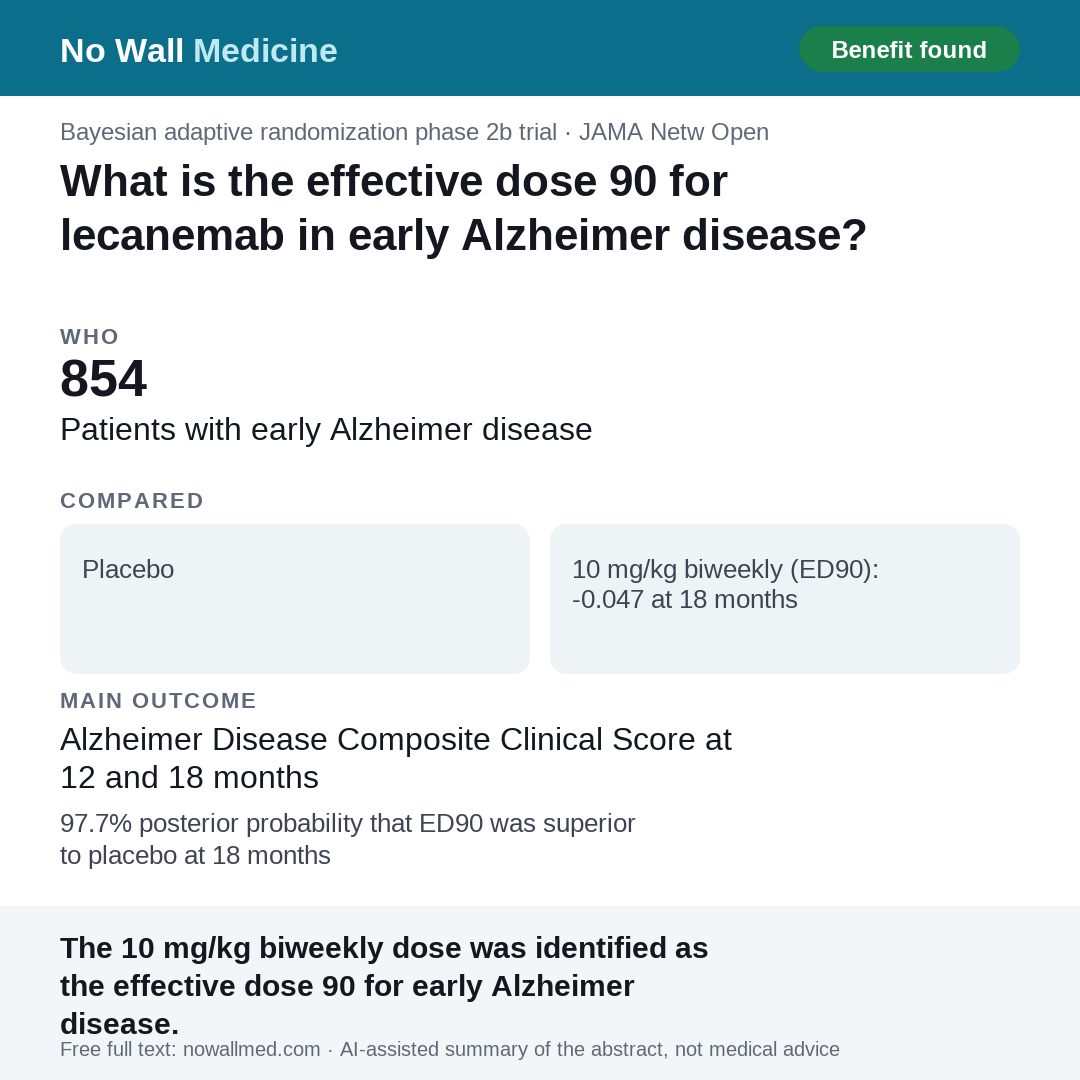
What is the effective dose 90 for lecanemab in early Alzheimer disease?
Who
854
Patients with early Alzheimer disease
Compared
Placebo
10 mg/kg biweekly (ED90): -0.047 at 18 months
Main outcome
Alzheimer Disease Composite Clinical Score at 12 and 18 months
Result: 97.7% posterior probability that ED90 was superior to placebo at 18 months
Bottom line: The 10 mg/kg biweekly dose was identified as the effective dose 90 for early Alzheimer disease.
JAMA Netw Open · 2023-04-03Download image
Clinical question: What is the effective dose 90 for lecanemab in early Alzheimer disease?
Why it matters: The optimal dose for treating early Alzheimer disease needed to be identified through an efficient trial design that could handle missing data.
Key points
- The study analyzed 854 patients, including 238 in a placebo group and 587 receiving one of five lecanemab dosages, to find the dose achieving 90% of maximum effectiveness.
- The 10 mg/kg biweekly dose was identified as the effective dose 90, with a 97.5% posterior probability of being superior to placebo at 12 months and 97.7% at 18 months.
- Using a Bayesian approach allowed more patients to be assigned to better-performing doses, such as 30% receiving 10 mg/kg monthly and 19% receiving 10 mg/kg biweekly.
Headline and key points written with AI from the paper’s abstract, with every number checked against it. Read the paper before relying on them.
Was this summary helpful?
Subject terms
Cite this article
Berry DA, Dhadda S, Kanekiyo M, Li D, Swanson CJ, Irizarry M. Lecanemab for Patients With Early Alzheimer Disease: Bayesian Analysis of a Phase 2b Dose-Finding Randomized Clinical Trial. JAMA Netw Open. 2023. doi:10.1001/jamanetworkopen.2023.7230
Spotted a mistake? Suggest a correction
Top studies every Monday
The week’s key trials and guidelines in your specialties, plus any topics you follow. By email, free.
Get the weekly digest