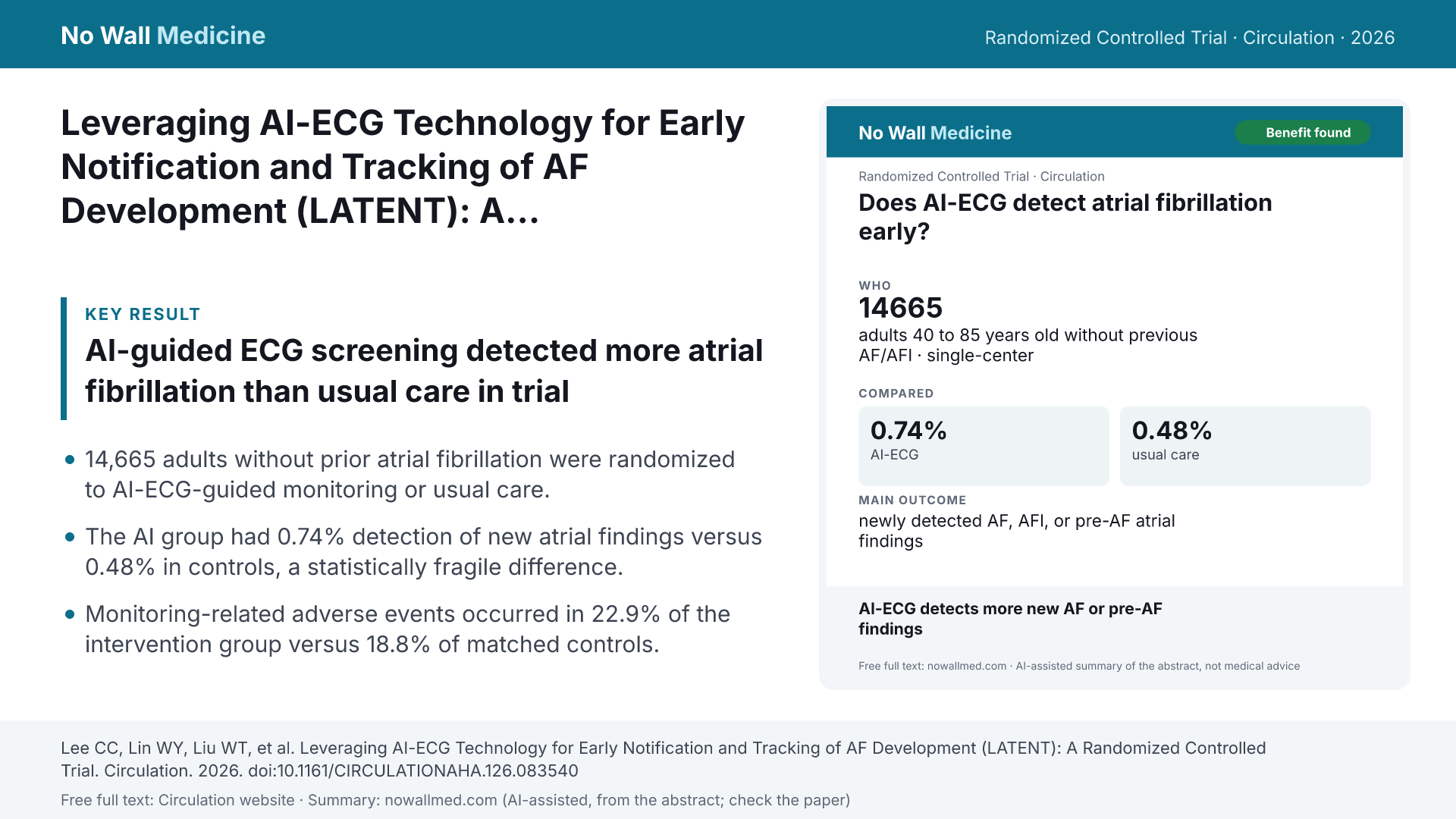
AI-guided ECG screening detected more atrial fibrillation than usual care in trial
Leveraging AI-ECG Technology for Early Notification and Tracking of AF Development (LATENT): A Randomized Controlled Trial
Randomized Controlled TrialBenefit found
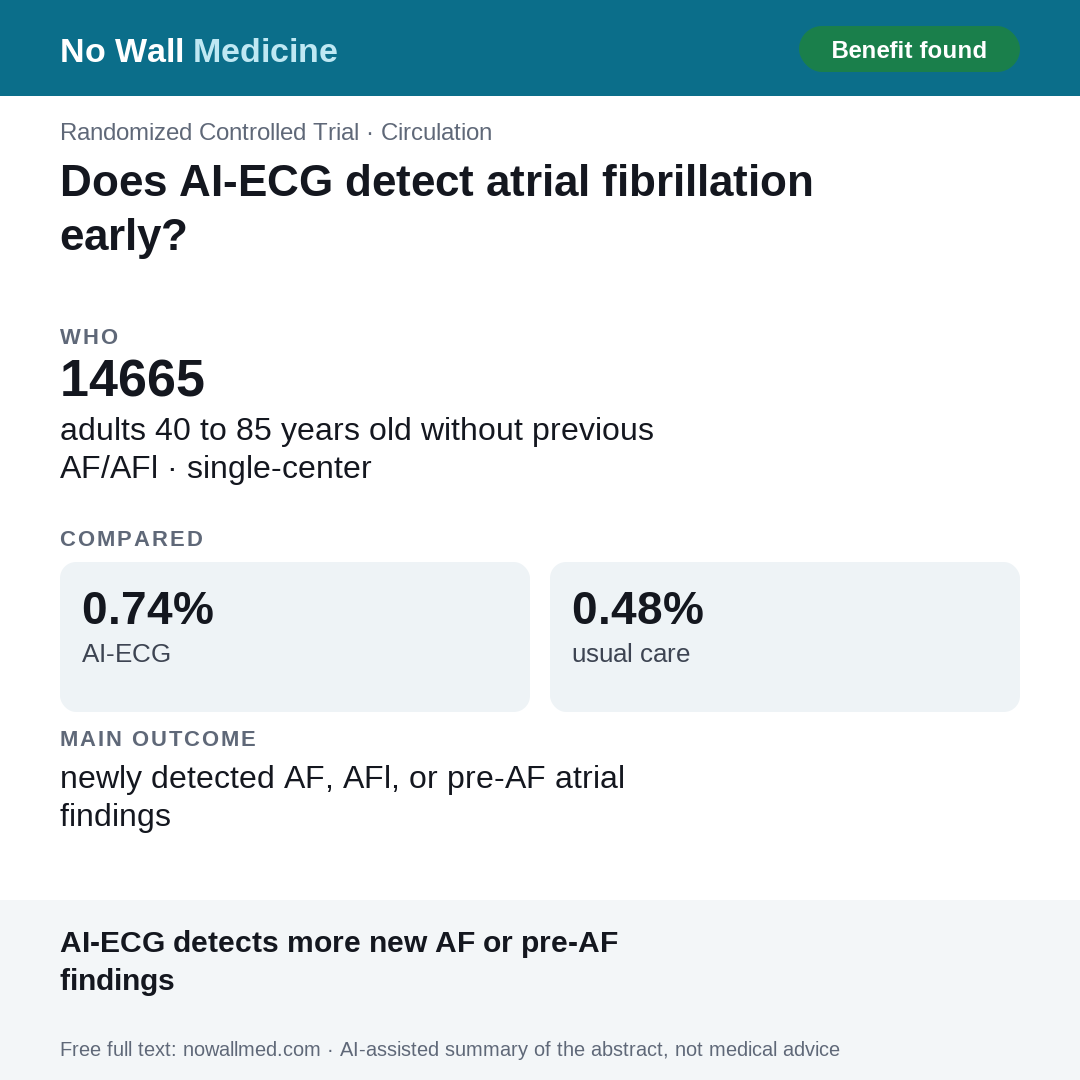
Does AI-ECG detect atrial fibrillation early?
Who
14665
adults 40 to 85 years old without previous AF/AFl · single-center
Compared
0.74%AI-ECG
0.48%usual care
Main outcome
newly detected AF, AFl, or pre-AF atrial findings
Result: odds ratio 1.54 (95% CI 1.01-2.37)
Bottom line: AI-ECG detects more new AF or pre-AF findings
Limitation: findings fragile statistically
Circulation · 2026-11-07Download image
Clinical question: Does AI-ECG detect atrial fibrillation early?
Why it matters: It was unclear whether AI-enabled ECG analysis could effectively detect atrial fibrillation or pre-atrial fibrillation findings in a randomized trial.
In absolute numbers
AI-ECG: 0.74% · usual care: 0.48% → a difference of 0.3 percentage points, so about 385 people would need the treatment for 1 more to benefit (number needed to treat) over the trial’s follow-up.
Worked out by us from the two group results above, not reported by the authors. Check the paper for the exact outcome and timing.
Key points
- 14,665 adults without prior atrial fibrillation were randomized to AI-ECG-guided monitoring or usual care.
- The AI group had 0.74% detection of new atrial findings versus 0.48% in controls, a statistically fragile difference.
- Monitoring-related adverse events occurred in 22.9% of the intervention group versus 18.8% of matched controls.
Limitation the authors note: The study was conducted at a single center and the primary result was statistically fragile.
Headline and key points written with AI from the paper’s abstract, with every number checked against it. Read the paper before relying on them.
Was this summary helpful?
Cite this article
Lee CC, Lin WY, Liu WT, et al. Leveraging AI-ECG Technology for Early Notification and Tracking of AF Development (LATENT): A Randomized Controlled Trial. Circulation. 2026. doi:10.1161/CIRCULATIONAHA.126.083540
Spotted a mistake? Suggest a correction