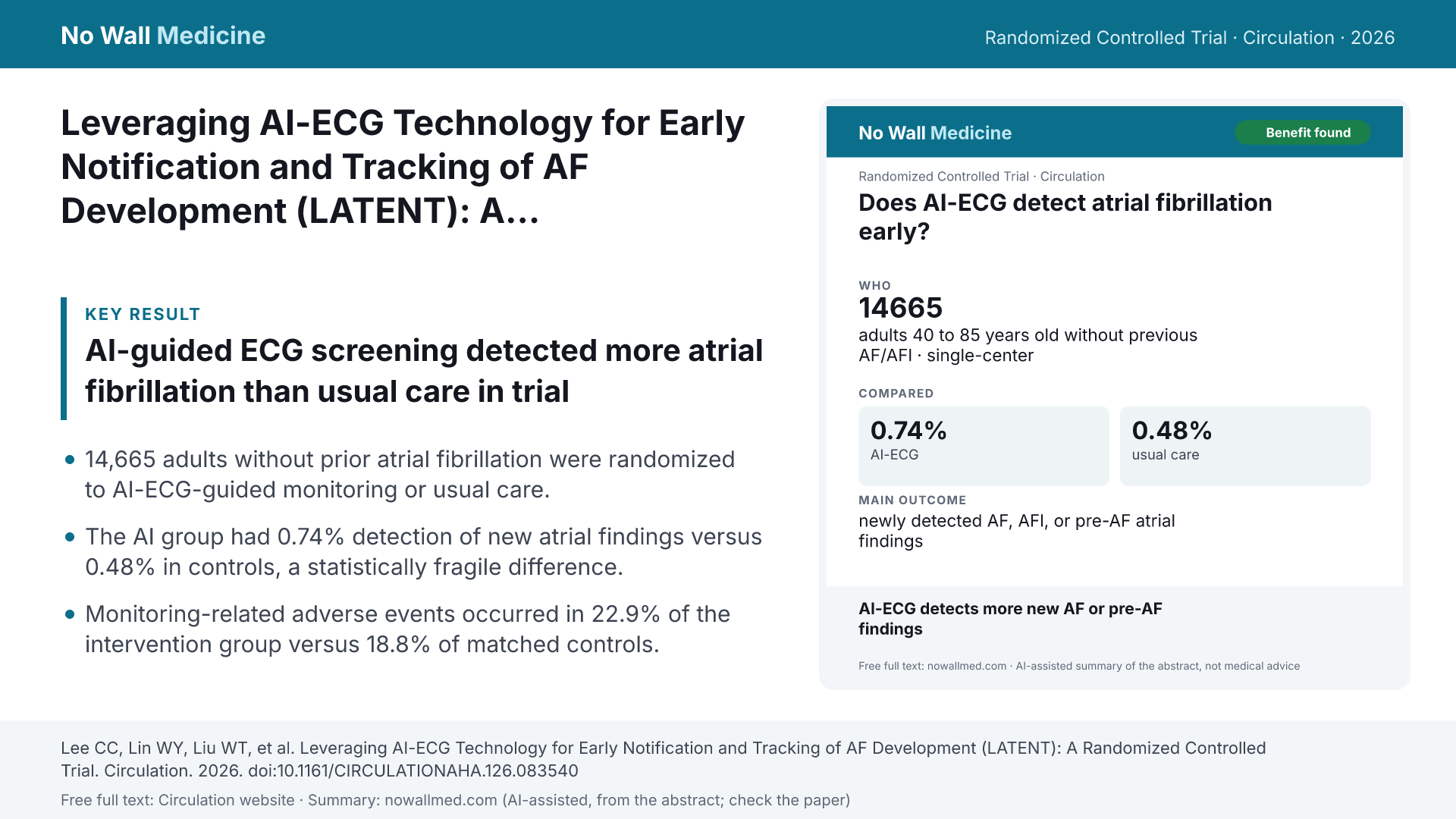
Leveraging AI-ECG Technology for Early Notification and Tracking of AF Development (LATENT): A Randomized Controlled Trial
Key result: AI-guided ECG screening detected more atrial fibrillation than usual care in trial
AI-ECG: 7.4 in 1,000 · usual care: 4.8 in 1,000
About 385 people would need the treatment for 1 more to benefit over the trial’s follow-up (number needed to treat).
Key points
- 14,665 adults without prior atrial fibrillation were randomized to AI-ECG-guided monitoring or usual care.
- The AI group had 0.74% detection of new atrial findings versus 0.48% in controls, a statistically fragile difference.
- Monitoring-related adverse events occurred in 22.9% of the intervention group versus 18.8% of matched controls.
In absolute numbers: AI-ECG 0.74% vs usual care 0.48%, a difference of 0.3 percentage points (about 385 people treated for one more to benefit).
Limitation the authors note: The study was conducted at a single center and the primary result was statistically fragile.
Discussion prompts
- Would these patients look like yours? Who was left out?
- Is the main outcome one that matters to patients?
- Is the difference large enough to change what you do?
Cite: Lee CC, Lin WY, Liu WT, et al. Leveraging AI-ECG Technology for Early Notification and Tracking of AF Development (LATENT): A Randomized Controlled Trial. Circulation. 2026. doi:10.1161/CIRCULATIONAHA.126.083540
Free full text: Circulation website · Summary and visual abstract: nowallmed.com/a/leveraging-ai-ecg-technology-for-early-notification-and-tracking-of-bzy6a0/ (AI-assisted from the abstract; check the paper before relying on it).