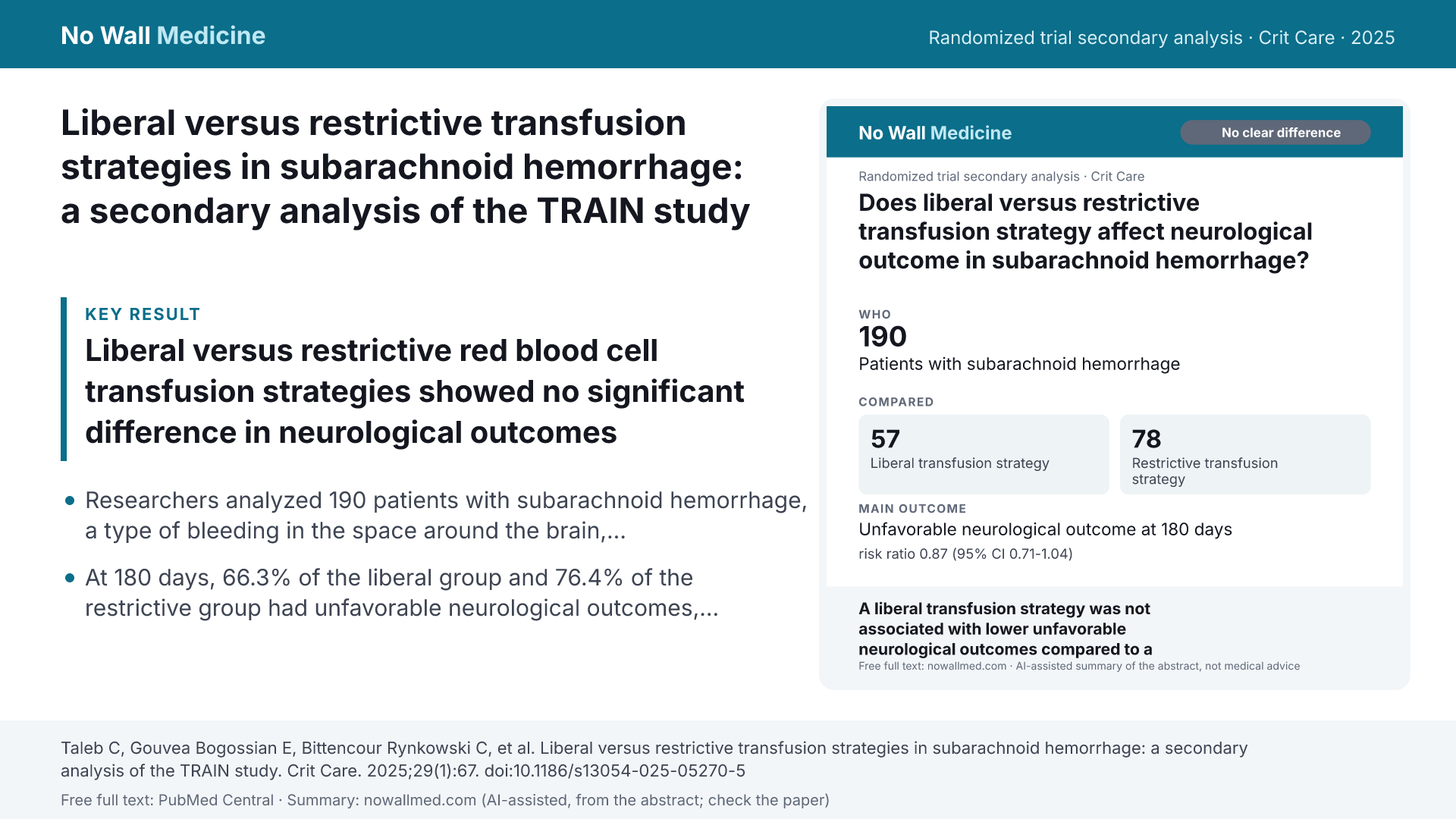
Liberal versus restrictive transfusion strategies in subarachnoid hemorrhage: a secondary analysis of the TRAIN study
Key result: Liberal versus restrictive red blood cell transfusion strategies showed no significant difference in neurological outcomes
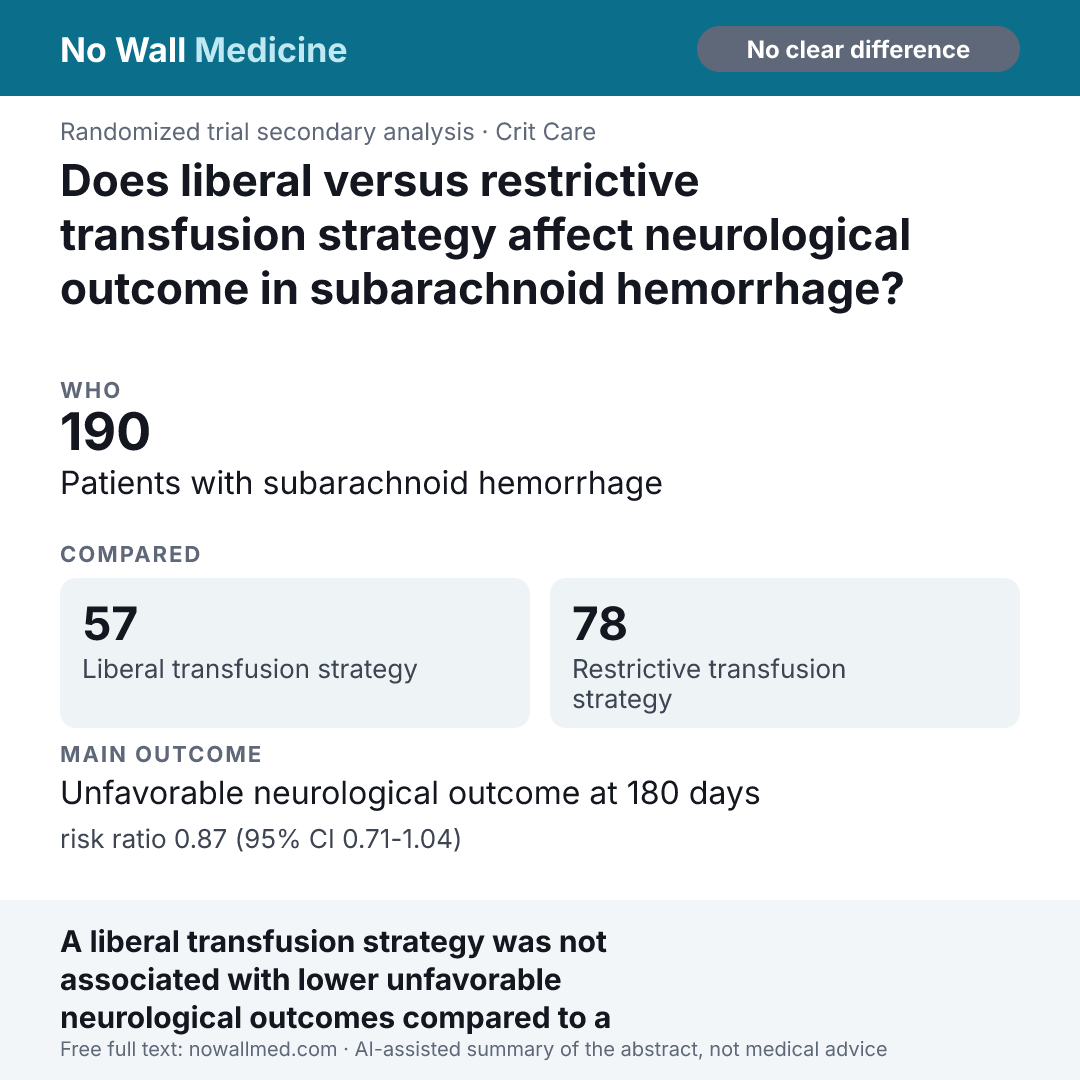
Randomized trial secondary analysisNo clear difference
Does liberal versus restrictive transfusion strategy affect neurological outcome in subarachnoid hemorrhage?
Who
190
Patients with subarachnoid hemorrhage
Compared
57Liberal transfusion strategy (66.3%)
78Restrictive transfusion strategy (76.4%)
Main outcome
Unfavorable neurological outcome at 180 days
Result: risk ratio 0.87 (95% CI 0.71-1.04)
Bottom line: A liberal transfusion strategy was not associated with lower unfavorable neurological outcomes compared to a restrictive strategy.
Crit Care · 2025-02-07 · Save PNG
Key points
- Researchers analyzed 190 patients with subarachnoid hemorrhage, a type of bleeding in the space around the brain, comparing transfusion triggers of 9 g/dL to 7 g/dL.
- At 180 days, 66.3% of the liberal group and 76.4% of the restrictive group had unfavorable neurological outcomes, which was not a statistically significant difference.
- The liberal transfusion group was associated with a lower risk of cerebral ischemia, which is a lack of blood flow to the brain.
Discussion prompts
- Would these patients look like yours? Who was left out?
- Is the main outcome one that matters to patients?
- Is the difference large enough to change what you do?
Cite: Taleb C, Gouvea Bogossian E, Bittencour Rynkowski C, et al. Liberal versus restrictive transfusion strategies in subarachnoid hemorrhage: a secondary analysis of the TRAIN study. Crit Care. 2025;29(1):67. doi:10.1186/s13054-025-05270-5
Free full text: PubMed Central · Summary and visual abstract: nowallmed.com/a/liberal-versus-restrictive-transfusion-strategies-in-subarachnoid-qz3ffi/ (AI-assisted from the abstract; check the paper before relying on it).