Relugolix combination therapy maintained low menstrual blood loss volume for 78.4% of women through 76 weeks
LIBERTY randomized withdrawal study: relugolix combination therapy for heavy menstrual bleeding associated with uterine fibroids
Randomized withdrawal trialBenefit found
Does relugolix combination therapy maintain low menstrual blood loss volume in women with uterine fibroids?
Who
229
Women with uterine fibroid-associated heavy menstrual bleeding
Compared
78.4%Relugolix combination therapy
15.1%Placebo
Main outcome
Proportion of women maintaining menstrual blood loss volume <80 mL through week 76
Result: difference, 63.4%; 95% confidence interval, 52.9%-73.9%
Bottom line: Relugolix combination therapy demonstrated durable efficacy in maintaining low menstrual blood loss volume in women with uterine fibroids.
AJOG · 2023-09-02Download image
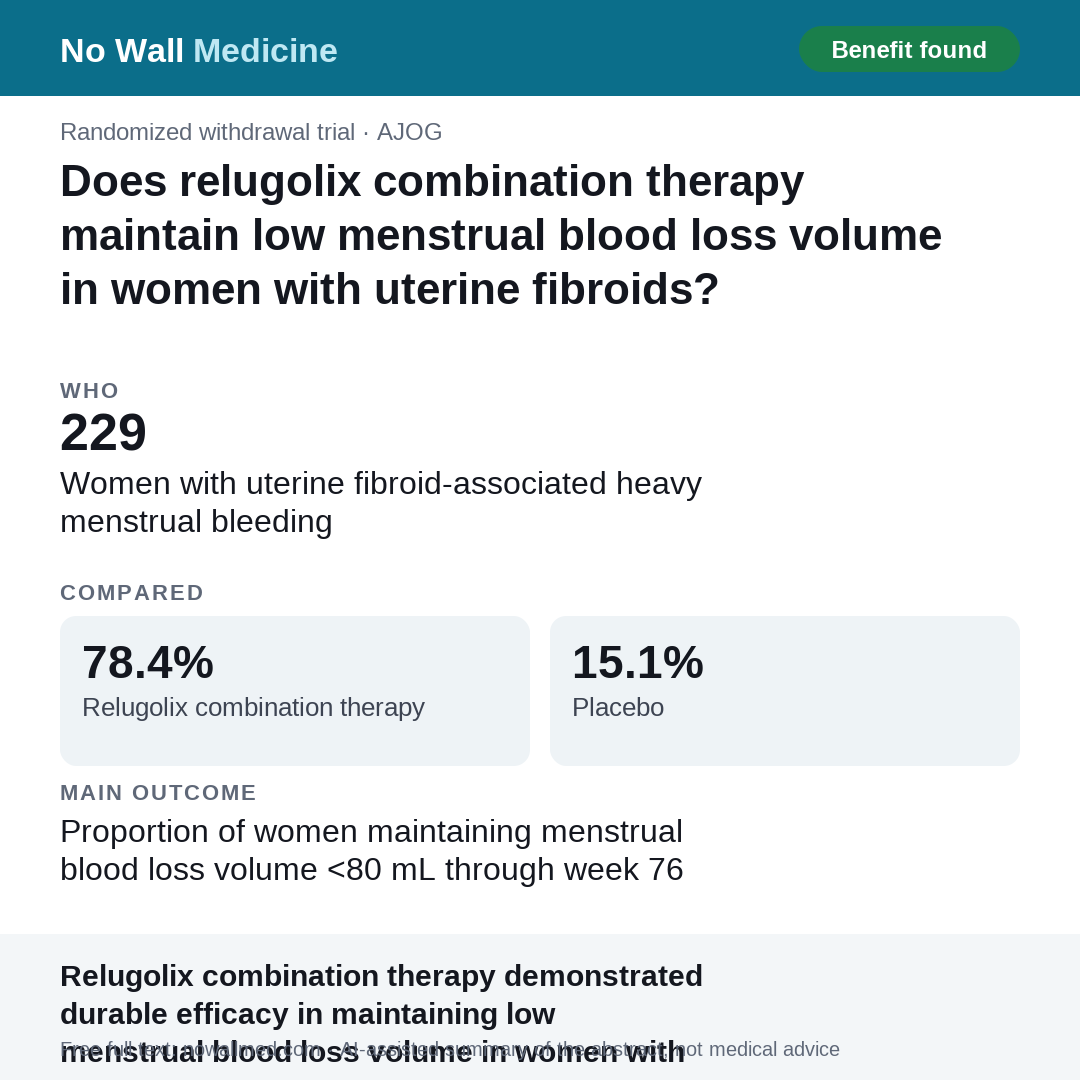
Clinical question: Does relugolix combination therapy maintain low menstrual blood loss volume in women with uterine fibroids?
Why it matters: It was unknown if the effects of relugolix combination therapy on menstrual blood loss volume and symptoms would remain durable over a 2-year period.
In absolute numbers
Relugolix combination therapy: 78.4% · Placebo: 15.1% → a difference of 63.3 percentage points, so about 2 people would need the treatment for 1 more to benefit (number needed to treat) over the trial’s follow-up.
Worked out by us from the two group results above, not reported by the authors. Check the paper for the exact outcome and timing.
Key points
- In this randomized withdrawal study, 229 women with uterine fibroid-associated heavy menstrual bleeding were randomized to receive either relugolix combination therapy or a placebo.
- At week 76, 78.4% of women on relugolix combination therapy maintained menstrual blood loss volume <80 mL compared to 15.1% in the placebo group.
- At week 104, 69.8% of women on relugolix combination therapy maintained menstrual blood loss volume <80 mL compared to 11.8% in the placebo group.
Headline and key points written with AI from the paper’s abstract, with every number checked against it. Read the paper before relying on them.
Was this summary helpful?
Subject terms
Cite this article
Al-Hendy A, Venturella R, Arjona Ferreira JC, Li Y, Soulban G, Wagman RB. LIBERTY randomized withdrawal study: relugolix combination therapy for heavy menstrual bleeding associated with uterine fibroids. AJOG. 2023. doi:10.1016/j.ajog.2023.08.030
Spotted a mistake? Suggest a correction
Top studies every Monday
The week’s key trials and guidelines in your specialties, plus any topics you follow. By email, free.
Get the weekly digest