Recurrence and reintervention rates vary across different uterine-sparing treatments for symptomatic adenomyosis
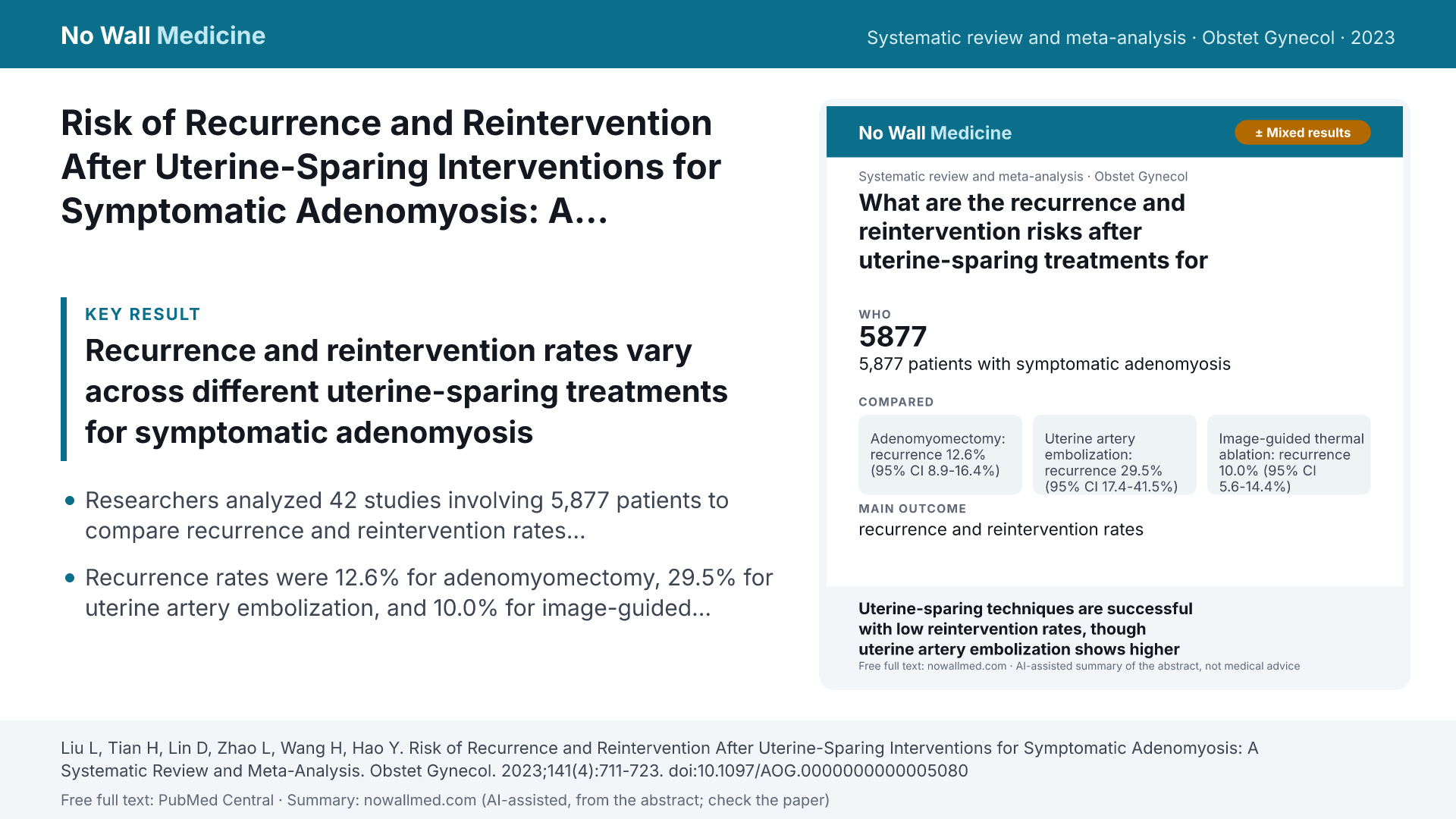
Risk of Recurrence and Reintervention After Uterine-Sparing Interventions for Symptomatic Adenomyosis: A Systematic Review and Meta-Analysis
Systematic review and meta-analysisMixed results
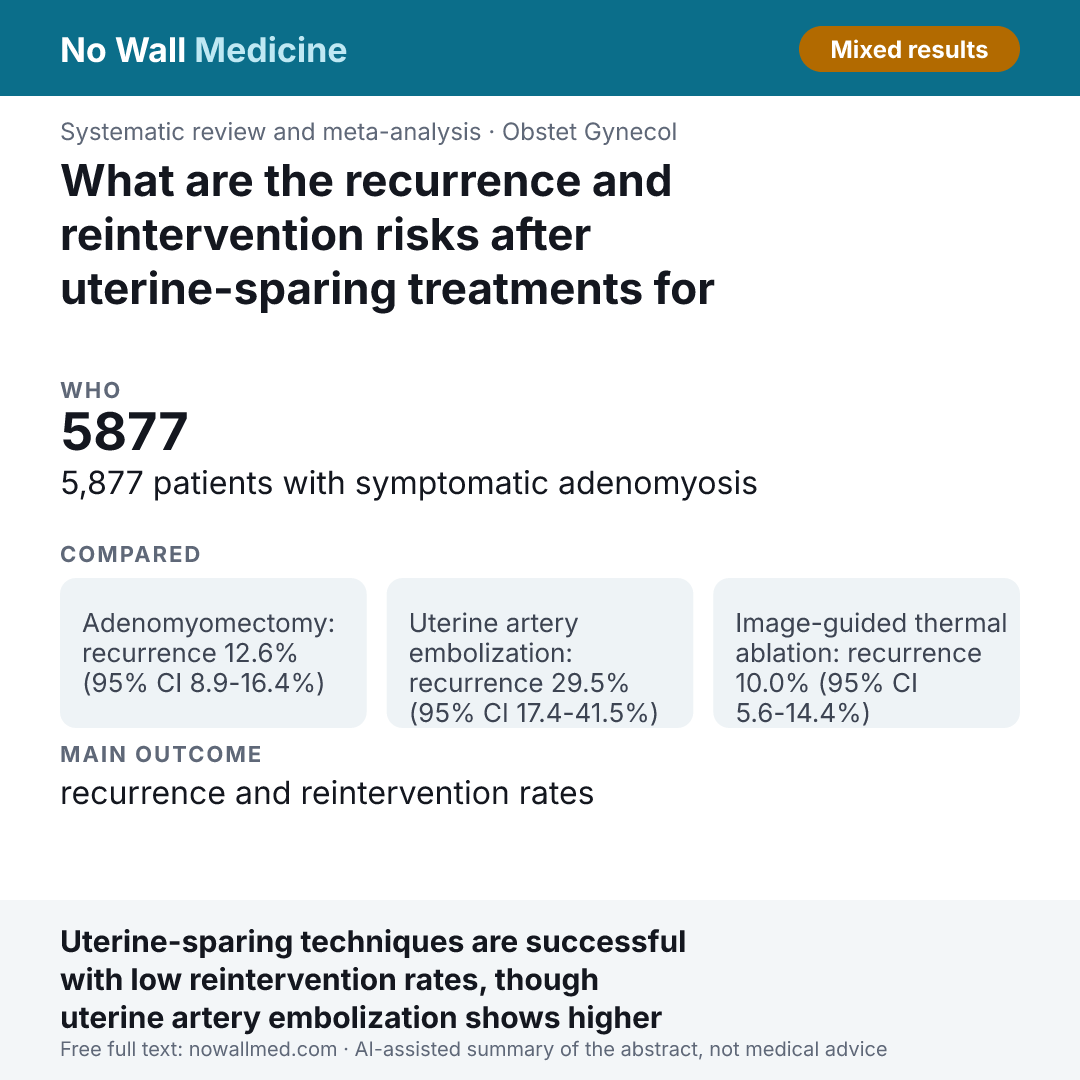
What are the recurrence and reintervention risks after uterine-sparing treatments for symptomatic adenomyosis?
Who
5877
5,877 patients with symptomatic adenomyosis
Compared
Adenomyomectomy: recurrence 12.6% (95% CI 8.9-16.4%)
Uterine artery embolization: recurrence 29.5% (95% CI 17.4-41.5%)
Image-guided thermal ablation: recurrence 10.0% (95% CI 5.6-14.4%)
Main outcome
recurrence and reintervention rates
Bottom line: Uterine-sparing techniques are successful with low reintervention rates, though uterine artery embolization shows higher recurrence and reintervention rates.
Limitation: Selection bias may influence results as uterine artery embolization patients had larger uteri and larger adenomyosis.
Obstet Gynecol · 2023-03-09 · Save PNG
Clinical question: What are the recurrence and reintervention risks after uterine-sparing treatments for symptomatic adenomyosis?
Why it matters: The risks of symptoms returning or needing further surgery after uterine-sparing treatments for adenomyosis are not clearly quantified across different procedures.
Key points
- Researchers analyzed 42 studies involving 5,877 patients to compare recurrence and reintervention rates after adenomyomectomy, uterine artery embolization, and image-guided thermal ablation.
- Recurrence rates were 12.6% for adenomyomectomy, 29.5% for uterine artery embolization, and 10.0% for image-guided thermal ablation.
- Reintervention rates were 2.6% for adenomyomectomy, 12.8% for uterine artery embolization, and 8.2% for image-guided thermal ablation.
Limitation the authors note: Selection bias may influence results because patients treated with uterine artery embolization had larger uteri and larger adenomyosis.
Headline and key points written with AI from the paper’s abstract, with every number checked against it. Read the paper before relying on them.
Was this summary helpful?
Subject terms
Headline, design, result, key points, caveat and citation as plain text.
Cite this article
Liu L, Tian H, Lin D, Zhao L, Wang H, Hao Y. Risk of Recurrence and Reintervention After Uterine-Sparing Interventions for Symptomatic Adenomyosis: A Systematic Review and Meta-Analysis. Obstet Gynecol. 2023;141(4):711-723. doi:10.1097/AOG.0000000000005080
Spotted a mistake? Suggest a correction