Previous uterine surgeries other than cesarean sections were associated with placenta accreta spectrum risk
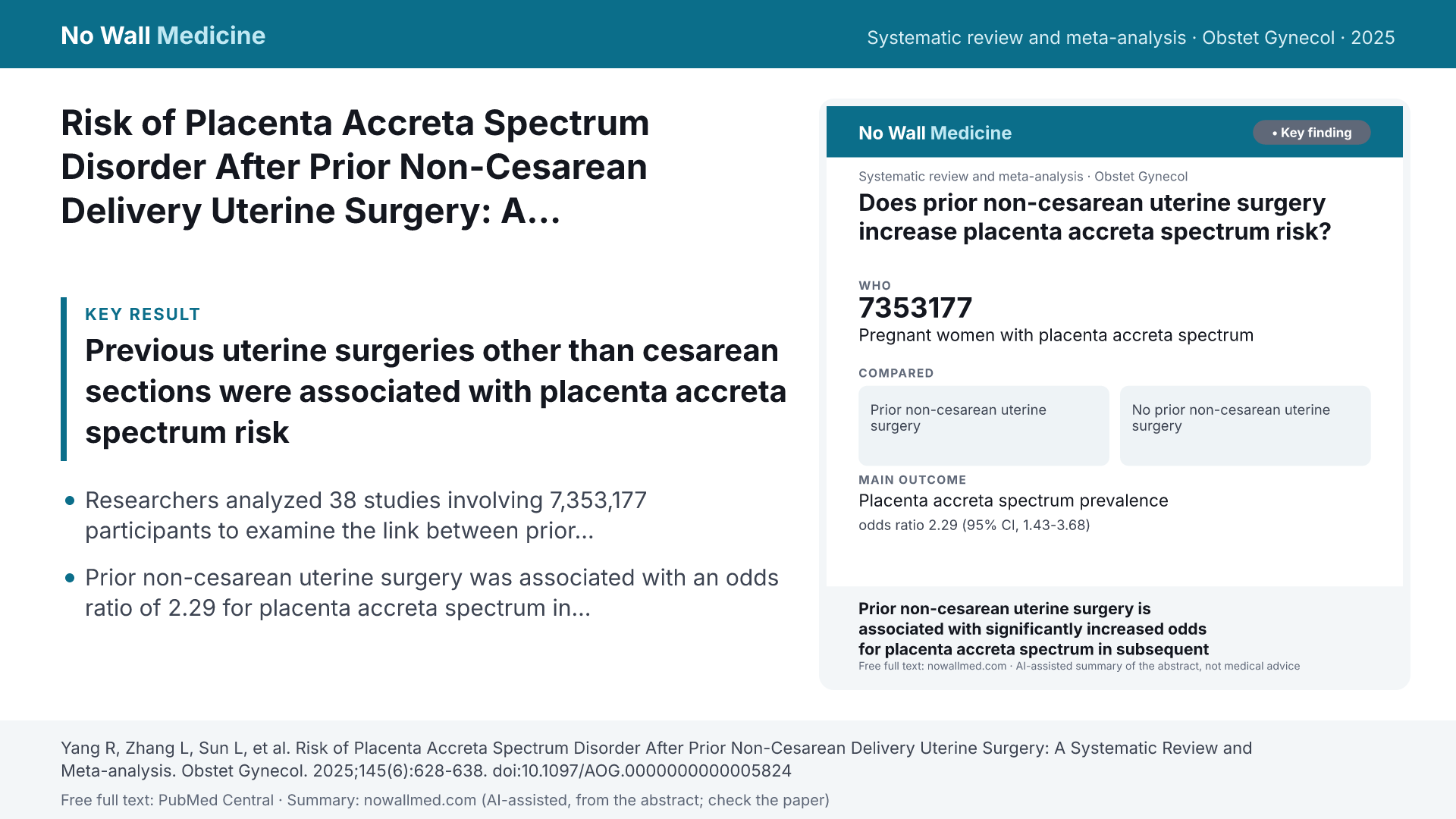
Risk of Placenta Accreta Spectrum Disorder After Prior Non-Cesarean Delivery Uterine Surgery: A Systematic Review and Meta-analysis
Systematic review and meta-analysisKey finding
Does prior non-cesarean uterine surgery increase placenta accreta spectrum risk?
Who
7353177
Pregnant women with placenta accreta spectrum
Compared
Prior non-cesarean uterine surgery
No prior non-cesarean uterine surgery
Main outcome
Placenta accreta spectrum prevalence
Result: odds ratio 2.29 (95% CI, 1.43-3.68)
Bottom line: Prior non-cesarean uterine surgery is associated with significantly increased odds for placenta accreta spectrum in subsequent pregnancy.
Obstet Gynecol · 2025-02-06 · Save PNG
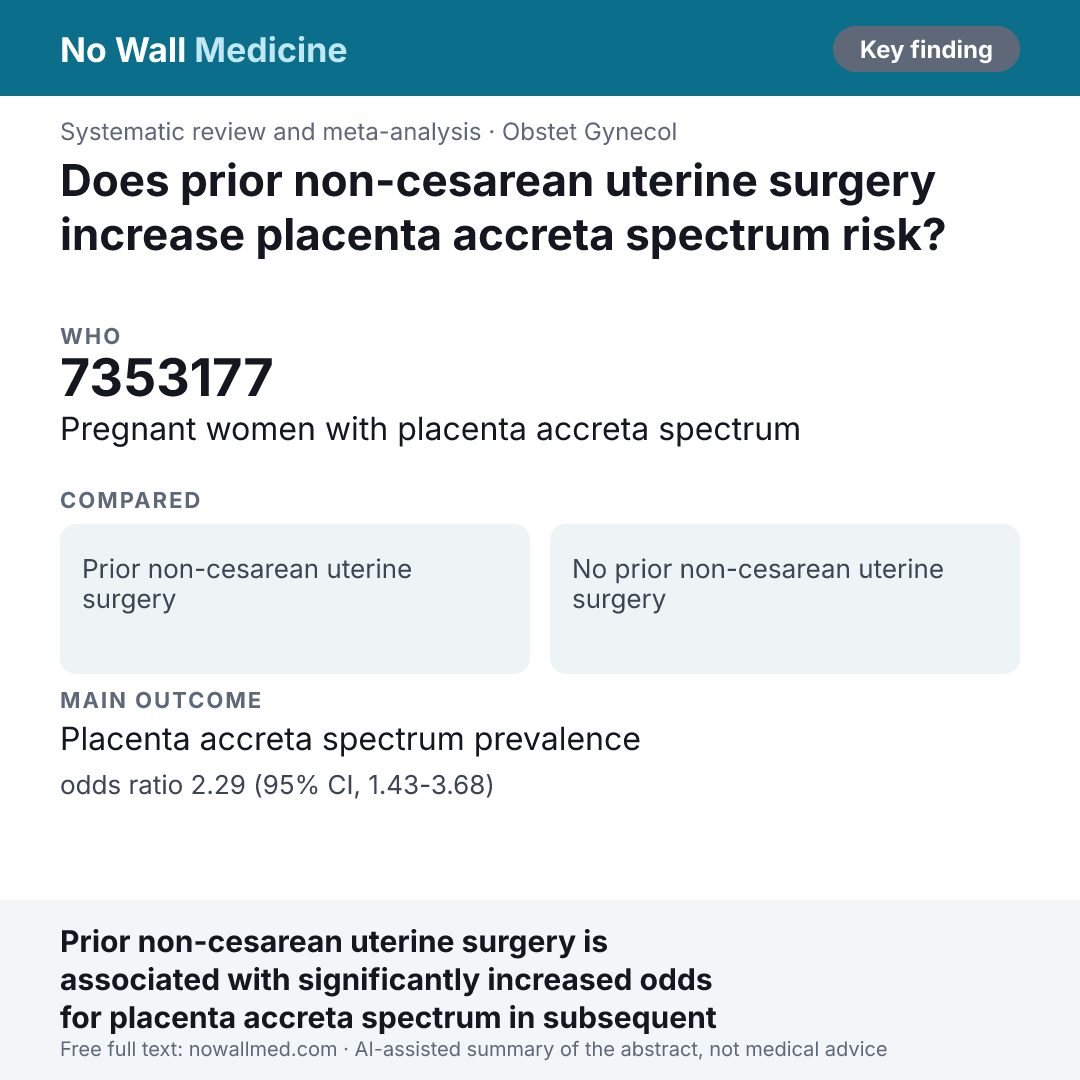
Clinical question: Does prior non-cesarean uterine surgery increase placenta accreta spectrum risk?
Key points
- Researchers analyzed 38 studies involving 7,353,177 participants to examine the link between prior non-cesarean uterine surgery and placenta accreta spectrum, a condition where the placenta grows too deeply into the uterine wall.
- Prior non-cesarean uterine surgery was associated with an odds ratio of 2.29 for placenta accreta spectrum in subsequent pregnancies.
- Specific procedures linked to higher odds included uterine artery embolization with an odds ratio of 43.16 and endometrial ablation with an odds ratio of 20.26.
Headline and key points written with AI from the paper’s abstract, with every number checked against it. Read the paper before relying on them.
Was this summary helpful?
Subject terms
Headline, design, result, key points, caveat and citation as plain text.
Cite this article
Yang R, Zhang L, Sun L, et al. Risk of Placenta Accreta Spectrum Disorder After Prior Non-Cesarean Delivery Uterine Surgery: A Systematic Review and Meta-analysis. Obstet Gynecol. 2025;145(6):628-638. doi:10.1097/AOG.0000000000005824
Spotted a mistake? Suggest a correction