Higher lipoprotein(a) levels were associated with faster progression of aortic valve narrowing
Lipoprotein(a) and Calcific Aortic Valve Stenosis Progression: A Systematic Review and Meta-Analysis
Systematic review and meta-analysisBenefit found
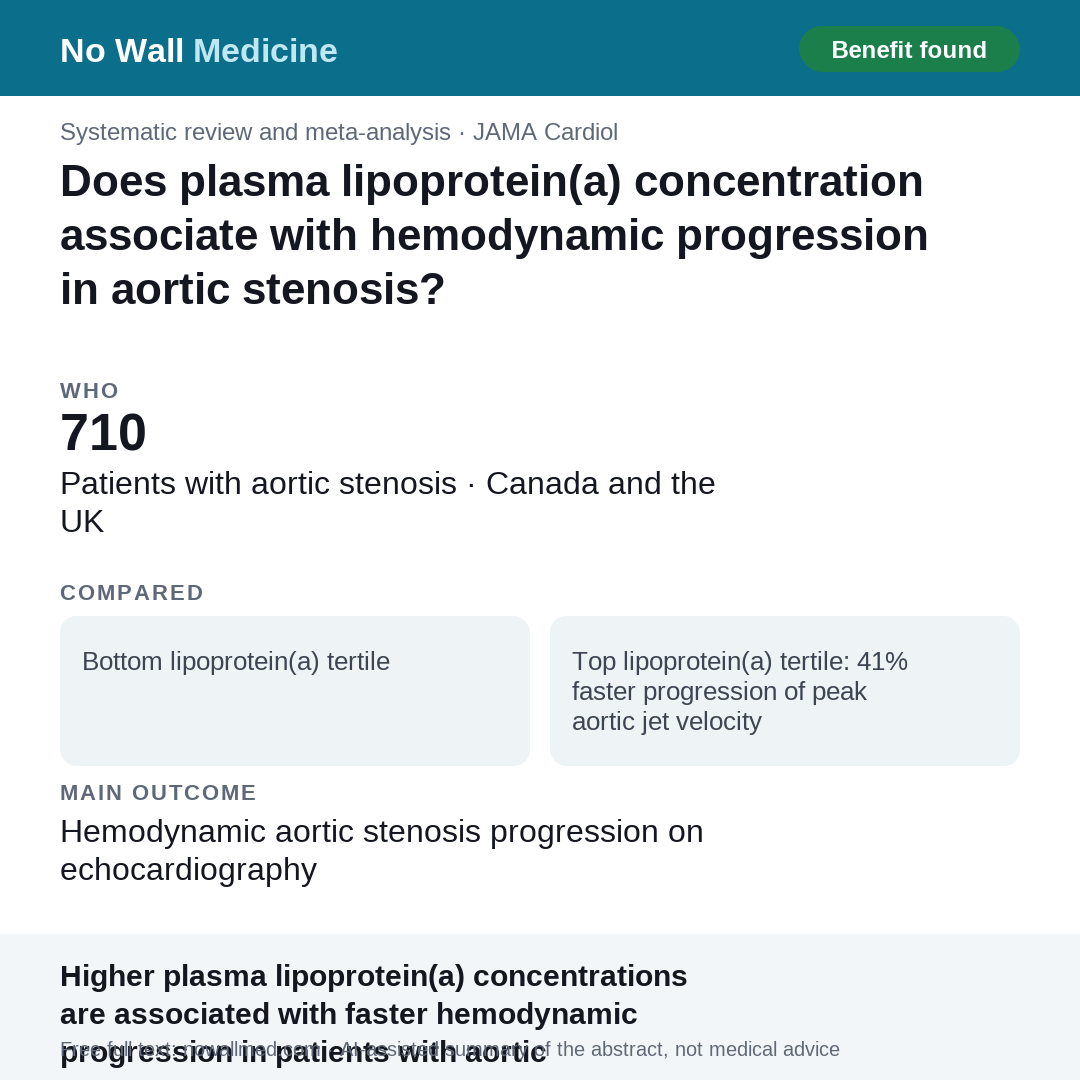
Does plasma lipoprotein(a) concentration associate with hemodynamic progression in aortic stenosis?
Who
710
Patients with aortic stenosis · Canada and the UK
Compared
Bottom lipoprotein(a) tertile
Top lipoprotein(a) tertile: 41% faster progression of peak aortic jet velocity
Main outcome
Hemodynamic aortic stenosis progression on echocardiography
Result: estimate, 1.41; 95% CI, 1.13-1.75
Bottom line: Higher plasma lipoprotein(a) concentrations are associated with faster hemodynamic progression in patients with aortic stenosis.
JAMA Cardiol · 2024-07-17Download image
Clinical question: Does plasma lipoprotein(a) concentration associate with hemodynamic progression in aortic stenosis?
Why it matters: It is unknown if plasma lipoprotein(a) concentrations are associated with the hemodynamic progression of aortic stenosis.
Key points
- Researchers analyzed 710 patients from five longitudinal studies to examine how lipoprotein(a) levels relate to the worsening of aortic stenosis.
- Patients in the highest lipoprotein(a) group showed 41% faster progression of peak aortic jet velocity and 57% faster progression of mean transvalvular gradient.
- The progression of aortic valve area was comparable between the different lipoprotein(a) groups.
Headline and key points written with AI from the paper’s abstract, with every number checked against it. Read the paper before relying on them.
Topics
Cite this article
Arsenault BJ, Loganath K, Girard A, Botezatu S, Zheng KH, Tzolos E. Lipoprotein(a) and Calcific Aortic Valve Stenosis Progression: A Systematic Review and Meta-Analysis. JAMA Cardiol. 2024. doi:10.1001/jamacardio.2024.1882
Spotted a mistake? Suggest a correction
Top studies every Monday
The week’s key trials and guidelines in your specialties, by email. Free.
Get the weekly digest