Liraglutide reduced cardiovascular events in type 2 diabetes patients
Liraglutide and Cardiovascular Outcomes in Type 2 Diabetes
Why it matters: Showed cardiovascular benefit from the GLP-1 receptor agonist liraglutide in type 2 diabetes.
Related landmark trials: EMPA-REG OUTCOME
Context written by the No Wall Medicine team.
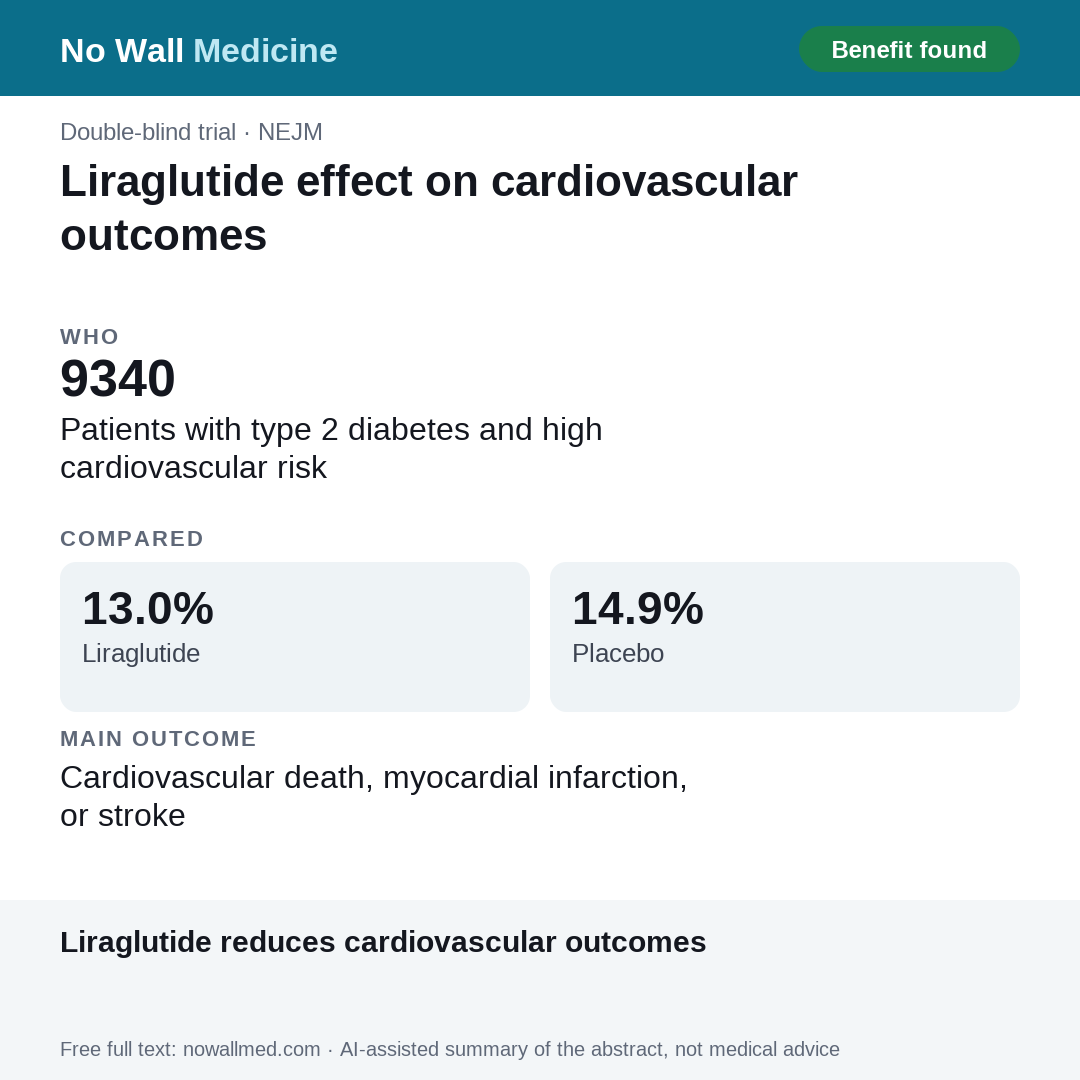
Double-blind trialBenefit found
Liraglutide effect on cardiovascular outcomes
Who
9340
Patients with type 2 diabetes and high cardiovascular risk
Compared
13.0%Liraglutide (608/4668)
14.9%Placebo (694/4672)
Main outcome
Cardiovascular death, myocardial infarction, or stroke
Result: hazard ratio, 0.87; 95% confidence interval [CI], 0.78 to 0.97
Bottom line: Liraglutide reduces cardiovascular outcomes
Funded by: Novo Nordisk and National Institutes of Health
NEJM · 2016-06-13Download image
Trial at a glance
Bottom line: Liraglutide reduced cardiovascular outcomes and death in type 2 diabetes patients
Clinical question
Liraglutide's cardiovascular effect in type 2 diabetes
Design
Multicentre, double-blind, randomized, placebo-controlled trial. 32 countries, 410 sites
Who was studied
9340 patients with type 2 diabetes and high cardiovascular risk
Key inclusion criteria
- age 50 or more with cardiovascular coexisting condition
- age 60 or more with cardiovascular risk factor
- glycated hemoglobin level of 7.0% or more
Key exclusion criteria
- type 1 diabetes
- use of GLP-1–receptor agonists or DPP-4 inhibitors
- familial or personal history of multiple endocrine neoplasia type 2 or medullary thyroid cancer
Interventions
- liraglutide group: 1.8 mg liraglutide once daily as subcutaneous injection
- placebo group: matching placebo once daily as subcutaneous injection
Primary outcome
first occurrence of death from cardiovascular causes, nonfatal myocardial infarction, or nonfatal stroke. 608 of 4668 patients [13.0%] in liraglutide group, 694 of 4672 [14.9%] in placebo group, hazard ratio 0.87, 95% CI 0.78 to 0.97
Secondary outcomes
- death from cardiovascular causes: 219 patients [4.7%] in liraglutide group, 278 [6.0%] in placebo group, hazard ratio 0.78, 95% CI 0.66 to 0.93
- death from any cause: 381 patients [8.2%] in liraglutide group, 447 [9.6%] in placebo group, hazard ratio 0.85, 95% CI 0.74 to 0.97
Harms
gastrointestinal events, acute pancreatitis, acute gallstone disease
Limitations reported by the authors
- patients followed for only 3 years
Funding
Novo Nordisk and National Institutes of Health
Written with AI from the full paper; every number was checked against it. Read the paper before relying on it.
In absolute numbers
Liraglutide: 13% · Placebo: 14.9% → a difference of 1.9 percentage points, so about 53 people would need the treatment for 1 more to benefit (number needed to treat) over the trial’s follow-up.
Worked out by us from the two group results above, not reported by the authors. Check the paper for the exact outcome and timing.
Key points
- 9340 patients with type 2 diabetes and high cardiovascular risk were studied.
- Liraglutide had a 13.0% primary outcome rate, compared to 14.9% with placebo.
- Fewer patients died from cardiovascular causes with liraglutide, with a hazard ratio of 0.78.
Headline and key points written with AI from the paper’s abstract, with every number checked against it. Read the paper before relying on them.
Topics
Cite this article
Marso SP, Daniels GH, Brown-Frandsen K, Kristensen P, Mann JF, Nauck MA. Liraglutide and Cardiovascular Outcomes in Type 2 Diabetes. NEJM. 2016. doi:10.1056/NEJMoa1603827
Spotted a mistake? Suggest a correction