Liraglutide did not improve beta-cell function in adults with long-standing type 1 diabetes
Liraglutide and Βeta-Cell Function in Young Adults With Long-Standing Type 1 Diabetes and Residual C-Peptide: A Blinded, Randomized Controlled Trial
Randomized, blinded, placebo-controlled trialNo clear difference
Does liraglutide affect residual beta-cell function in young adults with type 1 diabetes?
Who
18
Adults with long-standing type 1 diabetes and detectable fasting C-peptide
Compared
Liraglutide
Placebo
Main outcome
Change in stimulated C-peptide area under the curve
Bottom line: Liraglutide did not improve stimulated C-peptide compared with placebo after 52 weeks in adults with type 1 diabetes.
Diabetes Obes Metab · 2026-08-13Download image
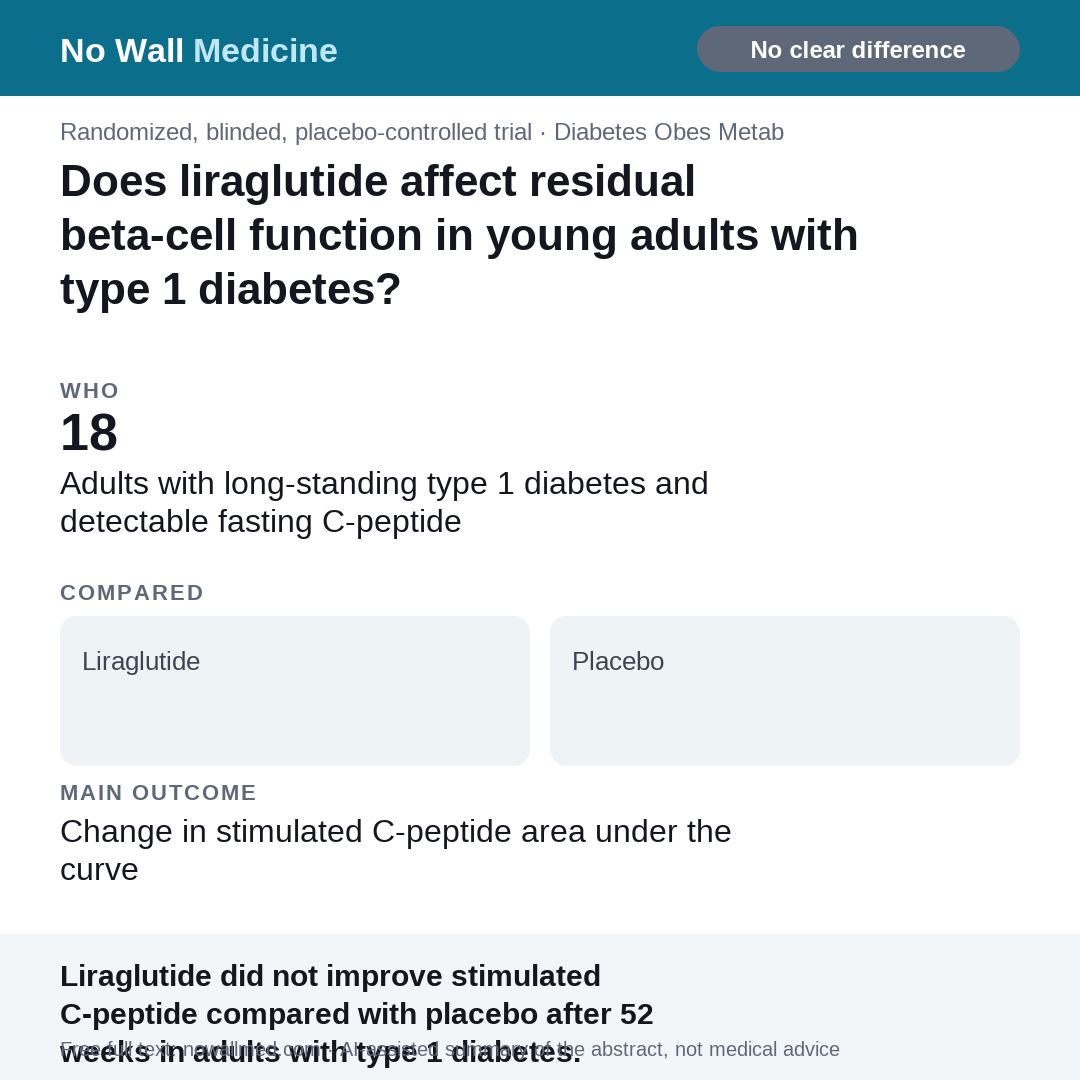
Clinical question: Does liraglutide affect residual beta-cell function in young adults with type 1 diabetes?
Why it matters: It is unclear if liraglutide can preserve residual beta-cell function in adults with long-standing type 1 diabetes.
Key points
- Researchers studied 18 adults with type 1 diabetes lasting 5 years or more and detectable C-peptide, comparing liraglutide to a placebo for 52 weeks.
- Liraglutide did not improve stimulated C-peptide, a marker of insulin production, compared to placebo at week 52.
- Exploratory analyses suggested stimulated C-peptide declined more steeply in the liraglutide group than in the placebo group, alongside increasing insulin requirements.
Headline and key points written with AI from the paper’s abstract, with every number checked against it. Read the paper before relying on them.
Topics
Cite this article
Caballero-Corbalán J, Lundkvist P, Espes D, Carlsson PO. Liraglutide and Βeta-Cell Function in Young Adults With Long-Standing Type 1 Diabetes and Residual C-Peptide: A Blinded, Randomized Controlled Trial. Diabetes Obes Metab. 2026. doi:10.1111/dom.71204
Spotted a mistake? Suggest a correction